

Cox’s Bazar Dried Fish Market: A 300cr Industry Beckons Tourists, Exporters
The burgeoning dried fish industry in Cox’s Bazar, centred primarily on the 100-acre Nazirartek area, has transformed into a vital economic powerhouse generating more than Tk 4,000 crore annually while supporting the livelihoods of tens of thousands of coastal residents
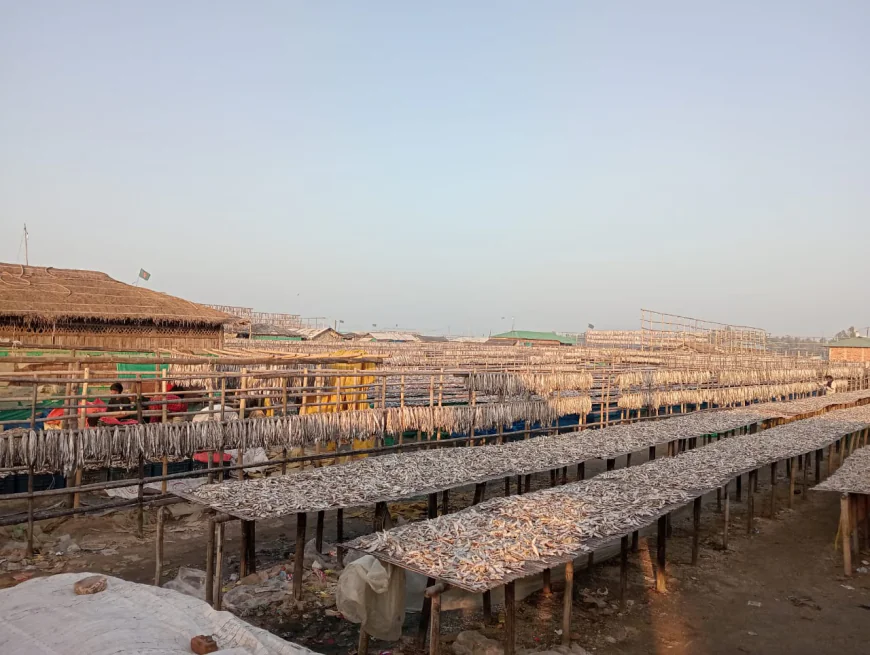
The burgeoning dried fish industry in Cox’s Bazar, centred primarily on the 100-acre Nazirartek area, has transformed into a vital economic powerhouse generating more than Tk 4,000 crore annually while supporting the livelihoods of tens of thousands of coastal residents.
At the hub of this business lies Nazirartek, Bangladesh’s largest dried fish production hub, covering nearly 100 acres and processing 50,000 to 60,000 tonnes of shutki (dried fish) each season. Dried fish is called shutki in Bangla language. The people of that locality are dependent on fishing and dried fishing business primarily.
Throughout the peak production season from November to April, an estimated 60,000 tonnes of shutki are processed using traditional sun-drying methods, where a diverse workforce—predominantly composed of women—meticulously prepares more than 25 marine species on bamboo racks.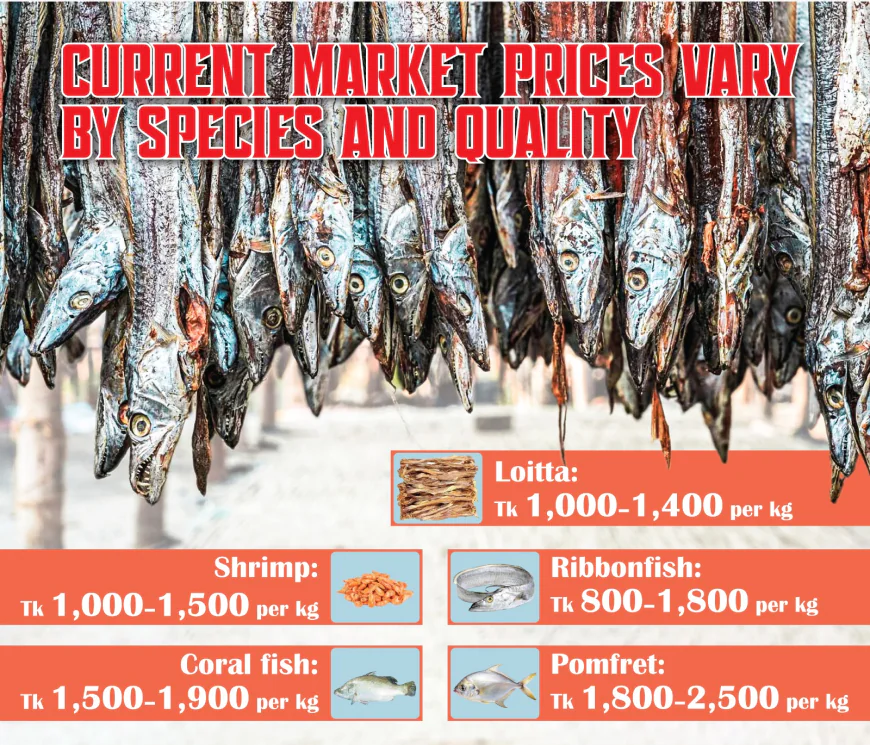
The current market prices of dried fish at wholesdale market in Cox's Bazar.
As the winter tourist season reaches to zenith, the market comes alive with exciting activities. More than 25 varieties of marine fish—including pomfret, ribbonfish, loitta (Bombay duck), shrimp, and coral fish—are cleaned, sun-dried on bamboo racks, and packed for eager buyers. The drying process typically takes three to seven days, relying on traditional methods given down through generations.
For tourists visiting the world's longest sea beach Cox’s Bazar, shutki has become a unique culinary relic. “No tourist comes home without buying dried fish here,” remarked a visitor, though he joined others in calling for stricter quality controls to confirm chemical-free products. Existing market prices range from Tk 800 to Tk 2,500 per kilogram depending on species and value.
Current market prices vary by species and quality:
Loitta: Tk 1,000–1,400 per kg
Ribbonfish: Tk 800–1,800 per kg
Shrimp: Tk 1,000–1,500 per kg
Coral fish: Tk 1,500–1,900 per kg
Pomfret: Tk 1,800–2,500 per kg
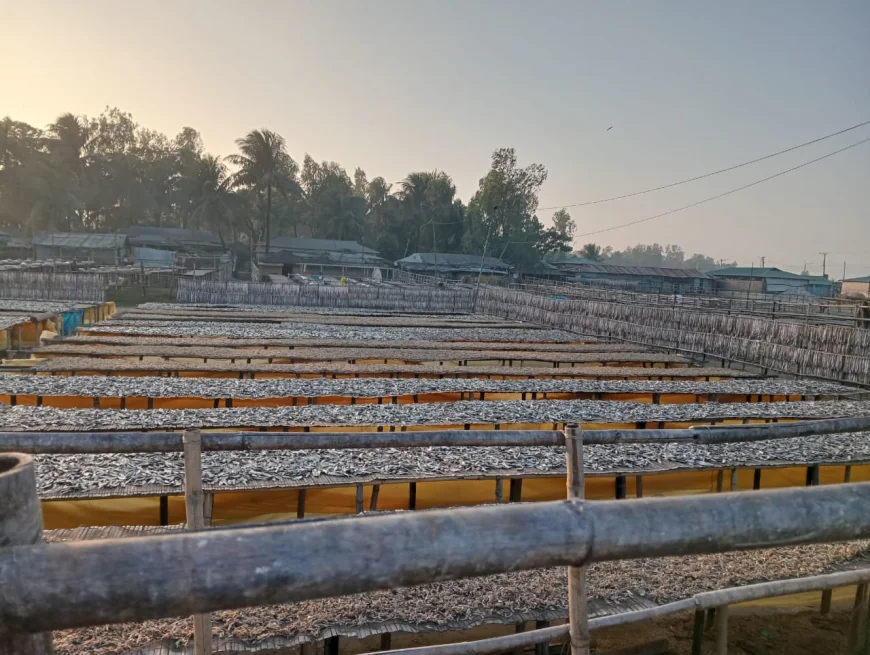
An estimated 60,000 tonnes of shutki are processed in Bangladesh using traditional sun-drying methods. Photo: Dr Mohammad Ferdous Khan
The industry engages approximately 20,000 to 40,000 workers directly and indirectly, with women establishing most of the processing workforce. Women spend long hours under the sun washing and arranging fish, the seasonal work provides key family income.
Beyond domestic sales, Cox's Bazar dried fish catches international markets including Hong Kong, Malaysia, Singapore, Indonesia, and the Middle East, with export earnings potentially reaching Tk 8 billion this season. Competitors like Myanmar, Thailand, India, and Vietnam have captured larger market shares using sophisticated technology and lower production costs.
Experts document that most dry fish production in Cox's Bazar relies on conventional methods, while competitors utilize top-notch technologies safeguarding better quality and market demand. While traditional sun-drying remains the core component of the market, an alteration is ongoing Amidst concerns over hygiene and the ancient use of pesticides, modern-day initiatives are taking root.
Organisations like the COAST Foundation and the Bangladesh Fisheries Research Institute (BFRI) are now training processors in organic methods. Mechanical dryers and solar-powered tunnels are appearing alongside the traditional holders aiming to make the shine "poison-free" for international markets in Hong Kong, South Korea, and the US.
The government is considering ensuring chemical-free production, aiming to boost the sector's global positioning.
Read More: Why Bangladesh Struggles to Attract Tourists
Tourism Struggles Ahead of Ramadan in Bangladesh
How Political Unrest Crushed Bangladesh's Tourism & Aviation Industry
Why Bangladesh Struggles to Attract Tourists
A Year of Rapid Change in Bangladesh’s Aviation Industry
Some Heritage Sites and Monuments of Bangladesh
Nine Attractive and Scenic Places of Bangladesh
Narayanganj's Murapara Zamindar Bari: A Unique Example of Architectural Style
Bangladesh’s Aviation Drive Could Reshape Future of Tourism
Bangladesh-India Relations Show Signs of Recovery
New Bangladesh Govt Brings Light of Hope to Indian Tourism Sector
Bangladesh Resumes Visa Services in India
Bangladesh in the Eyes of an Indian Traveller
International Arbitration Board orders CAAB to Pay Tk1,650cr to ADC
Prime Minister Holds Meeting on Dhaka Airport’s Third Terminal
Old Dhaka’s Iftar: A Timeless Cuisine of Flavours and Heritage
New Airport Cargo Facility Lies Idle Amid Export Slowdown
Russia Unbound: Tours, Visas, and Travel Tips for Bangladeshi Nationals
Govt Steps Up Airport Safety Measures
Cricket Diplomacy Delivers Tourism Boom for Sri Lanka
UK to Issue Only E-Visas for Bangladeshi Applicants from February 25
Indonesia Visa System for Bangladeshi Travelers and Businessmen: What You Need to Know in 2026
What's Your Reaction?
 Like
0
Like
0
 Dislike
0
Dislike
0
 Love
0
Love
0
 Funny
0
Funny
0
 Wow
0
Wow
0
 Sad
0
Sad
0
 Angry
0
Angry
0

Dr Mohammad Ferdous Khan appears to be a multifaceted and evolving professional, balancing academic, creative, and media-oriented pursuits. He has done his PhD from University of Dhaka in 2025 entitled “Reflection of Social Relations in Advertising Art of Post Independent Bangladesh". His research papers appear in different journals home and abroad.
Comments (0)