How Political Unrest Crushed Bangladesh's Tourism & Aviation Industry
After August 2024, political instability triggered a sharp decline in Bangladesh's tourism, aviation, and hotel sectors. Here's the real economic fallout.
 The Editors Desk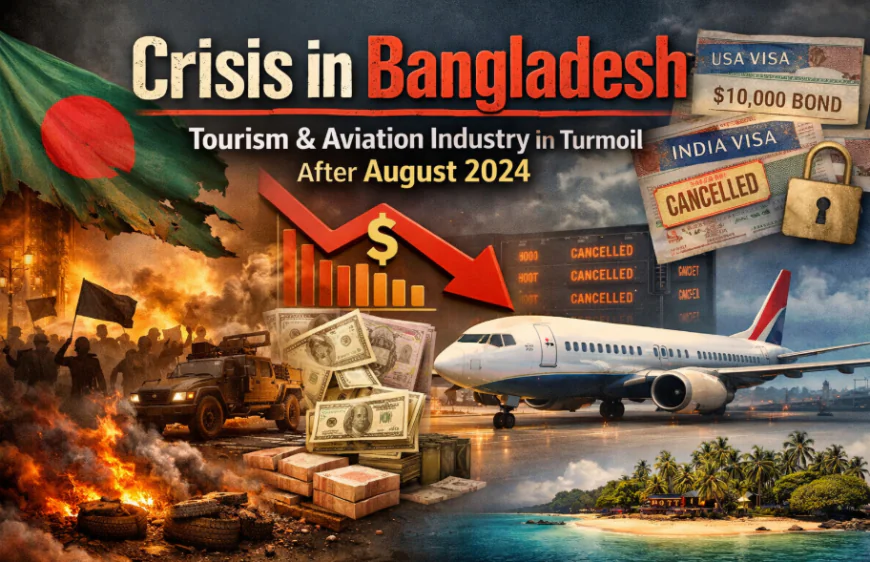
It has been over a year since the student movement of August 2024 reshaped the political landscape of Bangladesh. While the streets have quieted, the economic seismographs in our industry are still trembling. We often talk about "resilience" in this country, but resilience without recognition of reality is just denial.
Today, we are looking at the hard numbers. The data does not lie, and frankly, it paints a picture of a sector that is not just stumbling, but being actively strangled by a crisis of confidence.
The Tourism Balance Sheet: A Year of Regression
While the rest of the world celebrated the post-pandemic travel boom, Bangladesh stood alone in the cold. The numbers confirm what every tour operator already feels: we are shrinking. Despite global tourism recovering, our foreign earnings slid from $453 million in 2023 to $440 million in 2024. This isn't just a bad season; it is a structural failure driven by instability. The World Economic Forum’s 2024 Travel and Tourism Development Index now ranks us 109th out of 119 economies—dead last among 19 Asia-Pacific nations.
Consider this:
In 2024, we welcomed approximately 655,000 foreign visitors. That might sound decent until you look next door at Nepal, a country with a fraction of our GDP, which pulled in 1.2 million tourists. We are not even competing anymore; we are being left behind. And the cost? The Foreign Investors Chamber of Commerce and Industry (FICCI) estimated that even before the government fell, the economy hemorrhaged $10 billion due to the protests and blackouts. That is capital we cannot claw back.
Aviation: The $323 Million Blockade
If tourism is the body, aviation is the blood supply—and right now, we are suffering from severe circulation failure. The political turmoil exacerbated a dollar crunch that has left foreign airlines unable to take their money home. As of recent reports, Bangladesh is blocking approximately $323 million in airline revenues. This is not just an accounting issue; it is a reputation killer.
The International Air Transport Association (IATA) has already sounded the alarm: this blockage is threatening our air connectivity. When carriers cannot repatriate their earnings, they cut flights. We are seeing reduced inventory and frequency, isolating Dhaka at a time when we need connection the most.
The Shock Across Other Industries:
The most immediate victims of this instability were the hoteliers. In the weeks following the August unrest, the luxury hotel sector witnessed an occupancy collapse. The "business traveler"—the bread and butter of Dhaka’s 5-star ecosystem—simply canceled their tickets. One luxury hotel group reported losing Tk 3-4 crore ($250k-$330k) in just the last two weeks of July alone. This financial bleeding trickles down to the most vulnerable. Look at St. Martin’s Island, where restrictions and instability have jeopardized the livelihoods of 10,000 people who depend solely on tourism. History tells us this pain lingers; past disruptions saw temporary unemployment in the sector spike to 82.6%. We are dangerously close to mirroring those dark statistics.
Diplomacy: The Doors are Closing
Perhaps the most stinging aftershock is how the world is now looking at us. The political "uncharted territory" has cooled our diplomatic warmth, and the visa policies prove it. The United States has dealt a massive blow to our middle-class travelers. By expanding the Visa Bond Pilot Program in early 2026, the U.S. State Department may now require bonds of $5,000, $10,000, or even $15,000 for B-1/B-2 visas. This price tag effectively "geofences" the average.
Bangladeshi from visiting America.
Closer to home, the situation with India is equally grim. Following the attacks on diplomatic missions in December 2024, specifically the incident in Agartala, we have seen a de facto tightening of Indian visas. For a nation that relies on India for medical treatment and shopping, this is a catastrophic disconnect.
The Verdict:
We cannot fix the past, but we must face the present. The data from FICCI, IATA, and the WEF is a wake-up call. We are losing money, we are losing friends, and most dangerously, we are losing our reputation as an open, investable destination.
It is time to stop calling this a "transitional period" and start treating it as an emergency.
Read More: Why Bangladesh Struggles to Attract Tourists
Tourism Struggles Ahead of Ramadan in Bangladesh
Bangladesh–India–Tripura bus service resumes after 18-month suspension
How Political Unrest Crushed Bangladesh's Tourism & Aviation Industry
Why Bangladesh Struggles to Attract Tourists
A Year of Rapid Change in Bangladesh’s Aviation Industry
Some Heritage Sites and Monuments of Bangladesh
Nine Attractive and Scenic Places of Bangladesh
Narayanganj's Murapara Zamindar Bari: A Unique Example of Architectural Style
Bangladesh’s Aviation Drive Could Reshape Future of Tourism
Bangladesh-India Relations Show Signs of Recovery
New Bangladesh Govt Brings Light of Hope to Indian Tourism Sector
Bangladesh Resumes Visa Services in India
Bangladesh in the Eyes of an Indian Traveller
International Arbitration Board orders CAAB to Pay Tk1,650cr to ADC
Prime Minister Holds Meeting on Dhaka Airport’s Third Terminal
Old Dhaka’s Iftar: A Timeless Cuisine of Flavours and Heritage
New Airport Cargo Facility Lies Idle Amid Export Slowdown
Russia Unbound: Tours, Visas, and Travel Tips for Bangladeshi Nationals
Travel Alert Issued Following Killing of Cartel Leader in Mexico