

Medical tourism: Tk61,000cr drained annually by faltering faith in local healthcare
A massive number of patients are leaving the country every year to seek medical treatment abroad.

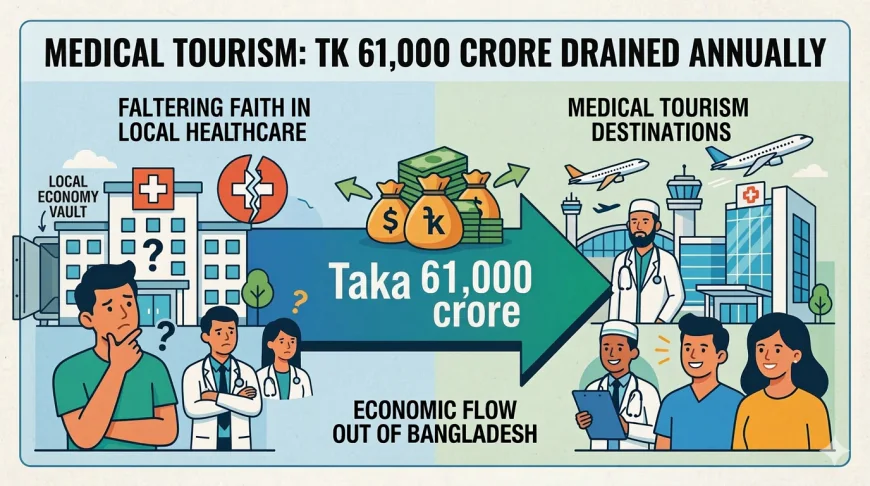
A surprising Tk 61,000 crore (approximately $5 billion) flows out of Bangladesh each year as hundreds of thousands of patients seek medical treatment abroad, driven by a lack of trust in the country's healthcare system, reports the Daily Banik Barta.
The massive annual expenditure highlights a deepening crisis in Bangladesh's medical sector, where deficiencies in accurate diagnosis, underdeveloped service management, and inadequate infrastructure are pushing citizens to look overseas for reliable healthcare.
India dominates medical tourism destination
Data from the Dhaka Chamber of Commerce and Industry (DCCI) reveals that India remains the primary destination for Bangladeshi medical travellers, receiving approximately 52 percent of all medical visas issued by New Delhi. In 2024 alone, nearly 482,000 Bangladeshi patients crossed the border for treatment in Indian hospitals.
Following India, Thailand, Singapore, and Malaysia have emerged as popular destinations for Bangladeshi patients seeking advanced medical care. In recent years, China has also witnessed a growing influx of Bangladeshi medical tourists, attracted by affordable treatment costs and specialised expertise.
Root causes of departure
Health sector analysts attribute this massive outflow to multiple systemic failures within Bangladesh's healthcare system. Many patients harbour persistent doubts about diagnostic accuracy, while others fear sudden cost escalations and hidden charges during treatment. The prevalence of counterfeit medications and substandard medical equipment in the market further erodes public confidence.
Hospital management practices have also come under scrutiny. Patients frequently face long waiting periods, receive inadequate consultation, and experience poor coordination among service providers. These deficiencies have created widespread dissatisfaction with the overall quality of domestic healthcare services.
Inadequate public investment
Compounding these challenges is the government's relatively low allocation to the health sector—less than one percent of GDP. This insufficient investment hinders the development of modern infrastructure and advanced medical technology needed to compete with international healthcare providers.
Experts argue that without increasing public health expenditure to international standards, ensuring world-class medical services within the country will remain an elusive goal.
Health policy specialists recommend several measures to restore public trust and stem the outflow of medical tourists. First, diagnostic facilities must be upgraded with modern technology and advanced equipment to ensure faster, more accurate disease detection. Expanding the use of digital technology in healthcare delivery can significantly improve service quality.
Creating opportunities for increased private sector investment through public-private partnerships is equally crucial. Such collaborations can accelerate the development of modern hospitals, research centres, and specialised treatment facilities across the country.
Transparency and accountability
Improving hospital management through greater transparency and accountability is essential for building patient confidence. A patient-friendly environment with systematic service delivery can gradually rebuild trust in Bangladesh's healthcare system.
Stakeholders believe that through planned investment, technological modernisation, and enhanced service quality, the health sector can be transformed. Success in these efforts would not only ensure better healthcare for Bangladeshi citizens but also retain billions of dollars in foreign currency currently spent on treatment abroad.
The challenge now lies in translating these recommendations into concrete action before more patients lose faith and join the growing tide of medical tourism.
What's Your Reaction?
 Like
0
Like
0
 Dislike
0
Dislike
0
 Love
0
Love
0
 Funny
0
Funny
0
 Wow
0
Wow
0
 Sad
0
Sad
0
 Angry
0
Angry
0



Comments (0)