

A Year of Rapid Change in Bangladesh’s Aviation Industry
The aviation business in Bangladesh has thrived in the year of 2025, thanks to the interim government's liberal policy, reform initiative, pro-tourism stance and development of both domestic and international airports.

The aviation sector in Bangladesh has undergone sweeping change over the past year, thanks to sweeping reforms spearheaded by the Muhammad Yunus-led interim government. Policy updates, expanded air links, infrastructure upgrades and strengthened cargo services have helped steer the industry back towards growth after years of stagnation and post-pandemic strain.
From granting international status to Cox’s Bazar Airport to modernising civil aviation regulations and approving new routes, the authorities have adopted a coordinated strategy to revitalise the sector.
Dhaka airport enters a new phase
Hazrat Shahjalal International Airport (HSIA) has seen significant improvements aimed at easing passenger movement and enhancing services, particularly for expatriate workers whose remittances underpin the national economy.
A dedicated Probashi Lounge for outgoing and returning migrant workers was inaugurated by Chief Adviser Muhammad Yunus. It offers rest areas, affordable meals, prayer facilities and baby care rooms. An additional waiting area in the multi-storey car park accommodates expatriates and their families travelling from distant districts. The Civil Aviation Authority of Bangladesh (CAAB) has instructed staff to ensure courteous and efficient service.
Baggage handling has improved markedly, with more than 85 per cent of checked luggage now delivered within 15 to 55 minutes of arrival, addressing a long-standing complaint.
Security has been strengthened through the installation of 26 automated e-gates, upgraded surveillance and tighter access control. A 24-hour hotline and web portal have been introduced, alongside free Wi-Fi and phone booths for passengers without local SIM cards. Cleanliness has also been prioritised, with a 450-member team working in shifts.
To reduce congestion, entry to arrival and departure areas is now limited to two companions per passenger. CAAB has warned of strict legal action against anyone disrupting operations after a recent bomb hoax briefly grounded a flight.
Cox’s Bazar becomes an international gateway
A landmark development was the elevation of Cox's Bazar Airport to international status, making it Bangladesh’s fourth such airport after HSIA, Shah Amanat International Airport and Osmani International Airport.
The upgrade follows completion of major infrastructure, including a 10,700-foot runway partly built over the sea — the first in the country — and a new 18,000-square-metre international terminal nearing completion. The airport can now accommodate wide-body aircraft and night landings. Middle Eastern carrier Air Arabia has announced plans to launch weekly international services from Cox’s Bazar.
Expanding cargo capacity
After India suspended transshipment facilities for Bangladeshi exports, the government accelerated efforts to strengthen domestic air cargo operations. CAAB streamlined cargo flight approvals and reduced delays, encouraging private operators to expand routes.
New cargo links to Italy, Saudi Arabia and parts of South-East Asia have since been introduced. HSIA’s cargo village is being modernised with support from the Japan International Cooperation Agency, incorporating advanced screening, automation and temperature-controlled storage.
Osmani International Airport began full cargo operations in April, with Chattogram and Cox’s Bazar expected to follow. Proposals to reduce landing, parking and ground handling charges aim to further boost freight capacity.
Third terminal nears completion
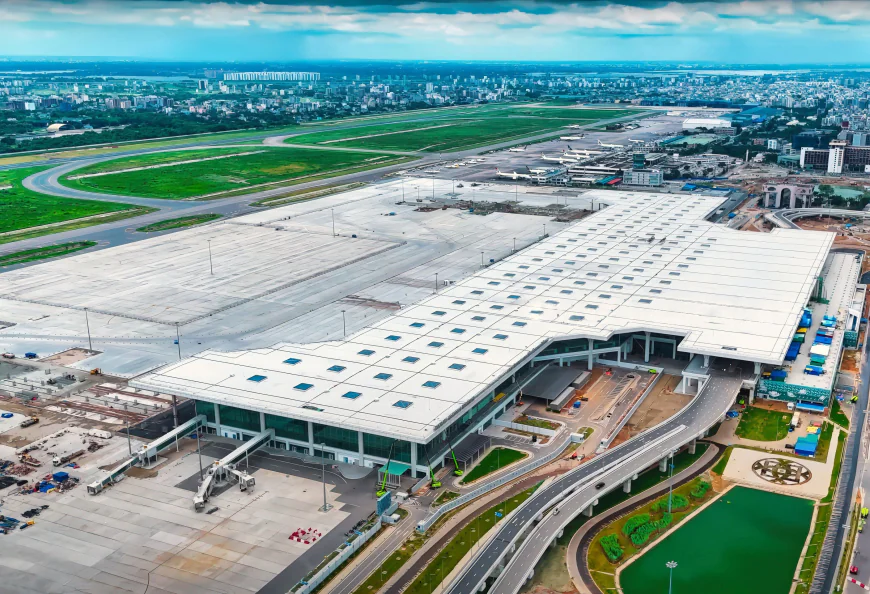
Construction of HSIA’s long-awaited Third Terminal, built with Japanese assistance at a cost exceeding $2 billion, is in its final stages, with trial runs scheduled this year.
Once operational, the facility will raise annual passenger capacity to more than 20 million and increase export cargo handling from 200,000 tonnes to 546,000 tonnes. A 36,000-square-metre cargo zone equipped with advanced automation forms part of the expansion.
Reviving regional airports and reform
The government has also moved to restore inactive regional airports to improve domestic connectivity. Bogura Airport, closed since 2000, is earmarked for phased redevelopment, while facilities in Ishwardi, Thakurgaon, Shamshernagar, Cumilla and Lalmonirhat are under review.
Meanwhile, draft reforms to the 1984 Civil Aviation Rules place renewed emphasis on safety, competitiveness and sustainability, alongside investment in technical training. CAAB has expanded programmes for air traffic controllers, cargo handlers and security staff in line with international standards, signalling a broader commitment to long-term sectoral resilience.
Read More: Why Bangladesh Struggles to Attract Tourists
Tourism Struggles Ahead of Ramadan in Bangladesh
Bangladesh–India–Tripura bus service resumes after 18-month suspension
How Political Unrest Crushed Bangladesh's Tourism & Aviation Industry
Why Bangladesh Struggles to Attract Tourists
A Year of Rapid Change in Bangladesh’s Aviation Industry
Some Heritage Sites and Monuments of Bangladesh
Nine Attractive and Scenic Places of Bangladesh
Narayanganj's Murapara Zamindar Bari: A Unique Example of Architectural Style
Bangladesh’s Aviation Drive Could Reshape Future of Tourism
Bangladesh-India Relations Show Signs of Recovery
New Bangladesh Govt Brings Light of Hope to Indian Tourism Sector
Bangladesh Resumes Visa Services in India
Bangladesh in the Eyes of an Indian Traveller
International Arbitration Board orders CAAB to Pay Tk1,650cr to ADC
Prime Minister Holds Meeting on Dhaka Airport’s Third Terminal
Old Dhaka’s Iftar: A Timeless Cuisine of Flavours and Heritage
New Airport Cargo Facility Lies Idle Amid Export Slowdown
Russia Unbound: Tours, Visas, and Travel Tips for Bangladeshi Nationals
Travel Alert Issued Following Killing of Cartel Leader in Mexico
What's Your Reaction?
 Like
0
Like
0
 Dislike
0
Dislike
0
 Love
0
Love
0
 Funny
0
Funny
0
 Wow
0
Wow
0
 Sad
0
Sad
0
 Angry
0
Angry
0





Comments (0)