

A journey through time and heritage of Old Dhaka
A walk through the Old Dhaka offers a journey into the past, to the eras of Mughal rulers, powerful Nawabs and the diverse communities that shaped the capital’s distinctive identity

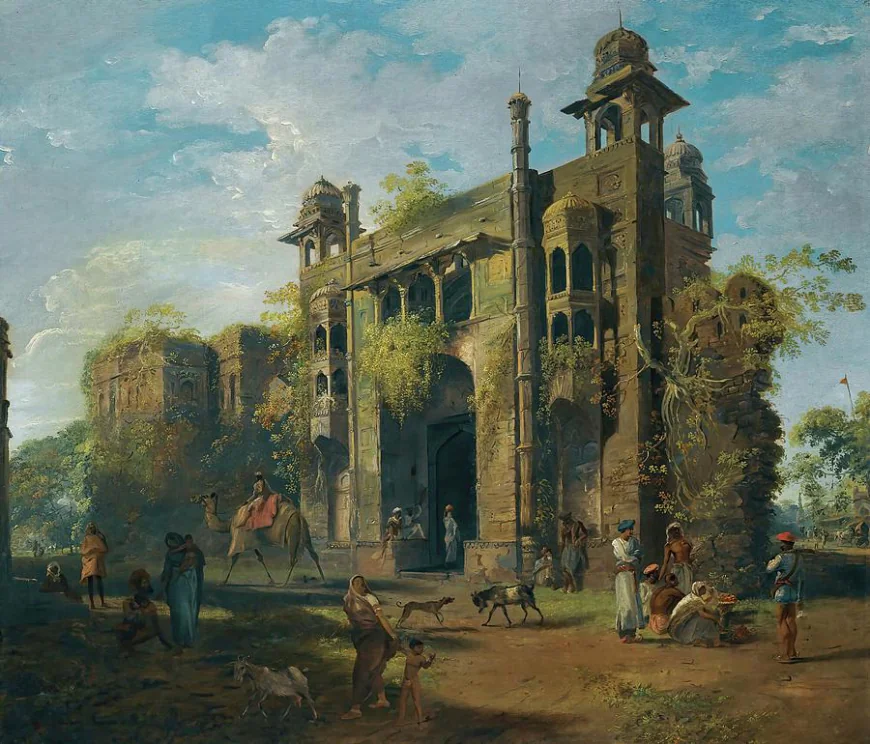
Dhaka is a city alive with energy, yet beneath its modern bustle lies a rich and layered history reflected in its remarkable architecture. A walk through the old quarters offers a journey into the past, to the eras of Mughal rulers, powerful Nawabs and the diverse communities that shaped the capital’s distinctive identity, reports BSS.
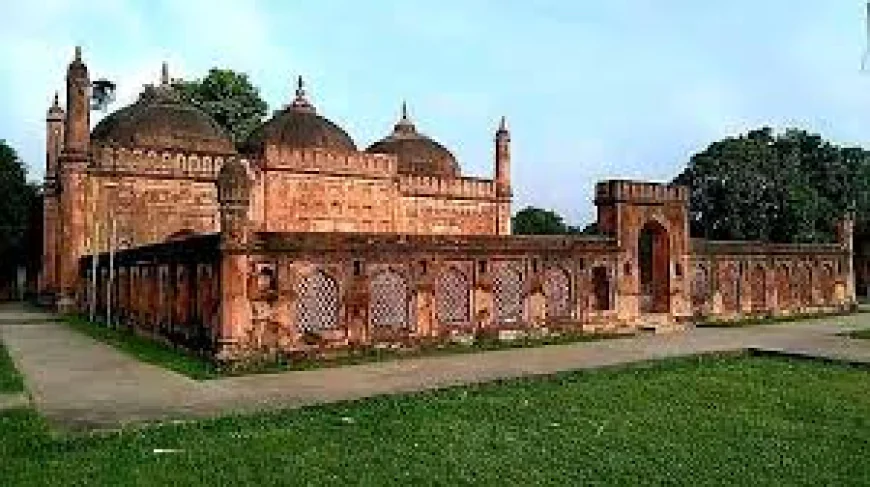
Lalbagh Fort is an incomplete 17th-century Mughal fort complex situated on the bank of the Buriganga River in Dhaka. Photo: Wikipedia
Our tour begins at Lalbagh Fort, also known as Fort Aurangabad. The unfinished Mughal palace-fortress stands near the banks of the Buriganga, bearing witness to shifting power and unrealised ambition. Construction began in 1678 under Prince Muhammad Azam, but he left Dhaka before it could be completed. Although Shaista Khan later governed the city for many years, the fort remained unfinished, leaving behind a striking reminder of a grand but incomplete vision.
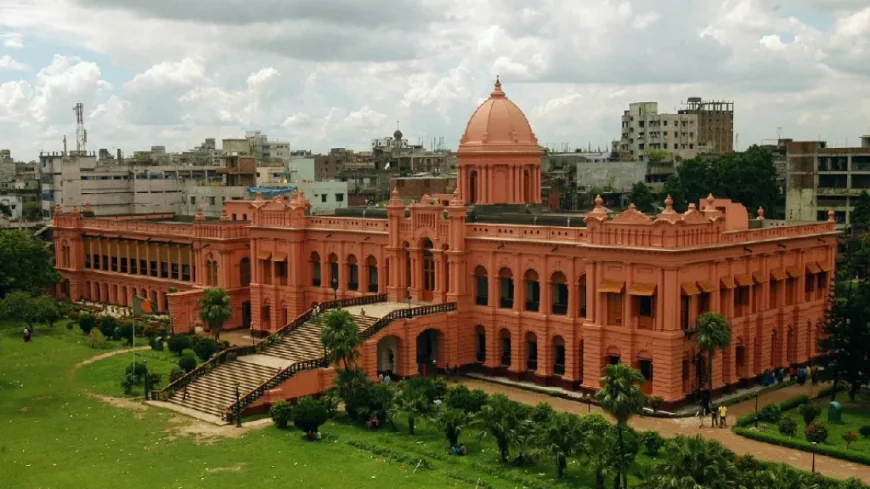
Ahsan Manzil is a historic palace situated in Kumartoli along the banks of Buriganga River in Dhaka, Bangladesh. Photo: Wikipedia
From there, we move to the majestic Ahsan Manzil, one of the city’s most celebrated heritage landmarks. The two-storey palace, set on a raised platform overlooking the Buriganga, once served as the residence of the Nawabs of Bengal. Measuring 125.4 metres in length and 28.7 metres in width, it reflects the scale and splendour of a bygone age. Now converted into a museum under the supervision of the National Museum, the palace displays rare photographs, paintings, period furniture and household items used by the Nawabs in their private and official lives.
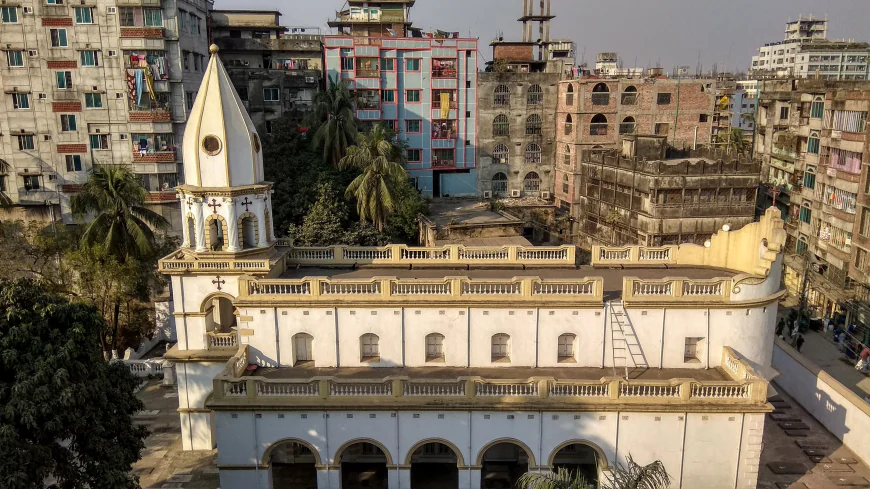
A side view of the Armenian Church, a historically significant architectural monument situated in the Armanitola area of old Dhaka, Bangladesh. Photo: Wikipedia
Another chapter of Dhaka’s past unfolds at the Armenian Church in Armanitola. The historic church stands as a reminder of the once-thriving Armenian community that lived and traded in the city during the 17th and 18th centuries. With its long structure, four doors and twenty-seven windows, the church retains a quiet, dignified charm. According to the Bangladesh Tourism Board, it also gained recognition as the place where Mother Teresa stayed during her visit to Dhaka in 1996.
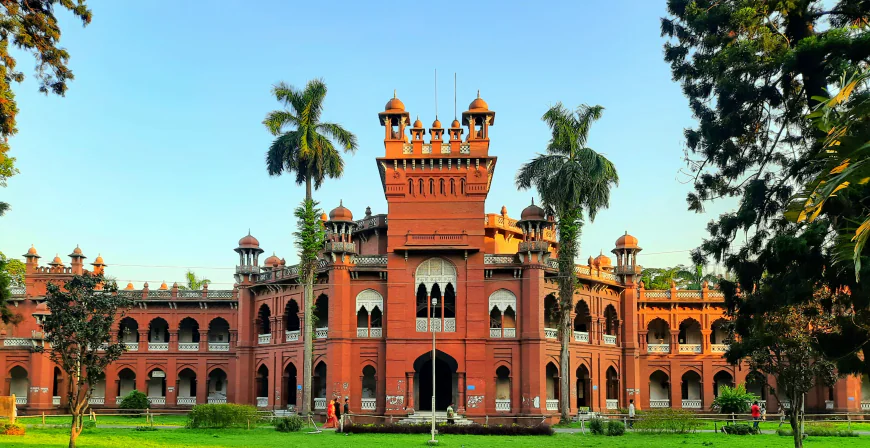
Curzon Hall is a British Raj-era building and the home of the Faculty of Sciences at the University of Dhaka, located in Shahbagh. Photo: Wikipedia
The journey concludes at the imposing Curzon Hall. Originally intended to serve as a town hall, it was named after Lord Curzon, the Viceroy of India, who laid its foundation stone in 1904. Combining European and Indian architectural elements, the building now houses the Faculty of Science of the University of Dhaka. Surrounded by gardens and open grounds, it remains one of the capital’s most recognisable landmarks.
Together, these historic sites offer a compelling glimpse into Dhaka’s diverse heritage. Each monument tells its own story, inviting visitors to explore the city’s past and better understand the forces that shaped this vibrant capital.
Read More: US suspends embassy services in Kuwait, Saudi Arabia, Iraq
A US F-15 fighter jet crashes in Kuwait
Two Bangladeshi expatriates killed and seven injured in Middle East conflict
US suspends immigrant visas for Bangladeshi citizens, effective from January 21
Airspace closures cancel 102 flights in 3 days at HSIA
More ME flights axed as misery deepens for stranded passengers
Govt to reopen closed airports before building new ones
Bangladesh in the Eyes of an Indian Traveller
Busting Myths: What It's Like to Travel Across Bangladesh
Why Bangladesh Struggles to Attract Tourists
Bandarban: The Paradise of Nature
How Political Unrest Crushed Bangladesh's Tourism & Aviation Industry
Some Heritage Sites and Monuments of Bangladesh
What's Your Reaction?
 Like
0
Like
0
 Dislike
0
Dislike
0
 Love
0
Love
0
 Funny
0
Funny
0
 Wow
0
Wow
0
 Sad
0
Sad
0
 Angry
0
Angry
0

Comments (0)