

Sonarong Jora Moth in Munshiganj stand as silent witnesses to time
The present Munshiganj district was an important centre of education, culture and religious activities for a long time and during the Sena period, Bikramapur emerged as a significant hub of Hindu religious and cultural practices

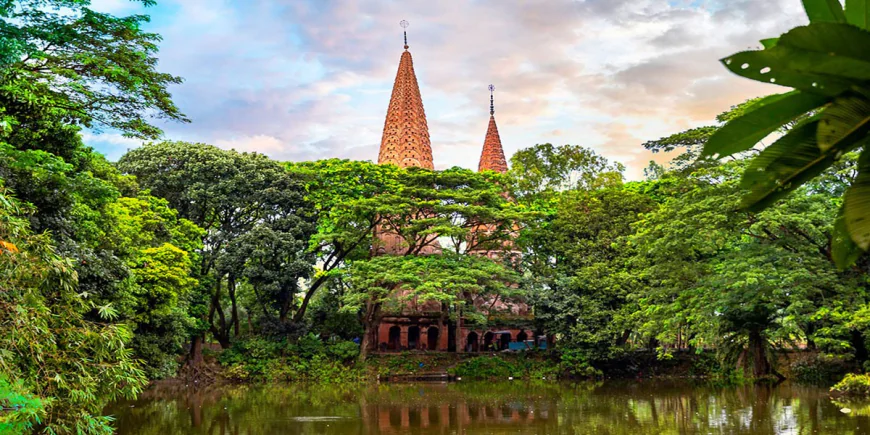
Bikramapur, now Munshiganj, was one of the most prosperous settlements of ancient Bengal. The present Munshiganj district was an important centre of education, culture and religious activities. During the Sena period, Bikramapur emerged as a significant hub of Hindu religious and cultural practices, reports BSS.
Following this tradition, monasteries and temples were established at various places in Munshiganj during the 17th and 18th centuries. According to historians, the twin monasteries or temples at Sonarang in Tongibari were built in that continuity. Due to long neglect and lack of care, this architectural heritage is now on the verge of disappearing. Although commonly known as the twin monasteries because the two structures stand side by side, they are in fact twin temples. The two temples were built in honour of two different deities, Kali and Shiva. The larger one is the Kali temple and the smaller one is the Shiva temple. As the two structures were built on the same platform with a gap of about three feet, they came to be known as the twin monasteries. With a heritage of around 180 years, the twin monasteries have now lost their former glory and stand as silent witnesses to time.
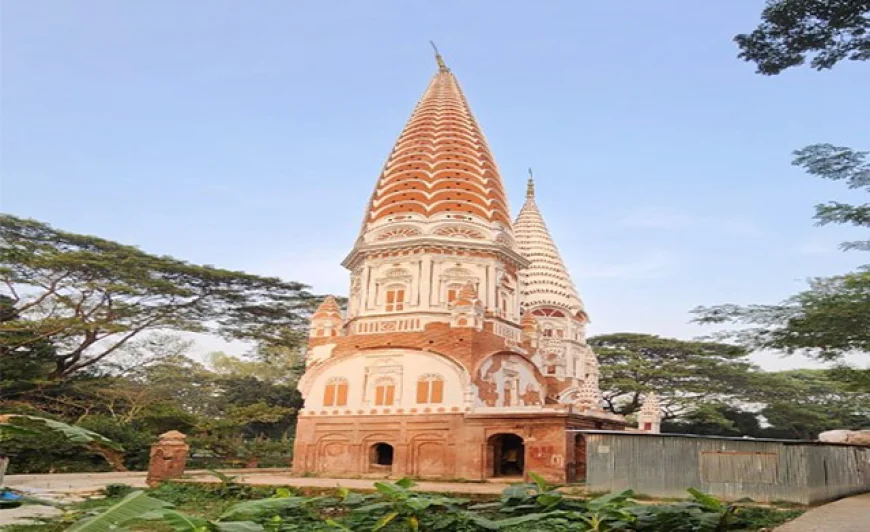
With a heritage of around 180 years, the twin monasteries have now lost their former glory and stand as silent witnesses to time. Photo: BSS
In the early 19th century, Hindu zamindar families used to build monasteries and temples either in memory of their parents or for spiritual merit. According to history, Rup Chandra Sen, a devout Hindu zamindar of Sonarang, constructed the two monasteries at the cremation site in memory of his parents. At that time, zamindar couples jointly undertook religious donations and the construction of monasteries and temples. An inscription placed above the entrance of the monastery indicates that Rup Chandra and his wife Bhabanimohan built the larger eastern monastery in 1843 in memory of his mother. Later, in 1886, they constructed the smaller structure beside it to the east. The history of construction was inscribed on a plaque placed on the upper part of the front wall. That inscription and the stone slab inside the shrine are no longer there.
Both monasteries follow the same design and are square in shape, with square inner chambers. The larger monastery is about 15 metres high and measures approximately 22 feet in length and width. The smaller eastern structure is about 14 feet long and 27 feet wide. Both the larger and smaller monasteries have inner chambers that were used as prayer rooms. The two structures bear features of Sena-period architecture. The inner chamber of the larger monastery is square, measuring about 11 feet on each side, while the inner chamber of the smaller one is also square, measuring about 9 feet on each side. The walls of both structures are about three feet thick. Floral and vine motifs decorate the upper sections of the prayer chambers. Niches have been carved into the walls for placing idols of deities.
To create an atmosphere suitable for meditation and worship in the sanctum, no windows were provided, keeping the chamber dimly lit. Only ornamental designs of doors and windows are present. In both structures, there is only one arched doorway, about seven feet high and three feet wide, located inside the southern verandah. On the other three sides, three door-like ornamental designs have been added. The western structure has a verandah only at the front, about six feet wide, with no verandahs on the other three sides. The eastern structure has verandahs about four feet wide on all sides. There is one doorway at the front, while the other three sides have only three decorative door-like designs each.
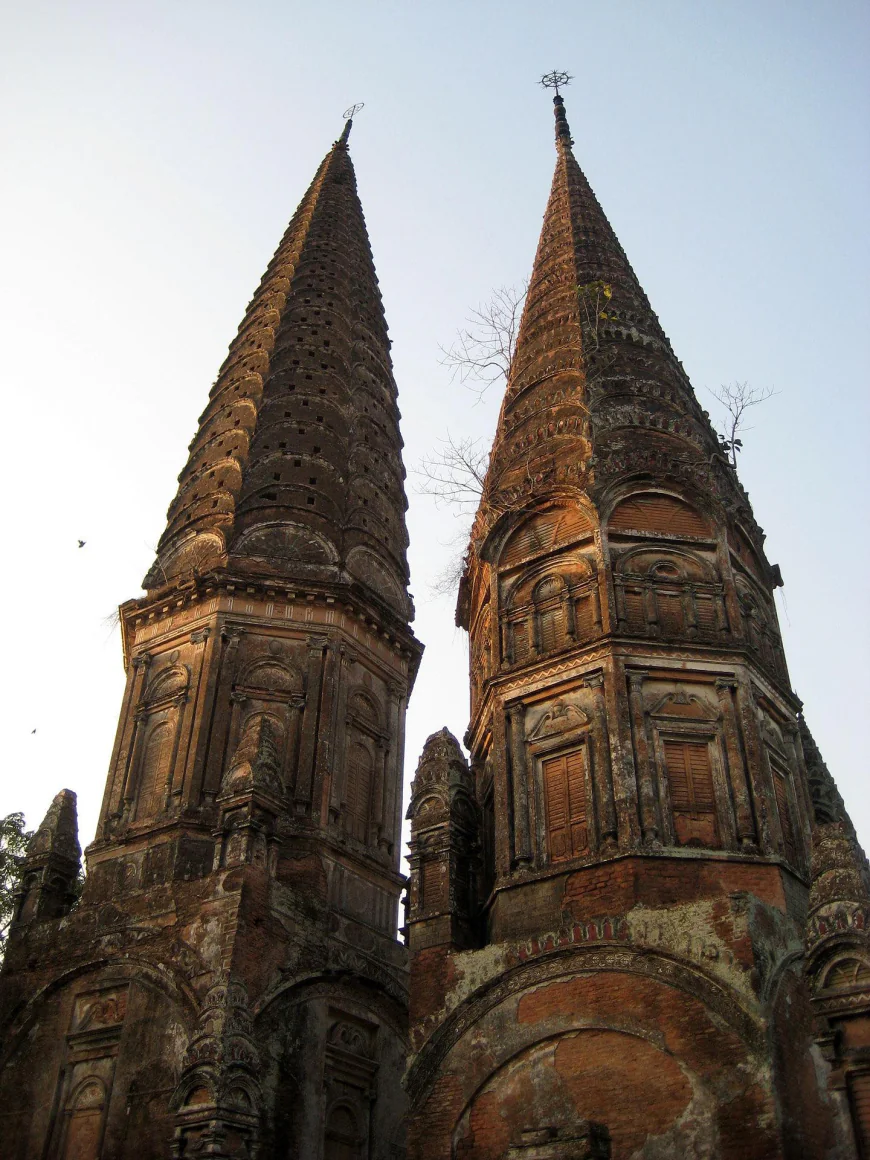
Both monasteries follow the same design and are square in shape, with square inner chambers. Photo: Collected
The prayer halls of the twin monasteries are covered with domes. Above the prayer halls are square tiers, surrounded by semi-circular arch designs. Above these arches are motifs resembling hooded snakes. The smaller structure has four pinnacles at its four corners, each adorned with semi-circular arch designs and clock-like motifs at the front. The third tier of the structures features rectangular panels and ornamental closed-door designs. Above this tier rises a tapering, concave, tall spire. The octagonal spire is topped with a kalash finial, above which stands a trident. The exterior is decorated with semi-circular arch patterns. Around the body of the larger structure (the Kali temple), there are small holes for birds, where various species now nest.
In front of the twin monasteries lies a large pond with a well-built ghat. The site has become a focal point for religious gatherings and festivals for the people of Sonarang and neighbouring villages. The dilapidated structures, lime-surki walls, massive stone foundations and domed roofs still speak of past glory. Due to long neglect, many parts have collapsed, and valuable stones and architectural elements have been lost to decay and theft. A visit to the site shows that several sections have crumbled, plaster has peeled off the walls, and doors remain open. Even so, it stands as an example of 18th-century architecture in the subcontinent. The Department of Archaeology has declared the twin monasteries a protected heritage site. Visitors from different areas come here every day. Md Mahbubur Rahman, headmaster of Kusumpur High School, told BSS that the archaeological sites of Munshiganj need proper restoration and preservation, otherwise centuries-old history will be lost. He also said that if a brief history provided by the Department of Archaeology were displayed here, tourists would easily learn about the construction history of the monasteries. This site holds special significance for local tourists, researchers and architects.
What's Your Reaction?
 Like
0
Like
0
 Dislike
0
Dislike
0
 Love
0
Love
0
 Funny
0
Funny
0
 Wow
0
Wow
0
 Sad
0
Sad
0
 Angry
0
Angry
0

Comments (0)