

Royalbari Fort unfolding untold chapters of Bengal’s history
Archaeologists believe the fort dates back to the late 14th or early 15th century, with major expansion under Sultan Nusrat Shah, son of Alauddin Hussain Shah

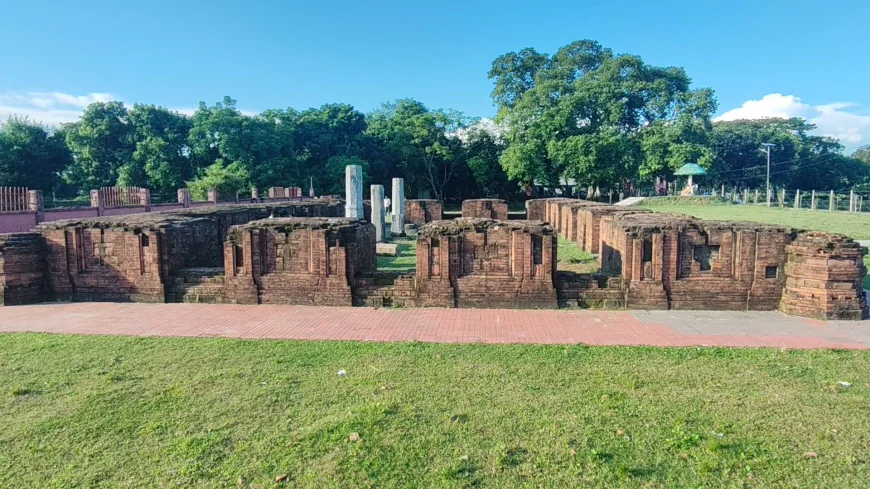
The full excavation of the ancient Royalbari Fort in Kendua upazila could reveal fresh insights into the military and administrative history of medieval Bengal, according to archaeologists and local historians.
Considered one of the region’s most significant archaeological sites, the fort continues to draw visitors from across the country keen to see the remnants of Bengal’s early rulers, reports BSS.
The Mymensingh Divisional Regional Office of the Department of Archaeology has confirmed that the structure dates back to the Sultanate period, though some believe it was built by a Mughal commander.
Historic sources, including Kedarnath Majumdar’s Mymensingher Itihas O Bibhaga, suggest that Isha Khan, leader of the Baro Bhuiyans, once conquered Nasirujial Pargana and Royalbari—a settlement then enclosed by fortified walls.
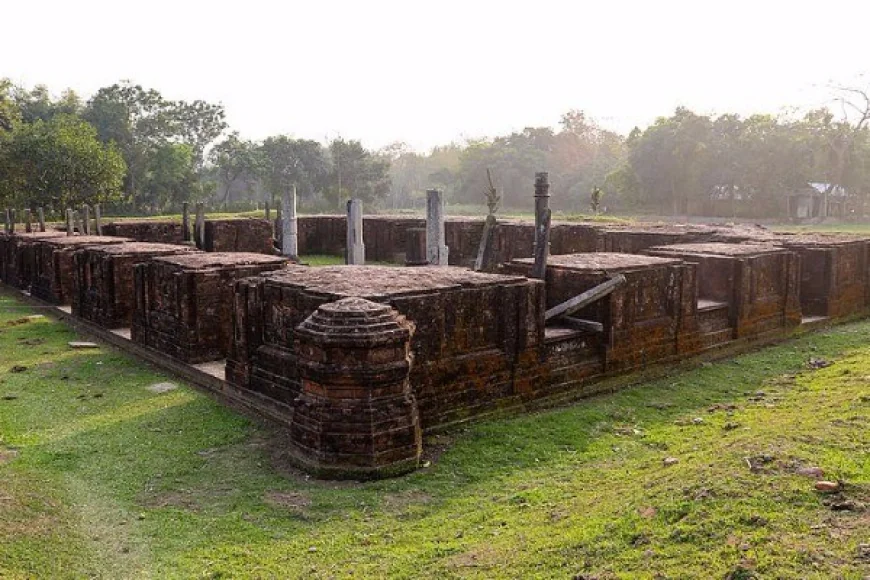
The Sultanate period mosque in the Royalbari Fort. Photo: touristplaces.com.bd
Royalbari Fort came to light in the 1980s and was declared a protected archaeological site in 1987. Excavations between 1991 and 1994 and again in 2016–2017 uncovered key features, including the main “lion gate”, two mounds, a mosque, ponds and a fortified boundary wall.
Artefacts such as pottery, stone fragments, tiles, terracotta-decorated bricks, iron tools and geometrically engraved stones were also recovered.
Archaeologists believe the fort dates to the late 14th or early 15th century, with major expansion under Sultan Nusrat Shah, son of Alauddin Hussain Shah. It likely later came under the control of Isha Khan and other local rulers.
Spanning 46 acres, the fort stretches 533.23 metres north to south and 327.57 metres east to west. It includes a pond, two mounds, a cemetery and the remains of several ancient structures. Excavations in 2022–23 at Dengu Mia and Niamat Bibi’s Mazar—identified as archaeological mounds—revealed further remains from the same period.
Researchers believe Royalbari Fort served as a military outpost during the late Sultanate and early Mughal periods. Its strategic location along the Betai River suggests it played a role in controlling river trade routes and defending the area from pirate attacks.
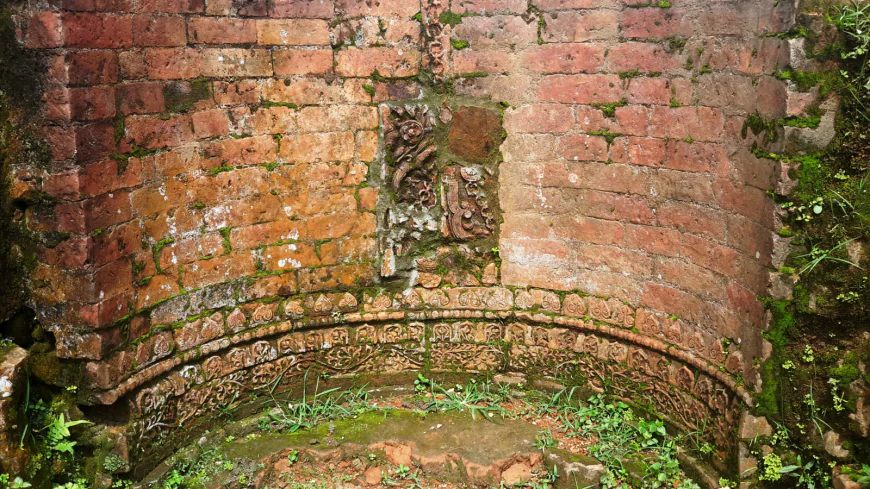
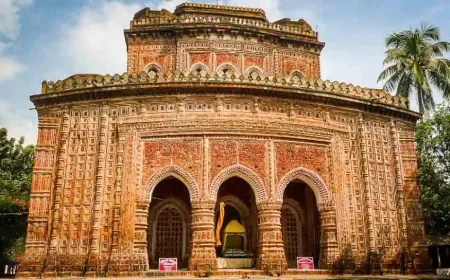
Decorated arched panel of the fort. Photo: Eliza Binte Elahi
A parade ground, moats, tunnels, watchtowers and fortified walls point to extensive military planning.
Former Assistant Director of the Department of Archaeology Mahbub ul Alam said the architectural style and artefacts indicate the fort is nearly 700 years old. “It was likely an army outpost,” he said.
The ruins reveal a complex layout, including two large ponds with paved ghats, two moats, a tower, a twelve-door mound, a tunnel and a mosque believed by some to be Masjid-e-Jalal, built by Dewan Jalal.
Local historians note that after Sultan Alauddin Hussain Shah conquered Kamrup in 1498, his son Nasrat Shah ruled the area until being driven out by rival forces.
Fleeing eastward, he is believed to have taken refuge in Royalbari, renaming the area “Nasrat o Jial” or “Nasrat Ajial”. The wider region later became known as Nasratshahi Pargana—a name that endured until the reign of Emperor Akbar.
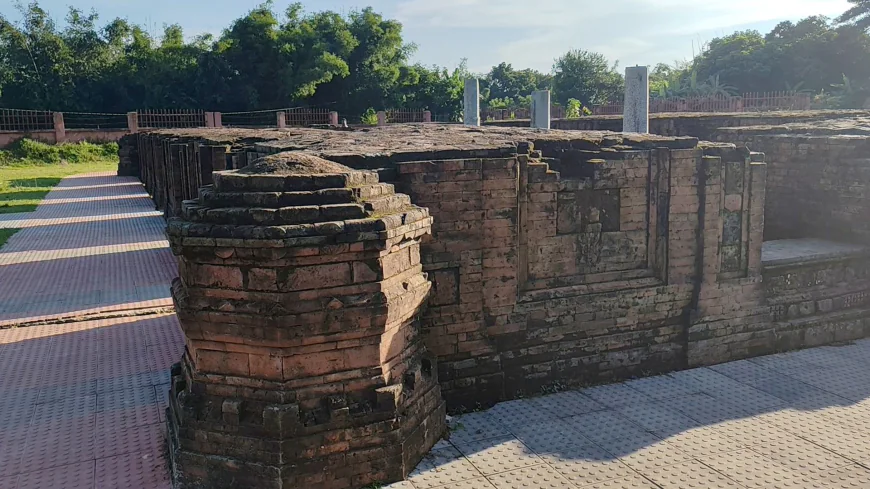
Archaeologists believe the fort dates back to the late 14th or early 15th century, with major expansion under Sultan Nusrat Shah. Photo: touristplaces.com.bd
Researcher Ali Ahmed Khan Ayyob argues that Royalbari, along with Tajpur, Pukhuria and Betam forts, was built to protect riverine settlements from pirates. “It appears the wider Royalbari area may once have formed a large fortified zone,” he said.
Kendua Upazila Nirbahi Officer Imdadul Haque Talukder said the site falls under the Department of Archaeology. “The upazila administration will continue to support preservation efforts,” he added.
Afroza Khan Mita, Regional Director of Archaeology for Dhaka and Mymensingh, said a new project—Renovation, Conservation and Development of Archaeological Sites in Mymensingh Region—is set to begin within two years to support further excavation. “After analysing the findings, a plan for conservation and exhibition will follow,” she said.
The site has already seen partial conservation, including boundary construction and development of nearby areas such as Baroduari Mosque. Excavated materials are being preserved for display.
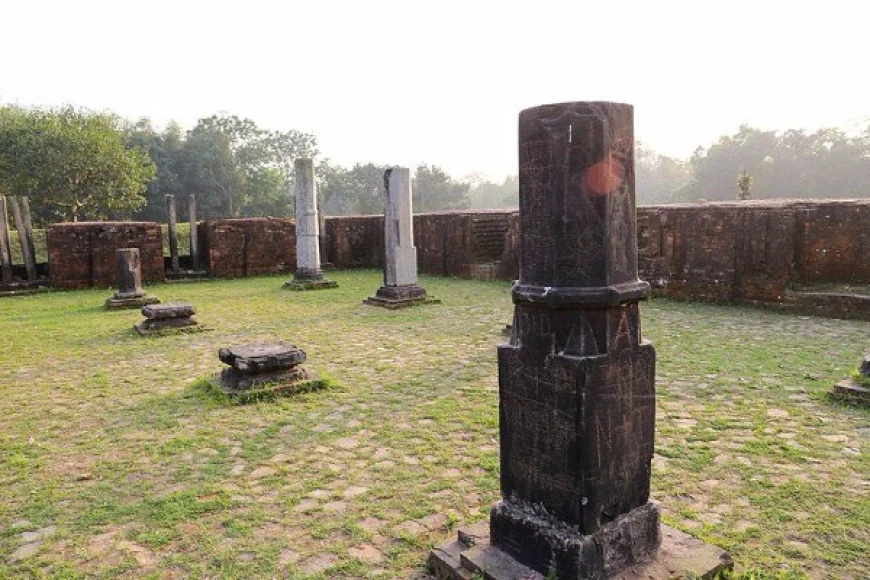
Archaeologists found 77 glazed tiles, ornamental bricks, iron chair, cooking pots, iron rods, etc. from the excavation site. Photo: touristplaces.com.bd
Experts believe a full excavation could shed light on a wider military network in eastern Bengal and the region’s political structure after the rise of Isha Khan.
They say it may reveal that not just the core site but the entire Royalbari area once functioned as a fortified settlement.
As anticipation grows, Royalbari Fort stands as a silent witness to centuries of Bengal’s past—its deeper story still buried beneath the soil of Netrakona.
What's Your Reaction?
 Like
0
Like
0
 Dislike
0
Dislike
0
 Love
0
Love
0
 Funny
0
Funny
0
 Wow
0
Wow
0
 Sad
0
Sad
0
 Angry
0
Angry
0

Comments (0)