

Riding the waves: surfing emerges as Cox’s Bazar’s newest adventure sport
For decades, visitors to Cox's Bazar have primarily engaged in inactive recreation—walking along the shoreline, bathing in designated zones marked by red-and-yellow flags at Kolatoli, Laboni and Sugandha points, and taking fresh seafood.

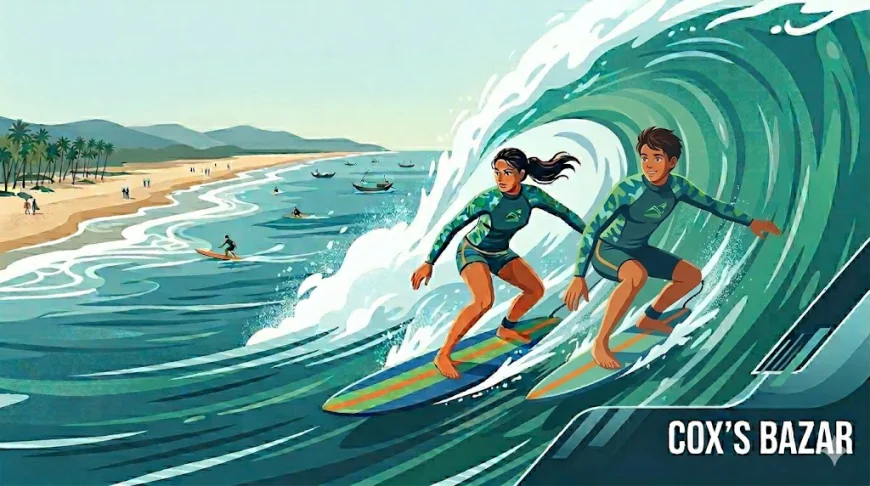
Cox’s Bazar, the world’s longest unbroken sandy beach, is adding an exciting new dimension to its beach culture. The beach town is celebrated for its natural beauty and serene sunsets. It is emerging as an embryonic destination for surfing enthusiasts, embracing adventure-based tourism in the country.
For decades, visitors to Cox's Bazar have primarily engaged in inactive recreation—walking along the shoreline, bathing in designated zones marked by red-and-yellow flags at Kolatoli, Laboni and Sugandha points, and taking fresh seafood.
However, recent tourism initiatives have begun introducing more energetic activities to attract both local and international visitors seeking adventurous travel.
The weeklong beach carnival and tourism fair in Cox's Bazar features surfing demonstrations alongside beach bike rallies, kite festivals, fire spinning shows, and concerts, marking one of the first organised efforts to showcase wave-riding as a viable entertaining option.
Local tourism authorities have recognised that diversifying activities is essential if Cox's Bazar is to compete with regional beach destinations that regularly feature in international rankings. Local surfers in Cox’s Bazar regularly ride the waves at Kolatoli and Sugandha points. Recently, they have been joined by foreign visitors and residents, who are also embracing the thrill of surfing on the world’s longest sea beach.
The emergence of surfing comes as part of a broader strategic vision. The Destination Development Plan for Cox's Bazar (2025-2027), developed by the International Labour Organisation in collaboration with government agencies, identifies eight high-potential locations—including Himchhari, Inani and Patuartek—where water sports and adventure tourism can be developed sustainably.
Industry stakeholders note that surfing infrastructure remains in its beginning stage. Unlike established destinations such as Bali’s Nusa Dua or Thailand's Phuket, which offer dedicated surf schools, equipment rentals, and wave-forecasting services, Cox's Bazar currently lacks extensive facilities.
However, the inclusion of surfing in official tourism programming represents a significant first step.
With the growth of adventure tourism, ensuring visitor safety has become increasingly critical. The Sea Safe initiative—backed by the Princess Charlene of Monaco Foundation and the Royal National Lifeboat Institution—has maintained round-the-clock lifeguard services at Cox's Bazar since 2013.
Through continuous surveillance, water safety education, and complimentary swimming instruction for children, the programme has significantly mitigated drowning hazards. This robust safety infrastructure now offers a solid platform for introducing supervised surfing activities.
Environmental stewardship is equally central to development plans. Officials stress that growing the water sports industry must not compromise coastal preservation, ensuring the unique marine life of Cox’s Bazar remains safeguarded.
Despite its extraordinary natural attribute, Cox’s Bazar has consistently been absent from international “best beaches” rankings, with analysts pointing to the limited range of structured activities compared to competitors. The introduction of surfing and other adventure sports directly addresses this gap.
The Cox’s Bazar Development Authority is drafting a 20‑year blueprint aimed at reshaping the coastal city into a modern, smart tourism hub, complete with water sports, amusement attractions, and eco‑friendly resorts. If successfully implemented, these initiatives could establish Cox’s Bazar as South Asia’s rising hotspot for surfing.
Surfing at Cox’s Bazar is still largely a niche pursuit for adventure-seekers rather than a mainstream industry. However, with the government’s increasing focus on diversifying tourism, enhanced international airport access, and organised development initiatives, the world’s longest natural beach may soon advance into a destination offering far more than tranquil seaside wanders.
Read More: US suspends embassy services in Kuwait, Saudi Arabia, Iraq
A US F-15 fighter jet crashes in Kuwait
Two Bangladeshi expatriates killed and seven injured in Middle East conflict
US suspends immigrant visas for Bangladeshi citizens, effective from January 21
Airspace closures cancel 102 flights in 3 days at HSIA
More ME flights axed as misery deepens for stranded passengers
Govt to reopen closed airports before building new ones
Bangladesh in the Eyes of an Indian Traveller
Busting Myths: What It's Like to Travel Across Bangladesh
Why Bangladesh Struggles to Attract Tourists
Bandarban: The Paradise of Nature
How Political Unrest Crushed Bangladesh's Tourism & Aviation Industry
Some Heritage Sites and Monuments of Bangladesh
Nine Attractive and Scenic Places of Bangladesh
Bangladesh Resumes Visa Services in India
What's Your Reaction?
 Like
0
Like
0
 Dislike
0
Dislike
0
 Love
0
Love
0
 Funny
0
Funny
0
 Wow
0
Wow
0
 Sad
0
Sad
0
 Angry
0
Angry
0


Comments (0)