

China successfully tests world's first maritime ground-effect vehicle
The vehicle enables real-time data transmission, remote operation of medical equipment, and online consultations with medical specialists

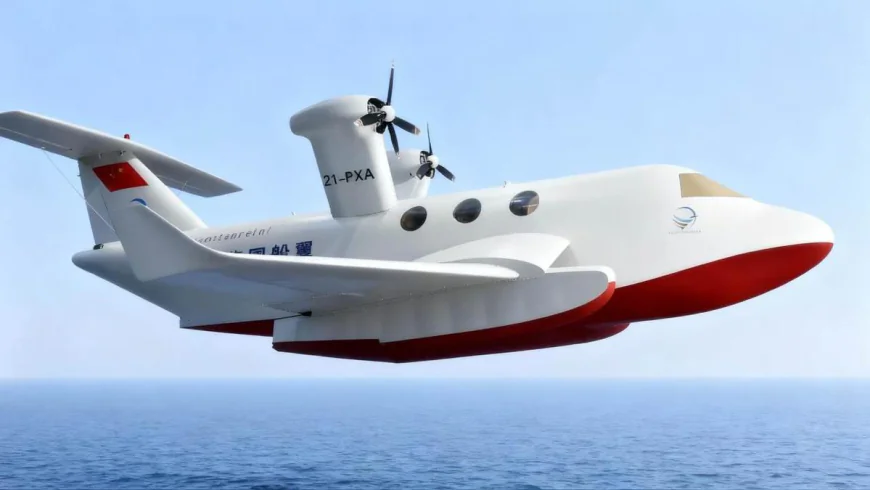
The world's first maritime ground-effect vehicle, developed by CSSC Haishen Medical Technology Co Ltd, successfully completed its test flight this week, marking China's advancement in maritime emergency medical rescue to an internationally advanced level, reports China Daily.
Advanced technology integration
The craft integrates a range of cutting-edge technologies, including embodied intelligence, biomanufacturing, quantum technology, and 6G communications. It builds upon four key national medical rescue technologies: maritime remote medical rescue equipment, maritime unmanned aerial vehicles, airborne helicopters, and medical evacuation modules.Mounted on a wing-in-ground-effect craft platform and compatible with a Maritime IoT Platform, the vehicle enables real-time data transmission, remote operation of medical equipment, and online consultations with medical specialists. This creates a continuous rescue chain covering on-site treatment, nearby support, and medical evacuation.
Technical specifications
The craft features a carbon-fiber composite structure with an overall weight of approximately 2.5 tons, a maximum takeoff weight of 5 tons, and an effective payload of around 2.5 tons. It is powered by a 540-ACIA5 six-cylinder piston engine system.
Performance capabilities
Maximum cruising speed: 200 kilometers per hour
Ground-effect flight altitude: 0.5 to 6 meters
Maximum flight altitude: 30 to 150 meters
Range: Up to 1,000 kilometers
Capacity
Up to five seated patients or three stretcher patients
Standard crew: two nurses, one doctor, and one pilot
Test flight success
At the test site, Huang Yuhong, president and chief engineer of Haishen, confirmed that the test flight validated the craft's performance in typical maritime emergency rescue scenarios, including the stability and reliability of medical rescue equipment and information systems, as well as the control performance of the wing-in-ground-effect craft in both navigation and flight.
He added that future versions of the craft will be equipped with additional functions such as maritime search, recovery, and salvage operations, enabling a full-cycle rescue system covering search, retrieval, treatment, and transfer.
What's Your Reaction?
 Like
0
Like
0
 Dislike
0
Dislike
0
 Love
0
Love
0
 Funny
0
Funny
0
 Wow
0
Wow
0
 Sad
0
Sad
0
 Angry
0
Angry
0



Comments (0)