

US fails to pass aviation safety bill as Pentagon drops support
The House voted 264-133 in favor of the ROTOR Act, passed unanimously by the US Senate in December, which would require aircraft operators to equip their fleets with a safety system known as the Automatic Dependent Surveillance-Broadcast system, or ADS-B, by the end of 2031. But under fast-track rules designed to expedite legislation, the bill needed a two-thirds majority to pass, and it fell one vote short, report agencies.

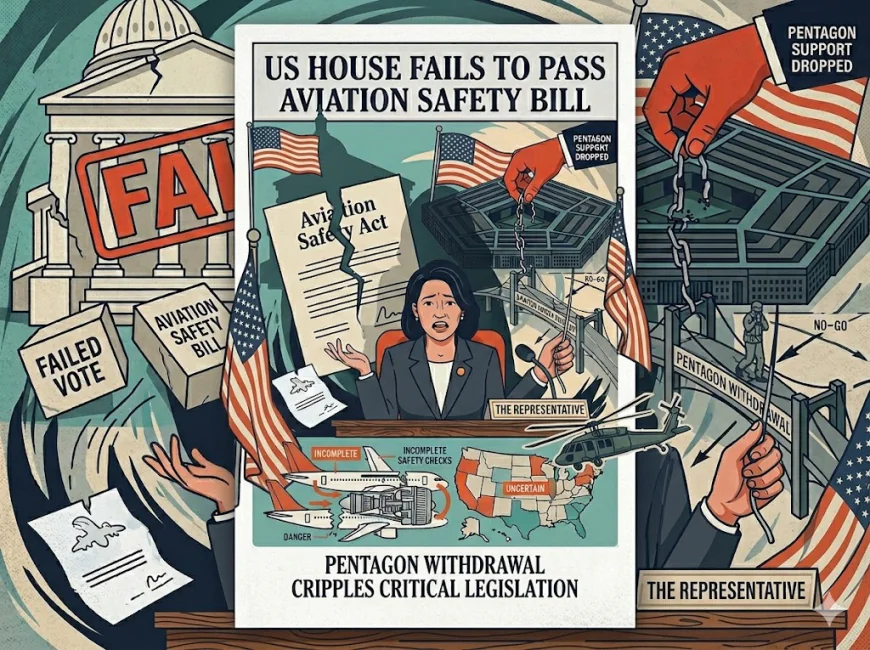
The US House of Representatives on Tuesday failed to pass key aviation legislation after the Pentagon raised last-minute objections, and despite pleas from lawmakers and relatives of those killed in the worst US aviation disaster since 2001.
The House voted 264-133 in favor of the ROTOR Act, passed unanimously by the US Senate in December, which would require aircraft operators to equip their fleets with a safety system known as the Automatic Dependent Surveillance-Broadcast system, or ADS-B, by the end of 2031. But under fast-track rules designed to expedite legislation, the bill needed a two-thirds majority to pass, and it fell one vote short, report agencies.
House Armed Services Committee Chair Mike Rogers, a Republican, criticized the ROTOR Act, saying it would undermine national security. But he added some military aircraft should be equipped with and transmit ADS-B in congested civilian airspace. He is also a co-sponsor of the ALERT Act.
The Rotorcraft Operations Transparency and Oversight Reform (ROTOR) Act, which passed the Senate unanimously in December, was constructed in response to the deadly midair collision near Washington, DC, last January that killed 67 people when an American Airlines passenger jet and a US Army Black Hawk helicopter crashed over the Potomac River.
Technology That Could Have Prevented Tragedy
The legislation would have mandated wider use of Automatic Dependent Surveillance-Broadcast (ADS-B) technology, which transmits aircraft locations to other aircraft. The National Transportation Safety Board determined this system could have prevented the collision by giving pilots closely a full minute of caution to react.
"How many more people need to die for us to decide that action needs to be taken?" NTSB Chair Jennifer Homendy asked before the vote.
Pentagon Reverses Position
Despite supporting the bill last year, Pentagon spokesman Sean Parnell delivered a statement Monday warning that enactment "would create significant unresolved budgetary burdens and operational security risks affecting national defense activities," without specifying details.
House Armed Services Committee Chairman Mike Rogers (R-Ala.) echoed these concerns, arguing that "requiring our fighters and bombers and highly classified assets to regularly broadcast their location puts our men and women in uniform at risk”.
Alternative Legislation Proposed
Rep. Sam Graves (R-Mo.), chairman of the House Transportation Committee, supported an alternative bill, the ALERT Act, describing the ROTOR Act as an "unworkable government mandate”. However, the NTSB and victims’ families have not supported this alternative.
Families Vow to Continue Fight
Senator Ted Cruz (R-Texas), the bill's co-author, pledged to continue the fight: "Today's result was just a temporary delay. We will succeed, and the ROTOR Act will become the law of the land”.
What's Your Reaction?
 Like
0
Like
0
 Dislike
0
Dislike
0
 Love
0
Love
0
 Funny
0
Funny
0
 Wow
0
Wow
0
 Sad
0
Sad
0
 Angry
0
Angry
0




Comments (0)