

Five-year integrated plan likely for haor development
Govt aims to improve livelihoods in the country’s haor regions, boost agricultural production, strengthen water management, preserve biodiversity and develop sustainable infrastructure


The government is set to undertake a five-year integrated programme through 2030 aimed at improving livelihoods in the country’s haor regions, boosting agricultural production, strengthening water management, preserving biodiversity and developing sustainable infrastructure, Prime Minister’s Adviser on the Ministries of Finance and Planning Dr Rashed Al Mahmud Titumir said on Friday.
Speaking at an exchange meeting held at the Sylhet Circuit House, Dr Titumir said the crises in the haor areas have deepened due to unplanned embankment construction, river encroachment, sediment accumulation disrupting water drainage, biodiversity loss, excessive use of pesticides in agriculture and the impacts of climate change.
He said the government has already started work on an integrated master plan to ensure sustainable solutions to these longstanding challenges.
“We want not only humanitarian assistance for the people of the haor region, but also a lasting solution to their problems. Over the next five years, we will work through an integrated plan to improve agriculture, the environment, biodiversity and the overall living standards of the people in the haor areas,” he said.
Dr Titumir said that although various projects had been implemented in the haor region in the past, many were fragmented and poorly planned, failing to bring meaningful benefits to local communities.
“Sedimentation has obstructed the natural flow of rivers and wetlands, many sluice gates have become ineffective, and waterlogging has increased,” he added.
He stressed the need for a welfare-oriented state to respond quickly to people in times of crisis.
“An accountable state must stand beside its people promptly, and that is exactly what we are trying to do,” he said.
Referring to the recent flash floods and hill runoff that affected several areas of Sunamganj, the adviser said a high-level delegation had already visited the affected areas and humanitarian support activities had begun. Listed families would receive assistance for three months, he added.
Highlighting the need for long-term planning, Dr Titumir said relief alone would not solve the problems of the haor region.
He said ensuring proper water flow, dredging rivers and canals, constructing submerged and water-resilient roads, creating green belts, developing haor-compatible rice varieties, supplying agricultural machinery, and ensuring the timely availability of labourers must all be addressed together.
“We want rice varieties that farmers can harvest before untimely rains arrive. At the same time, facilities such as harvesters, dryers and other agricultural equipment are essential,” he said.
The adviser also expressed concern over the destruction of biodiversity in the haor areas. He said excessive pesticide use has pushed many indigenous fish species towards extinction, while the declining bee population is affecting pollination.
He noted that migratory birds, once abundant in Tanguar Haor, are now disappearing due to environmental degradation.
“Tanguar Haor is an internationally recognised Ramsar site, but its ecosystem is under threat because of unplanned activities,” he said.
Dr Titumir said all relevant ministries and agencies, including those responsible for agriculture, fisheries, water resources, environment and climate issues, would need to work in coordination under a new haor and wetland-related legal framework.
He also stressed the importance of incorporating public participation and local knowledge into the implementation process.
The adviser alleged that although thousands of crores of taka had been spent on projects in the haor region over the past 17 years, many were driven by “loot and patronage”, resulting in little sustainable progress and worsening the crisis.
Mentioning the government’s farmer card initiative, he said all farmers across the country would gradually be brought under the programme. Through the cards, farmers would receive seeds, fertilisers, pesticides and other agricultural services more efficiently, while agricultural planning would also become easier.
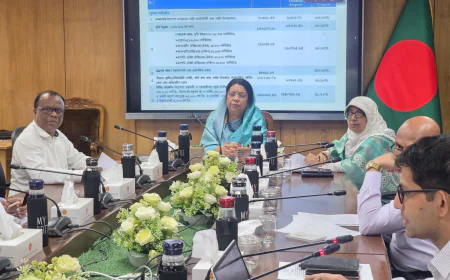
The meeting was attended by Sylhet Divisional Commissioner Md Mashiur Rahman and other relevant officials.
What's Your Reaction?
 Like
0
Like
0
 Dislike
0
Dislike
0
 Love
0
Love
0
 Funny
0
Funny
0
 Wow
0
Wow
0
 Sad
0
Sad
0
 Angry
0
Angry
0


Comments (0)