

Mughal-era marvel Ghaghra Khan Bari Jame Mosque in Sherpur
Local tradition and architectural evidence suggest the mosque was established during the time of rebel leader Hirangi Khan of the Boxer uprising, with Azimullah Khan believed to be its founder. It has witnessed over four centuries of history while remaining an active place of worship.

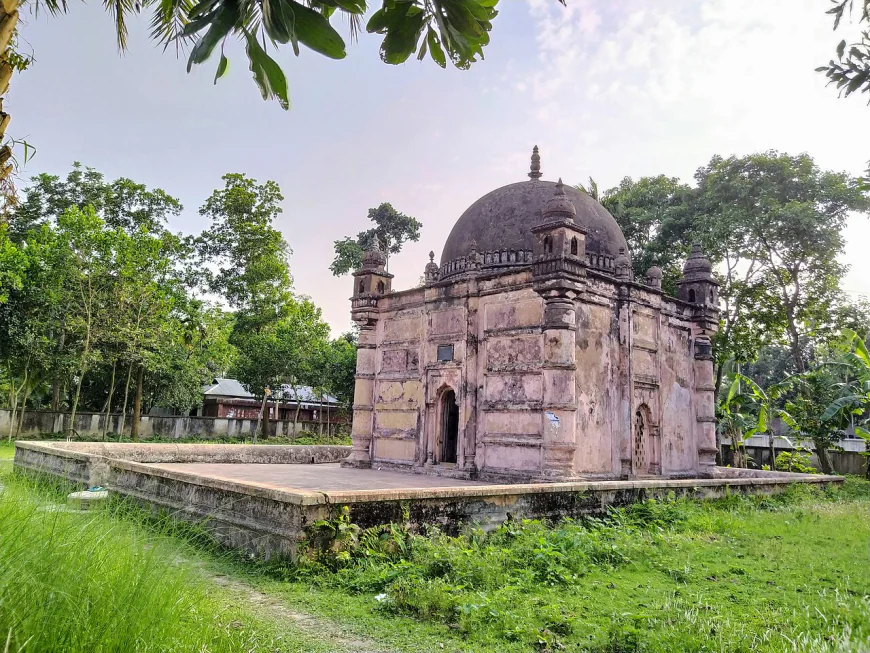
The Ghaghra Khan Bari Jame Mosque is a stunning 400-year-old Mughal-era relic in Bengal. Located in Ghaghra Lashkar village under Jhenaigati upazila in Sherpur, it remains a vital landmark even today, bridging the past and present as a spiritual sanctuary and a symbol of heritage, thereby becoming a premier tourist destination.
Historical Origin
Built during the Mughal rule, the single-domed mosque’s construction date is inscribed in Arabic on a stone fixed to its door, corresponding to 1607 AD in the Gregorian calendar.
Local tradition and architectural evidence suggest the mosque was established during the time of rebel leader Hirangi Khan of the Boxer uprising, with Azimullah Khan believed to be its founder. It has witnessed over four centuries of history while remaining an active place of worship.
Architectural Features
The mosque measures approximately 30 feet in both length and width, featuring a single central dome surrounded by 10 smaller and larger minarets that create a distinctive silhouette against the rural landscape. Two strong arches grace striking interior, alongside a mihrab and decorative floral and vase motifs that were once vibrantly painted in multiple colours along its walls.
The structure’s walls constructed four feet thick using traditional lime and surki—a mixture of brick dust and lime—demonstrate the sophisticated building techniques of the era. Architectural historians note influences of Greek and Corinthian styles in certain elements, giving the mosque a unique character that sets it apart from other structures.
Layout and Capacity
The mosque stands on 56 percent of land, with the main building and veranda occupying 16 percent and the remaining 41 percent serving as a cemetery. Inside, approximately 30 worshippers can pray in three rows, while the open veranda and courtyard accommodate around 100 more during larger congregations. Two ponds belonging to the mosque lie adjacent, their income helping maintain the facility.
Preservation Status
Recognising its historical importance, the Department of Archaeology took responsibility for the mosque’s preservation in 1999 and designated it as a protected heritage site. However, recent conservation efforts have drawn mixed reactions from local guardians. The interior, once adorned with colourful decorations, has been painted entirely white a change that mosque has faded much of the structure’s original visual aesthetic.
Community Role and Visual Appeal
The mosque attracts daily visitors, many of whom offer prayers while exploring this historical treasure. Located approximately 12 kilometres off Sherpur town, the structure becomes visible amid open fields after traveling two kilometres west off a rural path.
In this historic mosque, five daily prayers continue regularly with an appointed imam and muezzin. People from distant areas frequently travel to witness this Mughal-era masterpiece.
Future Potential
While the mosque is a stunning historical site, heritage specialists argue that a lack of thorough conservation has kept it from becoming a major tourist spot. By restoring its original Mughal authenticity, the Ghaghra Khan Bari Jame Mosque could be morphed into a major cultural landmark—a vibrant, “living monument” where centuries of history and modern-day worship coexist.
What's Your Reaction?
 Like
0
Like
0
 Dislike
0
Dislike
0
 Love
0
Love
0
 Funny
0
Funny
0
 Wow
0
Wow
0
 Sad
0
Sad
0
 Angry
0
Angry
0





Comments (0)