

Drone attacks and missiles disrupt pilot flight paths across Middle East
ME conflict turns world's busiest aviation hubs into a high-risk zone.

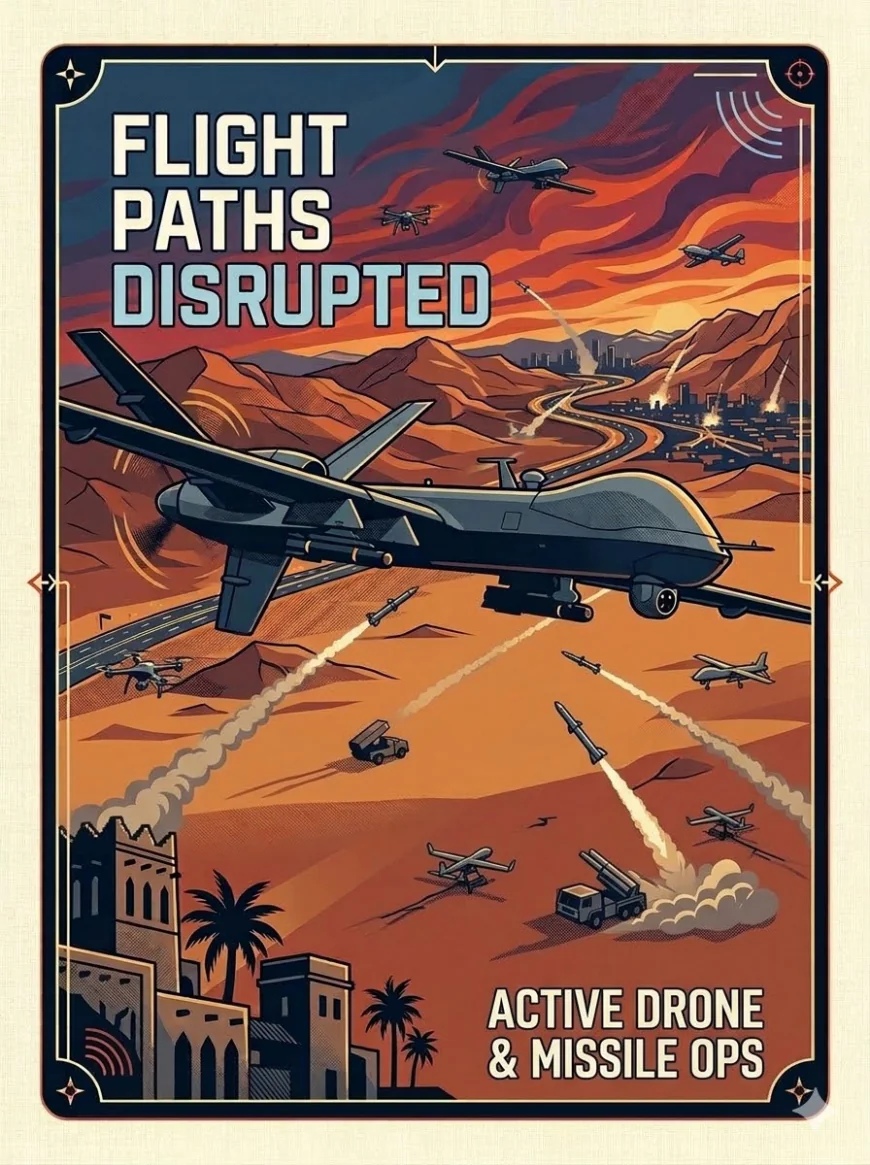
Commercial pilots navigating Middle Eastern airspace are facing unparalleled challenges as drone attacks and missile strikes continue to disrupt flight paths, forcing emergency diversions, triggering airspace closures, and raising critical safety concerns across the region, reports Reuters.
The situation escalated dramatically following "Operation Epic Fury"—the US-Israeli military strikes that began February 28—and subsequent Iranian retaliatory attacks that have transformed one of the world's busiest aviation hubs into a high-risk zone.
Dubai Airport suspends operations
On March 8, Dubai International Airport (DXB), the region's busiest aviation hub, suspended all operations after air defense systems intercepted a drone approaching the airfield. Debris from the downed aircraft fell onto the runway, according to the Dubai government media office.
"The remnants of the drone that was dealt with fell in the airport area, and work is underway to remove them," the statement read, adding that authorities were taking "necessary measures to ensure flight safety."
Emirates Airlines immediately cancelled all flights from noon until midnight, with affected passengers advised not to travel to the airport during the suspension period. Flydubai similarly halted all departures until further notice.
Pilots face impossible choices
Captain Mahmoud Hassan, a veteran Middle Eastern airline pilot with 25 years of experience, described the current reality to the media: "We're constantly monitoring NOTAMs (Notices to Air Missions) that change by the hour. What was safe airspace at takeoff may be closed or contested by landing time. We're diverting flights mid-route, burning extra fuel, and praying our calculations hold."
The psychological toll is equally severe. "Every glint on the radar could be a drone. Every radio silence could be the last. We're trained for emergencies, but not for sustained warfare," Hassan added.
Warplanes crash in Kuwait
The dangers extend beyond commercial aviation. On March 2, multiple American military aircraft crashed in Kuwait as Iranian strikes continued across the Gulf region. Kuwait's Ministry of Defence confirmed that several aircraft were involved, though all crew members survived.
Iranian state television claimed a US F-15 jet was downed over Kuwait because of Iranian air defence fire. CNN analysis of footage showing a jet descending in flames suggested the aircraft was an F-15E Strike Eagle, a twin-engine fighter jet.
Widespread disruptions
According to flight tracking data, approximately 54 international flights to and from Bangladesh were suspended until March 1 noon, with US-Bangla Airlines resuming scheduled services to Saudi Arabia and Oman while maintaining suspensions to UAE and Qatar.
Bahrain International Airport was struck by a drone, causing material damage, while Qatar reported missiles intercepted over Doha. Kuwait, Jordan, and other Gulf states closed their airspace repeatedly.
Industry response
Airlines including British Airways, Lufthansa, and Virgin Atlantic announced flight cancellations to and from the region as a precautionary measure. Flight-tracking maps showed airspace over much of the Middle East virtually empty during peak conflict periods.
The International Air Transport Association (IATA) has called for coordinated international action to protect civilian aviation. "Commercial aircraft are not and must never become targets," an IATA spokesperson said.
Long-Term implications
Aviation safety experts warn that the current crisis could have lasting effects on Middle Eastern aviation. The region's carriers, which built global empires on stability and connectivity, now face a prolonged period of uncertainty.
"Gulf airlines spent decades positioning themselves as the world's super-connectors," said aviation analyst Richard Aboulafia to the media. "That model assumes open skies and safe passage. Both are now in question."
For pilots navigating the world's most contested airspace, each flight has become a calculated risk—one that thousands of passengers take on faith every day.
What's Your Reaction?
 Like
0
Like
0
 Dislike
0
Dislike
0
 Love
0
Love
0
 Funny
0
Funny
0
 Wow
0
Wow
0
 Sad
0
Sad
0
 Angry
0
Angry
0




Comments (0)