

Dubai Airport evacuated after Iranian attack damages terminals
Dramatic footage circulating on social media showed panicked travelers and staff evacuating through hazy corridors, with some individuals visibly injured. A woman was seen running with blood covering her face, while another man fled with a bloodied shirt and a towel pressed against his head to stem bleeding.

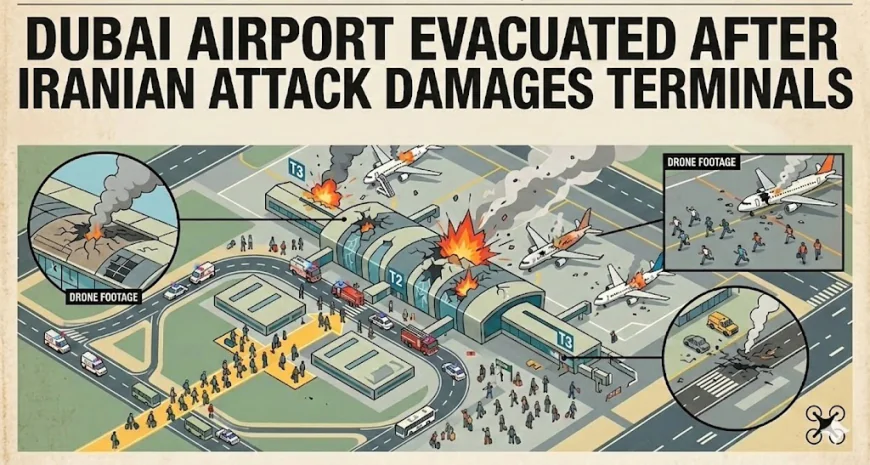
Passengers at Dubai International Airport were required to flee through smoke-filled terminals late Saturday after Iran launched a massive retaliatory missile and drone attack targeting multiple Gulf states, causing significant damage to one of the world’s busiest aviation hubs, report CNN and ABC.
Dramatic footage circulating on social media showed panicked travelers and staff evacuating through hazy corridors, with some individuals visibly injured. A woman was seen running with blood covering her face, while another man fled with a bloodied shirt and a towel pressed against his head to stem bleeding.
Dubai Airports confirmed that a concourse sustained "minor damage" in the incident, which was quickly contained. Four airport employees were injured and received prompt medical attention. Emergency response teams were immediately deployed to manage the situation in coordination with relevant authorities.
Due to pre-established contingency plans, most terminals had been cleared of passengers before the strike occurred. The airport's media office confirmed that operations at both Dubai International and Al Maktoum International airports have been suspended until further notice, urging passengers not to travel to the facilities and to contact airlines directly for updates.
Widespread regional impact
The attack was part of Iran's broader retaliation following US and Israeli strikes that reportedly killed Iranian Supreme Leader Ayatollah Ali Khamenei. Tehran launched 137 missiles and 209 drones toward the Gulf states, most of which were intercepted by defense systems.
Beyond Dubai, Abu Dhabi's Zayed International Airport was struck, resulting in one fatality and seven injuries among airport staff. Dubai's iconic Burj Al Arab hotel also sustained damage when intercepted drone debris sparked a minor fire on its outer facade. The Fairmont hotel on the Palm Jumeirah was directly hit, leaving four people injured and the building in flames. Fires were also reported at Jebel Ali port, which hosts US warships.
Aviation chaos across the region
The attacks triggered unprecedented disruption to regional aviation. Emirates Airlines took the rare step of suspending all flights out of Dubai, rather than just services to conflict zones. Flight-tracking data showed Emirates canceled 492 flights, Flydubai canceled 329, and Etihad Airways canceled 212 flights on February 28 alone.
Bahrain International Airport was also struck by a drone, causing material damage but no casualties. Qatar reported missiles intercepted over Doha, while Kuwait, Jordan, and other Gulf states closed their airspace.
Airlines including British Airways, Lufthansa, and Virgin Atlantic announced flight cancellations to and from the region as a precautionary measure. Flight-tracking maps showed airspace over much of the Middle East virtually empty.
The UAE government confirmed residents that food and essential supplies remain sufficient, with strategic reserves adequate for long-term needs, urging the public not to panic-buy.
What's Your Reaction?
 Like
0
Like
0
 Dislike
0
Dislike
0
 Love
0
Love
0
 Funny
0
Funny
0
 Wow
0
Wow
0
 Sad
0
Sad
0
 Angry
0
Angry
0



Comments (0)