

NASA’s rare Super Guppy aircraft lands in Lakeland
It is the widest in diameter for any cargo aircraft

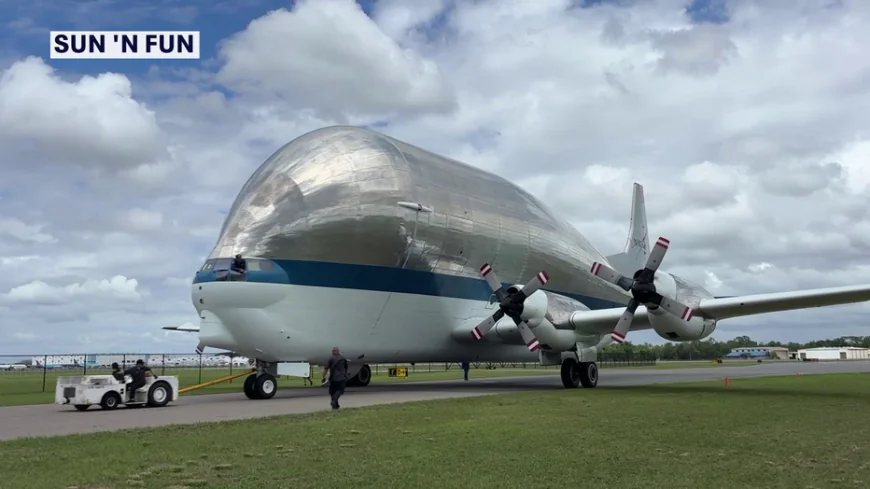
NASA’s iconic Super Guppy, one of the world’s most unique cargo aircraft, touched down at Lakeland Linder International Airport on Wednesday, April 8, ahead of the annual SUN ’n FUN Aerospace Expo, which runs from April 14 to 19, reports Fox 13 News.
The bulbous, wide-bodied aircraft — the largest-volume cargo transporter in the world by internal dimensions — was greeted by aviation enthusiasts as it arrived from Houston Ellington Airport. According to NASA, only four Super Guppy Turbines were ever built, and this aircraft, tail number N941NA, remains in active service supporting America’s space programme.
A flying relic of space history
The Super Guppy traces its origins to the 1960s, when it was developed to carry Saturn rocket stages for the Apollo programme. Today, it continues to transport oversized cargo for NASA, the Department of Defence, and government contractors. In recent years, the aircraft carried the Orion capsule used for Artemis I and the heat shield for Artemis II — the spacecraft that recently orbited the moon.
“It’s the widest in diameter for any cargo aircraft — 25 feet wide and 111 feet long,” said pilot Brett Pugsley. “It can carry the biggest piece of cargo, just not the heaviest”.
A rare appearance
SUN ’n FUN officials said they tried for three years to secure the Super Guppy for the expo. The aircraft’s appearance was made possible in part due to the Lakeland connection of NASA Administrator Jared Isaacman, who founded Draken International, based at the same airport.
Visitors can find the Super Guppy on the “warbird ramp” during the expo. Weather permitting, its unique hinged nose — which opens 110 degrees for frontal cargo loading — will be open for public viewing.
The expo runs April 14–19, featuring daily airshows, the U.S. Air Force Thunderbirds, and presentations by NASA officials.
What's Your Reaction?
 Like
0
Like
0
 Dislike
0
Dislike
0
 Love
0
Love
0
 Funny
0
Funny
0
 Wow
0
Wow
0
 Sad
0
Sad
0
 Angry
0
Angry
0




Comments (0)