

ME conflict puts airfreight demand under pressure
Air cargo has typically benefited during crises, this conflict is putting more pressure on airlines than on ocean shipping, with freight rates already climbing

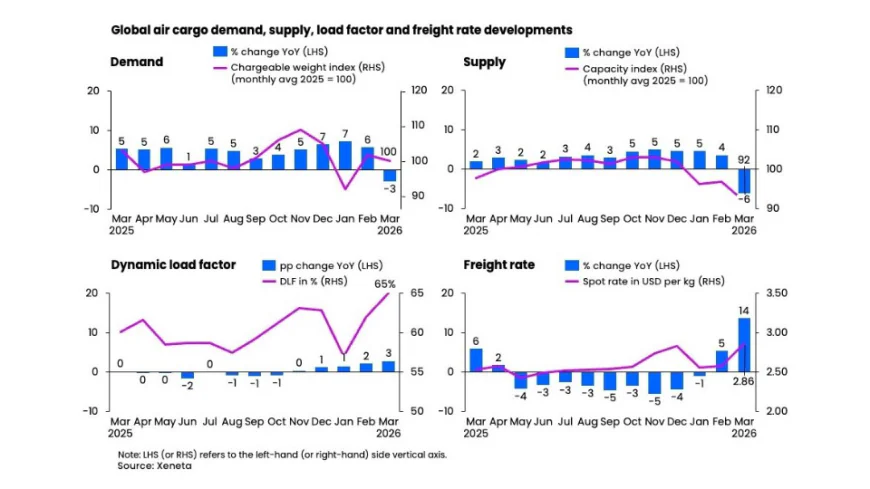
Airfreight demand remains steady for now as shippers continue prioritizing service and market share despite rising costs, according to Xeneta. However, the outlook is uncertain, especially if fuel prices keep increasing.
Industry players are taking a cautious approach, waiting to see how the Middle East situation develops. While air cargo has typically benefited during crises, this conflict is putting more pressure on airlines than on ocean shipping, with freight rates already climbing.
Global air cargo demand fell 3 percent year-on-year in March, while capacity dropped 6 percent, pushing utilization levels higher. Spot rates have risen sharply, particularly on routes from South and Southeast Asia to the Middle East, driven by limited capacity, higher fuel costs, and war-risk surcharges.
The disruption is spreading beyond the region, affecting major trade lanes between Asia, Europe, and the Americas. However, some routes, such as Europe–North America, have seen rate declines due to increased capacity.
In the short term, airfreight may see temporary gains as supply chains adjust. But if the conflict continues and fuel prices remain high, demand could weaken as broader economic pressures build.
Ultimately, the long-term impact on air cargo will depend on how prolonged the conflict is and its effect on the global economy.
What's Your Reaction?
 Like
0
Like
0
 Dislike
0
Dislike
0
 Love
0
Love
0
 Funny
0
Funny
0
 Wow
0
Wow
0
 Sad
0
Sad
0
 Angry
0
Angry
0




Comments (0)