

Artemis II astronauts return safely after historic Moon mission
Milestone mission paves the way for human return to the Moon by 2028

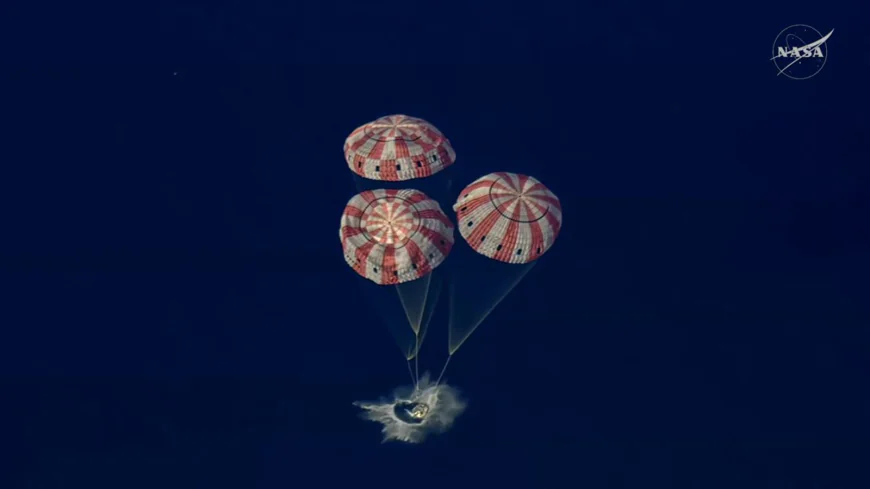
The crew of Artemis II safely returned to Earth on Friday, completing a nearly 10-day journey that marked humanity’s first crewed mission to the vicinity of the Moon in more than 50 years.
The gumdrop-shaped Orion capsule, named Integrity and built by Lockheed Martin, splashed down in the Pacific Ocean off the coast of Southern California shortly after 5 p.m. local time, following a high-speed re-entry through Earth’s atmosphere, reports Reuters.
The spacecraft carried four astronauts-Reid Wiseman, Victor Glover, Christina Koch, and Jeremy Hansen-who were later recovered by teams from NASA and the U.S. Navy.
The mission covered approximately 694,000 miles, including two Earth orbits and a lunar flyby that took the crew more than 252,000 miles from Earth-the farthest distance humans have traveled in space, surpassing a record set during the Apollo 13 mission.
Re-entry proved to be one of the most critical phases, as the capsule endured extreme heat reaching nearly 5,000 degrees Fahrenheit. During this period, a plasma layer temporarily disrupted communications before contact was restored and parachutes deployed, slowing the capsule for a controlled ocean landing.
The successful return marks a major milestone for the Artemis programme, validating the Orion spacecraft’s ability to safely carry humans on deep-space missions. It follows the uncrewed Artemis I test flight and sets the stage for future missions aimed at landing astronauts on the Moon as early as 2028.
Launched on April 1 aboard NASA’s Space Launch System rocket from Cape Canaveral, the mission also marked several historic firsts, including the participation of the first woman, the first Black astronaut, and the first non-U.S. astronaut in a lunar mission.
NASA officials said the mission represents a crucial step toward establishing a sustained human presence on the Moon and advancing long-term plans for human exploration of Mars.
What's Your Reaction?
 Like
0
Like
0
 Dislike
0
Dislike
0
 Love
0
Love
0
 Funny
0
Funny
0
 Wow
0
Wow
0
 Sad
0
Sad
0
 Angry
0
Angry
0





Comments (0)