

Asia flight chaos strands travellers across three key hubs
The flight tracking and schedule data for early April indicate that Jakarta’s Soekarno-Hatta International Airport, Chengdu’s main airport system and Tokyo’s dual-airport gateway have become flashpoints for disruption affecting connections across Asia and beyond


Travellers across Indonesia, China and Japan face mounting disruption, with operational data pointing to at least 51 cancellations and 143 delays linked to Batik Air, Chengdu Airlines and ANA Wings at the key hubs of Jakarta Soekarno-Hatta, Chengdu and Tokyo, leaving passengers stranded and rippling through regional and long-haul networks.
Jakarta, Chengdu and Tokyo emerge as disruption hotspots
Aggregated flight tracking and schedule data for early April indicate that Jakarta’s Soekarno-Hatta International Airport, Chengdu’s main airport system and Tokyo’s dual-airport gateway have become flashpoints for disruption affecting connections across Asia and beyond. As critical transfer nodes for domestic and international travel, even modest irregular operations quickly create a domino effect, leading to missed onward flights and overcrowded terminals.
Publicly available operational summaries show services run by Indonesia’s Batik Air, China’s Chengdu Airlines and Japan-based ANA Wings account for a notable share of today’s (Saturday) disruption, with at least 51 flights cancelled and 143 delayed across combined networks. While only a slice of daily operations, the timing—during peak travel periods—has magnified the fallout for passengers connecting across borders.
Aviation data providers report knock-on effects as aircraft and crews fall out of position, where tight turnaround windows leave little room to manoeuvre. In Jakarta, one of Southeast Asia’s busiest domestic hubs, minor morning delays have snowballed into longer waits later in the day, affecting Batik Air and other carriers sharing the same infrastructure.
In China, disruption centred on Chengdu has collided with heavy domestic demand and international links to Southeast Asia, Europe and the Middle East. In Japan, ANA Wings operations feeding Tokyo’s Haneda and Narita airports have struggled with punctuality, spilling into the wider All Nippon Airways network and complicating recovery efforts.
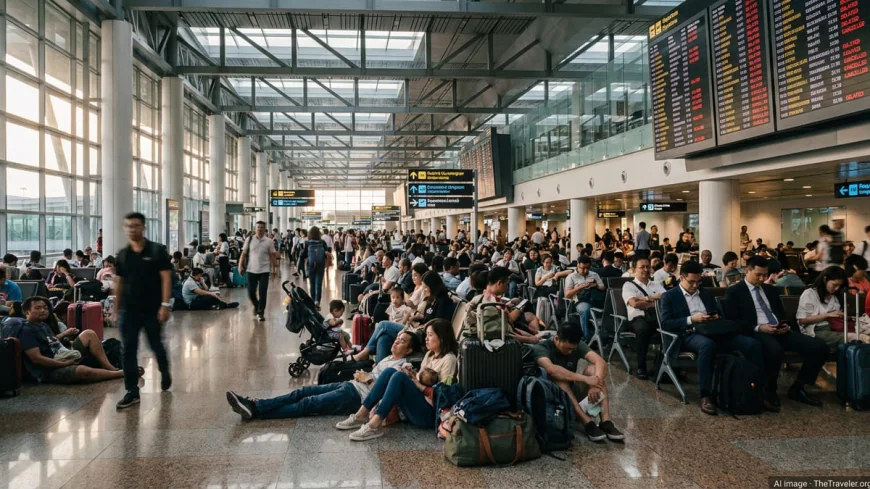
Stranded passengers of cancelled flights leisurely wait for the latest update at Soekarno-Hatta International Airport in Jakarta, Indonesia, on February 21. Photo: Global Travel News
Weather, congestion and tight turnarounds drive latest wave
Although no single trigger has been identified as the sole cause of the latest spike, weather constraints, airport congestion and tight aircraft turnarounds appear central. Recent coverage highlights bands of poor weather sweeping across East and Southeast Asia, reducing runway capacity and forcing ground stops or holding patterns at major airports.
At Jakarta Soekarno-Hatta, where Batik Air is a key operator, heavy traffic and intermittent thunderstorms have repeatedly slowed arrivals and departures, making it difficult for airlines to recover lost time. Analysts note that as carriers pack more rotations into daily schedules, minor morning disruption can ripple through the day.
Chengdu’s airport system, a major domestic and international hub for western China, faces similar pressures. When storms or low visibility reduce capacity, Chengdu Airlines must juggle packed domestic routes with international services linked to onward connections in Beijing, Shanghai, Southeast Asia and Europe. Recent cancellations and delays suggest some flights are being proactively cut to stabilise schedules.
Tokyo’s Haneda and Narita airports have also contended with high demand and intermittent weather issues. Operational data and media reporting indicate ANA Wings and other domestic operators have absorbed much of the strain, as delays to short-haul sectors feeding the capital disrupt tightly timed connections for travellers to regional cities or international gateways. This has resulted in some passengers missing onward flights despite arriving within what would normally be safe connection windows.
Passengers confront long queues, missed connections, limited options
For travellers, disruption means missed holidays, delayed business trips and overnight stays. Jakarta, Chengdu and Tokyo show long queues as passengers seek rebooking after cancellations and delays.
Batik Air passengers are re-routed to later flights or other carriers, but international travellers face tougher rebooking when long-haul services run infrequently.
Chengdu Airlines cancellations increased crowding at Chengdu terminals. With domestic routes near capacity, same-day alternatives are limited, forcing overnight waits. Separate-ticket passengers are most exposed.
ANA Wings disruptions spill into long-haul itineraries. Passengers connecting through Haneda or Narita missed flights and rushed transfers, some rebooked onto next-day departures when seats are unavailable.
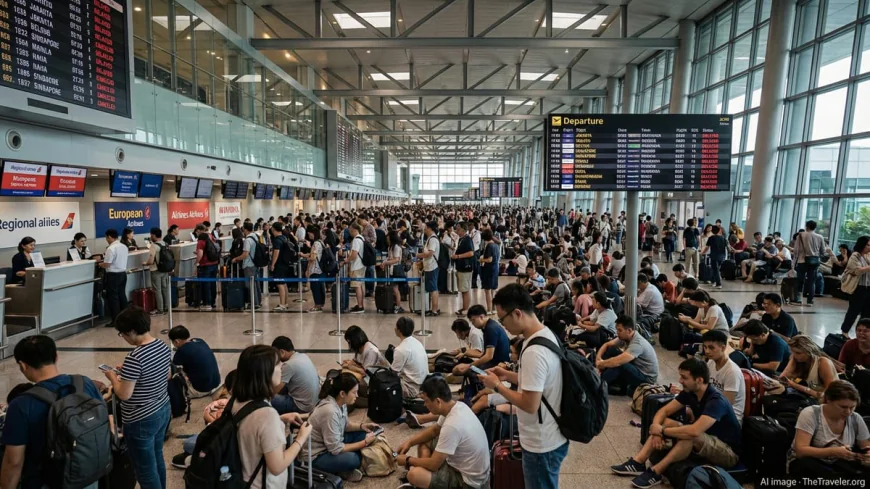
An AI-illustrated image of stranded passengers at Chengdu airport in China. Courtesy: TheTraveler.org
What travellers can do if their flight is affected
Travellers Jakarta, Chengdu and Tokyo guidance stresses preparation. Passengers should monitor flight status 24 hours before departure and check all segments, especially separate tickets or mixed carriers.
Urge review airline policies on delays and cancellations. Many carriers outline eligibility for rebooking, meals or hotel accommodation. Boarding passes and receipts essential.
Longer connection times advised at high-risk hubs. Earlier flights can provide recovery options, avoiding tight self-connections reduces missed onward travel.
Travel insurers stress cover for delays and missed connections though exclusions for weather and operational decisions often apply. Check policy conditions.
Lingering fragility across wider Asian network
The disruption in Jakarta, Chengdu and Tokyo underlines a broader fragility across parts of Asia’s aviation network. Recent analysis by industry data firms and media outlets points to rising delay rates at major hubs across China, Japan, South Korea, India and Southeast Asia as airlines rebuild capacity and adjust to shifting demand.
Congestion, crew and aircraft positioning challenges, and the complex interdependence of regional and long-haul operations continue to test schedule resilience. When one hub falters, the knock-on effects can spread quickly, as aircraft and crews arrive late or are reassigned, triggering last-minute timetable changes.
Carriers such as Batik Air, Chengdu Airlines and ANA Wings, which rely heavily on dense domestic or short-haul networks through a handful of key hubs, are particularly vulnerable. Their current performance in Jakarta, Chengdu and Tokyo shows how a cluster of delays at a single airport can affect thousands of passengers, as disruption feeds into already stretched systems.
With demand for air travel across Asia expected to remain strong in the months ahead, airlines and airports face mounting pressure to improve punctuality and bolster contingency plans. For passengers, the latest turmoil is a timely reminder that while aviation may be back in full swing, reliability can still hang by a thread, especially when weather and congestion collide at major gateways.
What's Your Reaction?
 Like
0
Like
0
 Dislike
0
Dislike
0
 Love
0
Love
0
 Funny
0
Funny
0
 Wow
0
Wow
0
 Sad
0
Sad
0
 Angry
0
Angry
0





Comments (0)