

Polghata Bridge: A unique Mughal-era heritage in Munshiganj
Polghata Bridge, a rare Mughal-era structure built of brick and surki, located at Panam Polghata village under Rampal union under Munshiganj Sadar upazila, is about 8 km from Munshiganj town and connects the Sadar area with Tongibari upazila
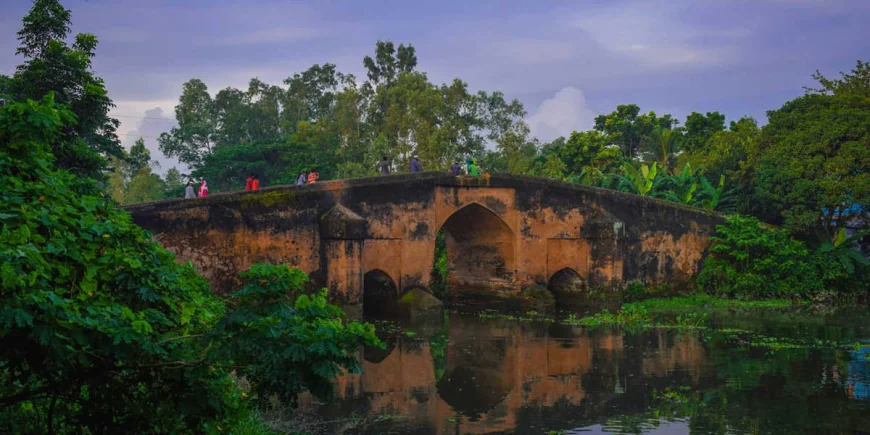
The historic region of the present-day Munshiganj district, once part of ancient Bengal’s Srivikrampur city, is rich in culture and tradition. The area contains many ancient monuments, artefacts, antiquities and rarities that reflect its long and varied history.
Among them is Polghata Bridge, a rare Mughal-era structure built of brick and surki (morter), located in Panam Polghata village under Rampal union in Munshiganj Sadar upazila. The bridge is about eight kilometre from Munshiganj town and connects the Sadar area with Tongibari upazila.
Locals also call it Mirkadim Bridge, as it stands over the Mir Kadim canal, which once marked the boundary moat of the Bikrampur region. The 52.42-metre-long arched bridge has three openings that allow boats to pass underneath. The central opening is larger than the two side passages. The bridge is currently under the supervision of the Department of Archaeology, Bangladesh.
The Polghata Bridge is believed to be linked with Panam City in Sonargaon, Narayanganj, and dates back to the Mughal period. A similar structure, known as the Panam Nagar Bridge, exists in Dulalpur, west of Panam City.
Locals say the bridge is also connected to memories of the Liberation War. Freedom fighters reportedly set up a camp around the area, using it for planning resistance against Pakistani forces. There were also direct clashes near the bridge. It is further said that Pakistani forces carried out a massacre at the nearby house of Tokani Pal.
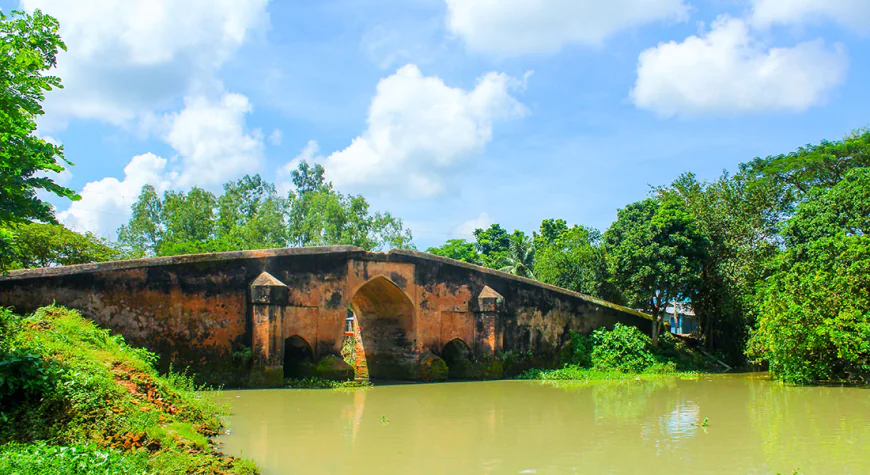
Under the protection of Department of Archaeology in 2006, was subsequently restored, and warning notices were installed on both sides. Photo: Sabbir Ahmed Amir
According to the Department of Archaeology, the bridge was brought under protection in 2006. It was later restored and warning signs were installed on both sides, stating that damaging the structure or writing on it is a punishable offence.
However, during a recent visit, the warning signs were not visible. Writing in lime and soot was seen on the railings. Parts of the southern wall have collapsed, and the lime-surki plaster on the lower sections is badly damaged. A brick and sand business is operating next to the bridge. Several shop structures are also being built about 10 yards from the southern end of the bridge, although construction work is currently halted.
The brick business is run by Kalim Mia from the Hatmara area of Rampal Union. He said, “I have bought this land. I am carrying out my business on my own property.” Abul Kalam from the Jorardeul area has also built shop structures near the bridge, but he could not be reached for comment.
Professor Sufi Mostafizur Rahman of Jahangirnagar University’s Department of Archaeology said the current condition of the bridge reflects neglect. He stressed the need to raise public awareness about the value of such heritage sites and said the government must help build respect for historical monuments.
Md Ataur Rahman, director of the Dhaka region of the Department of Archaeology, said the bridge was restored after being protected in 2006. However, repeated collisions from boats passing underneath have caused damage to both sides of the structure.
He added that he was not aware of the brick business nearby. Regarding the construction work, he said officials had stopped it after receiving reports and would visit the site soon. He also said a proposal would be made for funding in the next fiscal year for further restoration work.
How to go
Dhaka is about 26 km from Munshiganj district. Regular bus services are available from Gulistan to Munshiganj. From Munshiganj town, Polghata Bridge can be reached by autorickshaw or CNG.
What's Your Reaction?
 Like
0
Like
0
 Dislike
0
Dislike
0
 Love
0
Love
0
 Funny
0
Funny
0
 Wow
0
Wow
0
 Sad
0
Sad
0
 Angry
0
Angry
0

I am a journalist
Comments (0)