Rajshahi Novo Theatre struggles to attract visitors
The Novo Theatre was established to foster a science-minded generation and increase public interest in space and astronomy
 ATT Desk Report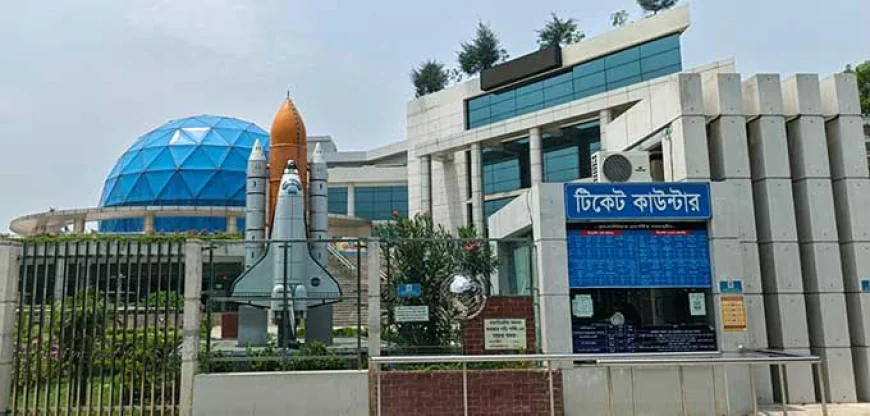
The Novo Theatre in Rajshahi was established to foster a science-minded generation, increase public interest in space and astronomy, and create opportunities for students to receive modern science education.
Nearly Tk 371 crore was spent on building this state-of-the-art science facility, one of the largest and most modern of its kind in Bangladesh, reports state news agency BSS.
However, more than three years after its launch, the institution has failed to attract the expected number of visitors.
A shortage of visitors, inadequate manpower and limited promotion have left this major science centre in northern Bangladesh operating far below its potential.
The situation has reached a point where monthly revenue is insufficient to cover regular operating expenses.
Approximately Tk 17 lakh in electricity bills has accumulated in arrears. Authorities, however, say necessary steps have already been taken to clear the outstanding payments.
Sources familiar with the matter said construction of the modern Novo Theatre began in 2018 in front of the Central Park in Rajshahi city.
Initially, the project cost was estimated at Tk 232 crore, but with land acquisition, infrastructure development and other expenses, the total cost rose to nearly Tk 371 crore.
The vast complex includes a 200-seat multipurpose hall, a 60-seat seminar and conference room, a modern scientific library, a Novo cafeteria, a snack bar, parking facilities for 85 vehicles, the country's largest dome-shaped planetarium, a cutting-edge 5D theatre, advanced observation telescopes and various science-based exhibition facilities.
The planetarium is the institution's main attraction, using advanced technology to present information about space, planets, stars, the solar system and the universe.
It was expected to play a significant role in making science education more engaging and practical for students. In reality, however, much of that potential remains unrealised.
Officials say many of the technology-based facilities and exhibitions cannot be operated fully because of a shortage of trained manpower.
Although the Ministry of Labour and Employment approved 19 positions for the institution, only two permanent officers are currently employed.
The remaining responsibilities are being handled by personnel deputed from other departments.
The most acute shortage is among operators. While seven operators are needed, only two are currently on duty.
As a result, although there are plans to run an average of five shows daily, most days only one or two shows can be conducted. Scheduled shows are sometimes cancelled altogether.
According to the authorities, the lack of regular exhibitions is dampening visitor interest. Each show attracts only around 10 to 15 viewers on average.
Many visitors travel long distances only to return disappointed when they are unable to watch the desired planetarium show or other exhibitions.
The institution is also facing financial challenges.
According to Novo Theatre authorities, total revenue in the 2024-25 fiscal year was about Tk 48 lakh, while expenditure amounted to approximately Tk 65 lakh, leaving a deficit of around Tk 17 lakh.
Revenue has improved somewhat during the current 2025-26 fiscal year, reaching approximately Tk 75 lakh, while expenditure stood at about Tk 55 lakh. Nevertheless, previous dues and ongoing operational costs continue to create financial pressure.
Currently, electricity bills worth around Tk 17 lakh remain unpaid. In addition, the institution must regularly cover salaries and allowances for officers and staff, security expenses for Ansar personnel, cleaning services, maintenance, water bills and other operational costs.
Visitors and local residents have complained that such a modern science centre, built at a cost of hundreds of crores of taka in a divisional city like Rajshahi, has not been utilised properly.
Many believe the situation could have been different had adequate promotion and public engagement initiatives been undertaken from the outset.
Several students and parents in Rajshahi city said many school and college students are not even aware that regular science exhibitions and planetarium shows are held there.
They suggested that collaboration with educational institutions, along with special educational tours, science workshops and student packages, could significantly increase visitor numbers.
Deputy Director Ebadat Hossain said, "We have taken various initiatives to increase visitor numbers. We are contacting different schools and colleges. There is much for students to learn here. They have opportunities to gain practical knowledge about space, planets, stars and science.
"If we could obtain a dedicated transport system, more students from educational institutions would be able to visit."
He added, "Our revenue has increased this year compared to last year. Promotional activities are being carried out to attract more visitors. We currently have around Tk 17 lakh in outstanding electricity bills, and steps have been taken to settle those dues as well."