

India succeeds in first private rocket launch
Skyroot’s Vikram-1 rocket lifted off on Saturday, carrying customer payloads and in-orbit experiments on its first orbital mission

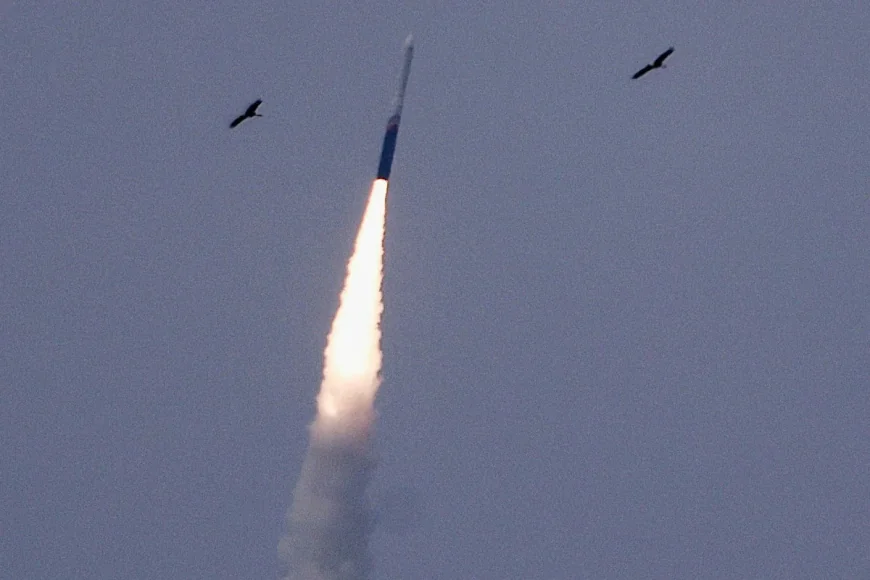
India’s first privately developed orbital rocket, Vikram-1, built by Skyroot Aerospace, successfully launched on Saturday from Sriharikota, carrying customer payloads into a 450-km orbit. The mission, named ‘Aagaman’, marked India as the third country after the US and China to achieve orbital launch capability through private enterprise, reports the South China Morning Post.
The feat drew widespread praise, including from Prime Minister Narendra Modi and opposition leader Rahul Gandhi. Skyroot’s co-founder Pawan K Chandana called it a dream come true, noting the team’s average age was just 28. However, experts caution that a single success does not guarantee commercial viability. Space analyst Ajay Lele said Skyroot must conduct one or two more flawless launches before the system is declared operational and ready to attract global customers.
Skyroot’s achievement stands out, especially since Japanese firms have recently failed in similar attempts. But the competitive landscape is brutal. Elon Musk’s SpaceX dominates the small-satellite launch market with rideshare programme, having sent thousands of satellites into orbit. To compete, Skyroot must prove it can offer regular, reliable, and low-cost launches critical factors for customers seeking dedicated missions to precise orbits.
India opened its space sector to private investment in 2020, and now hosts over 400 space start-ups. The government aims to expand the country’s space economy from $8.4 billion to $44 billion by 2033. Skyroot is positioning itself as a ‘space taxi’ for small satellites, with 70–80% of future demand expected from overseas markets like the US, Europe, and Southeast Asia.
The company is also using new technologies like carbon composites and 3D printing to cut costs. While India has long been known for its frugal space programme, experts note that private firms must now build clear profit models. Still, early revenues from components are already flowing in, and a successful launch cadence could generate millions per mission.
Beyond commerce, a proven private launch capability boosts India’s strategic autonomy and supports self-reliance in defence technology. Dr Satya Gupta of the VLSI Society of India said the success of SpaceX and Starlink has opened vast potential, driving demand for semiconductors and sensors in India’s space supply chain.
While Skyroot’s debut is a historic first step, analysts stress that turning this proof point into a sustainable business will require consistency, cost competitiveness, and customer trust in a crowded global market.
What's Your Reaction?
 Like
0
Like
0
 Dislike
0
Dislike
0
 Love
0
Love
0
 Funny
0
Funny
0
 Wow
0
Wow
0
 Sad
0
Sad
0
 Angry
0
Angry
0



Comments (0)