Seven air routes used for trafficking in Bangladeshis
Young people are being trafficked from Bangladesh to various countries in Europe, America, Australia, Russia or Southeast Asia under the guise of tourist, education and work visas
 ATT Desk Report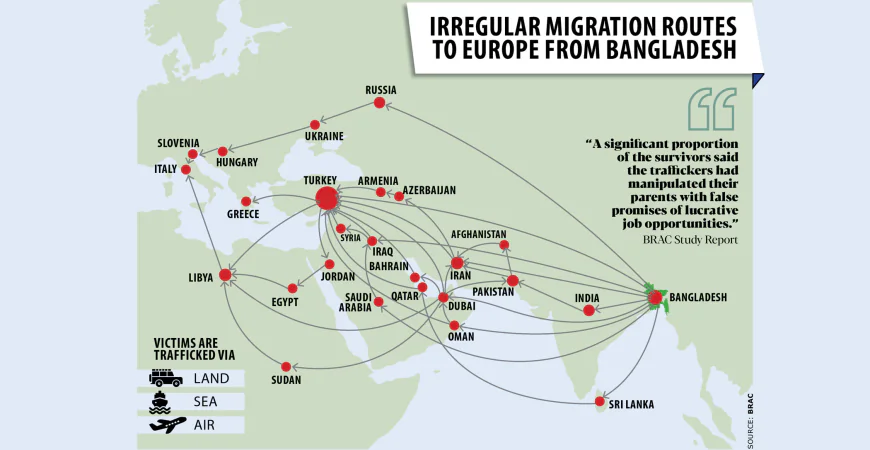
Cambodia and Laos in Southeast Asia have emerged as new hubs for human trafficking. Victims are first taken from Bangladesh to Thailand and then to Cambodia or Laos, reports vernacular daily Bonik Barta.
While promises of so-called 'online jobs' or 'customer service' work are made, many end up trapped in cyber scam centres. They are forced into online fraud, gambling, or financial scams. Those who try to escape face torture. Additionally, countless people are being pushed towards death through risky sea journeys.
This information comes from a report by the Criminal Investigation Department (CID), the specialised police unit working on human trafficking.
According to CID information, seven major international destinations are currently active for human trafficking by air. These include Italy, Serbia/Macedonia, Russia, America, Canada, Australia, and Cambodia/Laos. It is alleged that some local recruiting agencies, travel agencies, and broker gangs are involved in these activities.
The accused gangs lure victims with promises of attractive salaries in various countries. They then take their passports and send them abroad under the cover of legitimate documents. First, tourist, education, or work visas are arranged. Then, victims are taken via transit through a third country to the final destination to avoid direct surveillance by the destination country.
New trends are also seen in routes trafficking to the USA and Canada. For those headed to the USA, attempts are made to cross the border via Brazil first, then Mexico. Recently, the use of South America as a transit point has increased because on-arrival facilities or relatively weak immigration systems in many countries provide opportunities for traffickers.
Furthermore, the trend of using education and tourist visas for routes to Canada is increasing. Victims are taken from Bangladesh to a third country like Nepal first, and then sent to Canada.
Investigators involved in human trafficking cases state that the Italy route is currently one of the most complex and longest. Traffickers from Bangladesh first send victims to Nepal, India, or Sri Lanka, then to the Middle East. Afterwards, via Egypt, Tunisia, or Libya, they finally reach Italy. Countless youths have lost their lives attempting the sea crossing.
In many cases, victims are forced to cross deserts and the Mediterranean Sea, where the risk of death is extremely high. Multiple fake travel documents, forged visas, and local broker gangs are active along the way.
On Australia route, attempts are made to enter via Malaysia, then Indonesia, by sea. Often, mixed routes combining air and water are used. Hundreds of people are loaded onto small boats or fishing trawlers on this journey. Many go missing or die due to lack of food and safety.
On the other hand, for the Russia route, CID reports that victims are taken from Bangladesh via Saudi Arabia to Russia. The report notes that the trend of sending people to war zones has also alarmingly increased recently.
According to statistics from the CID's Human Trafficking Unit, the number of cases and arrests has consistently increased from 2022 to 2025. Over the past few years, the Trafficking in Human Trafficking (THB) Prevention Unit has arrested a total of 344 accused. In 2025, information showed a maximum of 122 cases under investigation or registered. Earlier, there were 100 cases in 2024 and 86 cases in 2023.
Crime analysts state that the trial proceedings for most human trafficking cases in various courts are progressing slowly. Investigating officers are unable to complete investigations on time due to difficulties in gathering case materials, evidence, and proof.
Although the Human Trafficking Prevention Act stipulates that charges should be framed within 90 working days and trials completed within 180 working days for cases filed under it, delays in investigation prevent timely justice. Consequently, case proceedings linger for years.
Bangladeshis are most frequently trafficked to India, Malaysia, Thailand, Greece, Italy, Cyprus, Saudi Arabia, Qatar, Oman, Iraq, Bahrain, and Libya. Remittance earners going to these countries for work fall victim to various frauds. They lose everything in the trap of deception and return home to seek legal recourse.
A CID official involved in human trafficking investigations said, "Human trafficking is now a transnational crime. No single country can combat it alone. Without information exchange and joint investigations, breaking large gangs is difficult. Human traffickers are now technology-dependent and internationally organised.