

Third terminal deal likely tomorrow: State minister
Civil Aviation and Tourism Minister Afroza Khanam Rita and Millat held a meeting with the Japanese envoy at the Secretariat

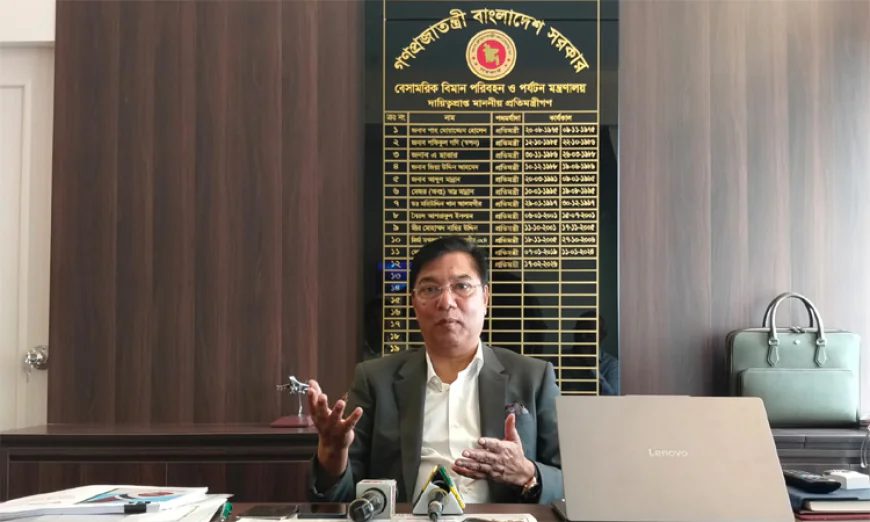
State Minister for Civil Aviation and Tourism M Rashiduzzaman Millat on Thursday said the long-awaited deal over Hazrat Shahjalal International Airport’s third terminal is likely to be finalised at a high-level meeting scheduled for tomorrow (Friday).
He expressed optimism that remaining financial issues have largely been resolved and that Japan has indicated support for moving the process forward, report BSS.
“I am hopeful that we would be able to reach a conclusion about the deal tomorrow,” Millat said.
He said Civil Aviation and Tourism Minister Afroza Khanam Rita and her deputy held a meeting with the Japanese Ambassador at the Secretariat earlier in the day, where key financial gaps in the proposal were discussed.
According to him, the ambassador showed understanding of the issues and assured efforts to engage the Japanese consortium and relevant authorities to reach a resolution.
Millat said the third terminal had remained largely inactive for about a year and a half during the interim government period, delaying operations of several foreign airlines in Bangladesh.
He added that if consensus is reached in tomorrow’s meeting, it may take around three months to sign the final agreement. The terminal could then be inaugurated by the end of this year or between January and February 2027.
The final negotiation meeting is scheduled for 3:00 pm tomorrow at the Ministry of Foreign Affairs, involving senior representatives from both Bangladesh and Japan, including officials from the Japan International Cooperation Agency (JICA) and a Japanese consortium comprising Japan Airport Terminal Company, Sumitomo Corporation, Sojitz Corporation, and Narita International Airport Corporation.
The third terminal project, largely financed by JICA and built at an estimated cost of Tk 21,398 crore, is designed to handle 12 to 16 million additional passengers annually and nearly 900,000 tonnes of cargo.
What's Your Reaction?
 Like
0
Like
0
 Dislike
0
Dislike
0
 Love
0
Love
0
 Funny
0
Funny
0
 Wow
0
Wow
0
 Sad
0
Sad
0
 Angry
0
Angry
0



Comments (0)