

Key points from Iran-US Switzerland talks
The ongoing fighting between Israel and Hezbollah in Lebanon was at the top of the agenda in the talks with the United States, alongside issues such as frozen Iranian assets and Iranian oil exports
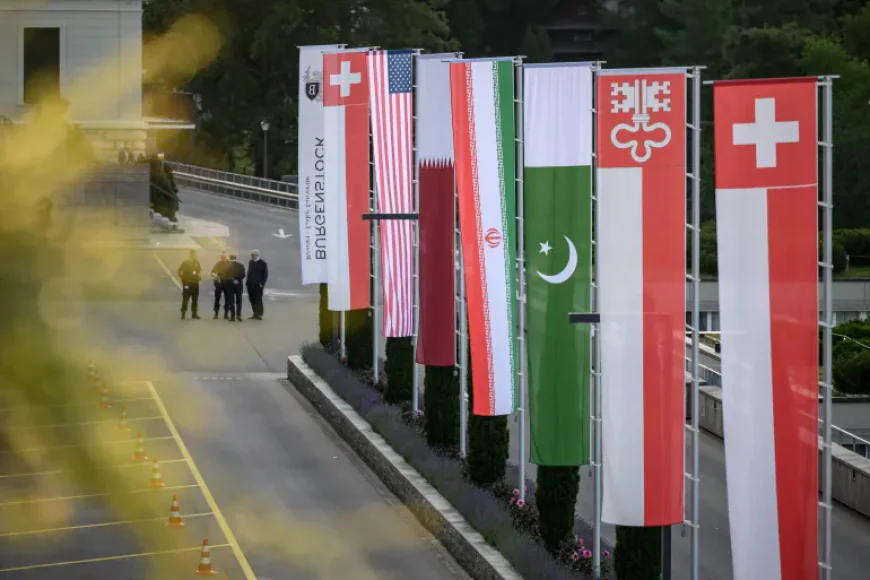
Key points from the Iran-US talks in Switzerland centred on the establishment of three technical working groups on nuclear issues, sanctions and monitoring, conditional on the prior implementation of a ceasefire and the lifting of the naval blockade.
In a diplomatic development that could mark a turning point in regional and international dynamics, Sunday's multilateral talks at the Burgenstock estate in Switzerland focused on implementing the provisions of the preliminary understanding and determining practical mechanisms to address future demands. The discussions came after a memorandum of understanding on ending the war between Iran and the United States was recently signed by the presidents of the two countries, reports Iranian media outlet Mehr News Agency.
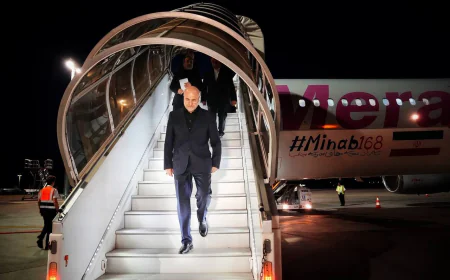
Against the backdrop of a sensitive and volatile situation in Lebanon caused by Israeli ceasefire violations, the five key points in a statement issued by the Media Committee of the "Minab 168" negotiating delegation (the Iranian team) provide a clear picture of the achievements and the way forward in these crucial talks.
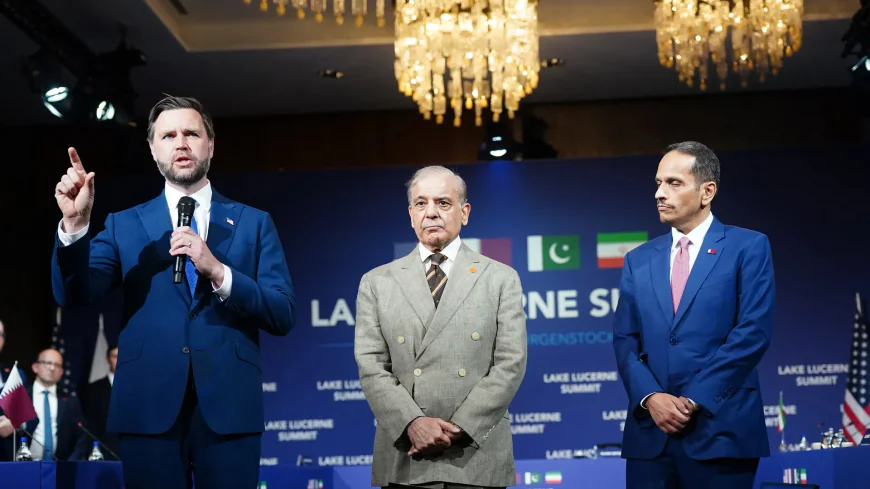
Vice President JD Vance, Pakistani Prime Minister Shehbaz Sharif and Qatari Prime Minister Sheikh Mohammed bin Abdulrahman bin Jassim Al-Thani at Lake Lucerne, near Stansstad, Switzerland, on Sunday. Photo: Nathan Howard-Pool/Getty Images
According to the Media Committee of the "Minab 168" negotiating delegation, the key points from Sunday's multilateral talks are as follows:
1. Due to pressure exerted by the Iranian negotiating delegation since Saturday evening, the fragile cessation of hostilities in Lebanon is currently being maintained. To stabilise the situation, a monitoring mechanism called the conflict control unit will be established with Iran's participation. Through this mechanism, the Islamic Republic of Iran will effectively and officially become part of Lebanon's security framework, whereas in recent months the Americans had made considerable efforts to exclude Iran from Lebanon's affairs. The Israeli regime will have no role in this mechanism.
2. Regarding the management of the Strait of Hormuz and guaranteeing its gradual reopening, it was agreed that a contact line would be established so the other side could contact Iran in the event of implementation issues and communicate any possible problems. This development signifies the consolidation of Iran's sovereignty over the Strait of Hormuz.
3. The three working groups on nuclear issues, sanctions and monitoring, which are to be formed under the statement, will begin their work after the implementation of clause 13 of the memorandum of understanding starts. This includes a ceasefire on all fronts, particularly in Lebanon, the beginning of the lifting of the naval blockade, the release of Iran's blocked assets, and the issuance of waivers for the removal of sanctions on oil, petrochemicals and related products. In effect, before the implementation of clause 13, the Islamic Republic will not enter the final stage of negotiations.
4. During this round of talks, a memorandum of understanding on the release of Iran's blocked assets was also signed between Iran and Qatar.
5. During the Switzerland talks, based on clause 10 of the memorandum of understanding, the US Treasury Department's Office of Foreign Assets Control (OFAC) issued documents allowing the removal of sanctions on oil, petrochemicals and related products for a period of 60 days. This means Iran can officially sell oil to its customers and receive payment through the official mechanisms of the Central Bank.
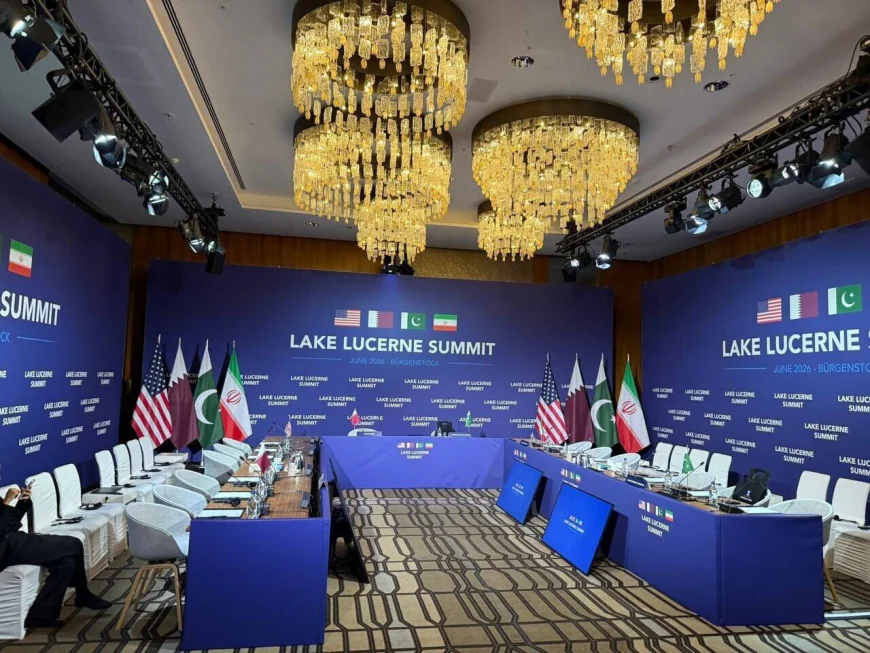
The conference room at the Buergenstock resort at Obbuergen city in Switzerland where the US-Iran peace talks kicked-off on Sunday. Photo: Iran International
Mediators push Iran-US talks forward
Meanwhile, Tehran Times reported that Pakistani Prime Minister Shehbaz Sharif, accompanied by Chief of Defence Forces (CDF) Field Marshal Asim Munir, is leading the mediation effort alongside Qatari Prime Minister Sheikh Mohammed bin Abdulrahman Al Thani.
Upon arriving at the venue earlier on Sunday, Ghalibaf held separate meetings with the Qatari and Pakistani mediators before leading his delegation into the four-party talks later in the day with US representatives.
Araghchi also met separately with his Swiss counterpart on Sunday morning.
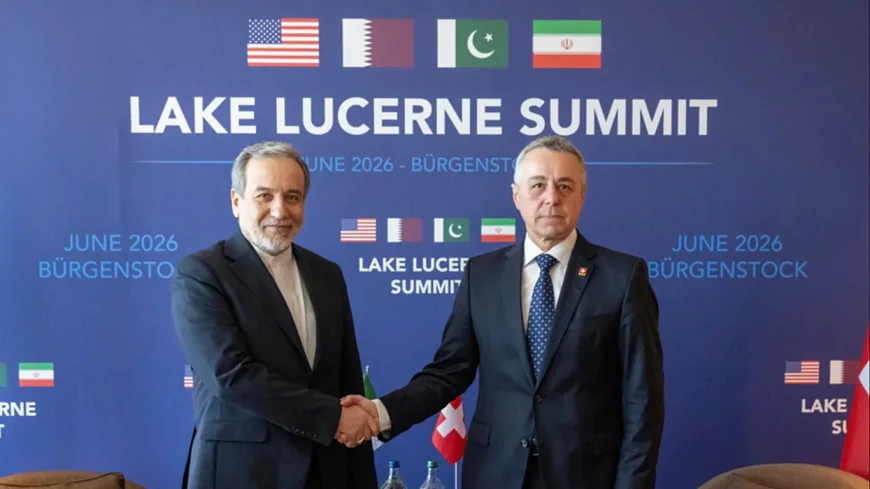
Iranian Foreign Minister Abbas Araghchi and Swiss Foreign Minister Ignazio Cassis shake hands at the Lake Lucerne Summit in Burgenstock, Switzerland. Photo: Reuters
Iran wants action, not handshakes
Organisers and the US side had planned a joint photo opportunity, including a handshake between members of the Iranian and American delegations, before the start of the meeting. However, the Iranian delegation rejected the proposal and informed organisers that it would not participate in any joint media appearance with US officials. The move underscored Tehran's preference for substantive negotiations over symbolic gestures, avoiding images that could be used to suggest diplomatic progress regardless of the talks' actual outcome.
Esmaeil Baghaei, spokesperson for the Iranian delegation, said the ongoing fighting between Israel and Hezbollah in Lebanon was at the top of the agenda in the talks with the United States, alongside issues such as frozen Iranian assets and Iranian oil exports.
"The Zionist regime continues to violate its commitments in Lebanon. This issue will be the main topic of discussion in today's talks," Baghaei said in a video shared by IRNA.
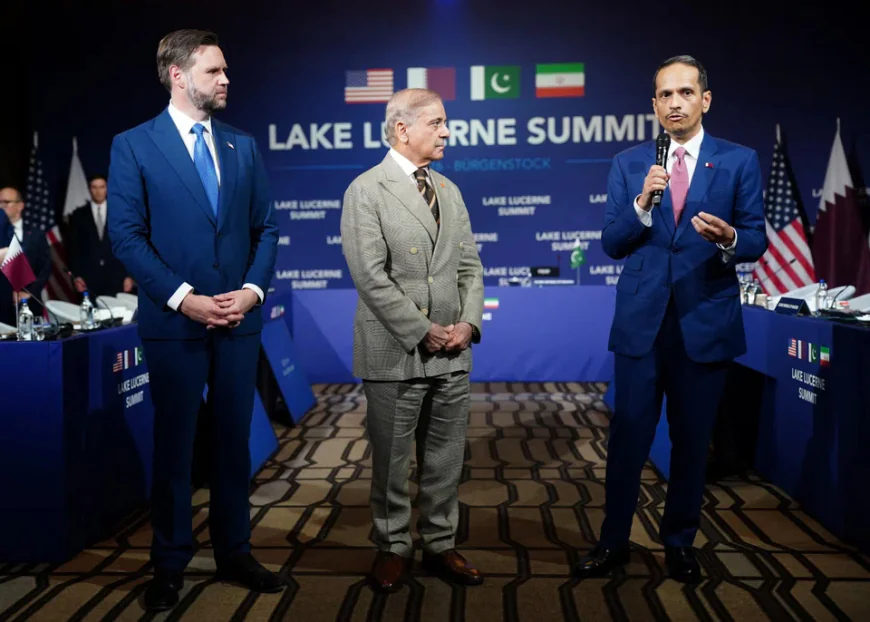
(From left) US Vice-President JD Vance, Pakistan's Prime Minister Shehbaz Sharif and Qatar's Prime Minister Sheikh Mohammed bin Abdulrahman bin Jassim Al-Thani at the start of US-Iran talks in Switzerland. Photo: Reuters
Speaking alongside Vance, the Qatari and Pakistani prime ministers thanked both the US and Iranian delegations for their efforts to promote peace in the Middle East.
"I think that every one of you has highlighted how important and historic this is, not only for the security of the region but also for the security of the world and for the global economy," the Qatari prime minister said.
"I would like to thank all of you for your leadership and determination that put us in this room. This is not really the main celebration; this is just the beginning, and I wish everyone all the best. Qatar will stay dedicated to this partnership to support this mediation until the end—until we reach a solution."
Vance said he hopes Washington and Tehran can reset their relationship, describing the Geneva meeting as "historic". He nevertheless repeated accusations that Iran is a source of regional instability.
Trump renews threats against Iran
US President Donald Trump in a post on 'Truth Social' writes, "Iran must immediately stop their highly paid PROXIES in Lebanon from causing trouble," Trump wrote on Truth Social on Sunday morning. "If they don't, we'll hit Iran very hard again, just like we did last week, only harder!!!"
Trump's threats came despite the 14-point MoU signed by him and President Masoud Pezeshkian on Wednesday. The interim agreement includes a commitment by both sides to pursue a final settlement within 60 days. It also calls for a permanent end to hostilities across multiple fronts, including Israeli strikes on Lebanon, the phased lifting of US sanctions, the removal of the naval blockade on Iran within 30 days, and the restoration of commercial traffic through the Strait of Hormuz.
On Saturday, Iran's central military command officially declared the Strait of Hormuz closed to all maritime traffic over US and Israeli violations of the Tehran-Washington MoU.
Iran has stressed that Lebanon is a red line and that Israeli strikes constitute a violation of the MoU, which calls for an end to the regime's war. Since the MoU was signed, Israel has killed dozens of people in Lebanon.
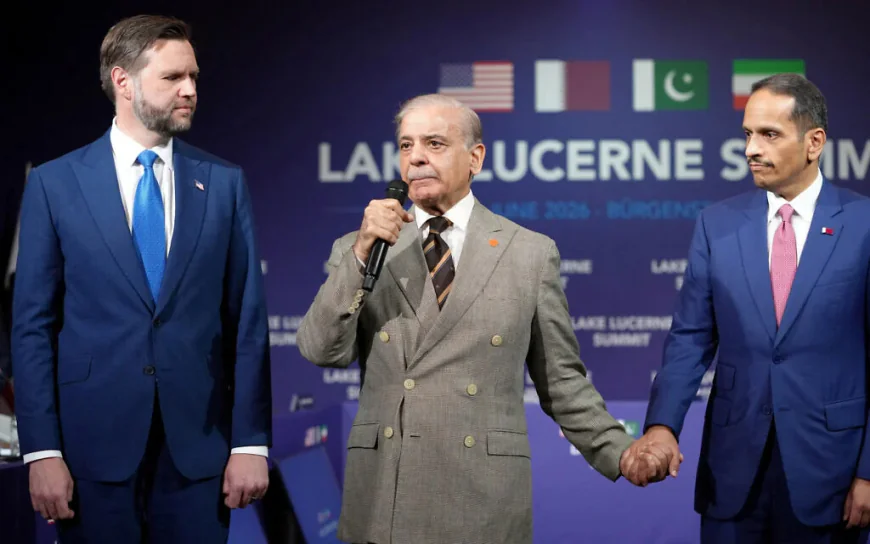
Pakistan's Prime Minister Shehbaz Sharif (C) speaks next to US Vice President JD Vance (L) and Qatar's Prime Minister and Minister for Foreign Affairs Sheikh Mohammed bin Abdulrahman bin Jassim Al-Thani during a quadrilateral meeting between the United States, Iran, Pakistan and Qatar at the Burgenstock luxury hotel complex overlooking Lake Lucerne, Switzerland, on Sunday (June 21, 2026). Photo: Nathan Howard/AFP
Tehran’s protest and Trump’s threats
Iranian media reported that Tehran refused to resume the second round in protest against a fresh social media post by US President Donald Trump, in which he urged Iran to “immediately stop their highly paid proxies in Lebanon from causing trouble” or Washington will hit Tehran “very hard again”. Earlier, the suspension of talks was linked to Israeli ceasefire violations in Lebanon. Iranian officials stressed that the talks cannot proceed until key provisions of the Islamabad Memorandum are fully implemented, including an immediate and permanent ceasefire across all fronts.
Mediation efforts
Pakistani and Qatari officials are in touch with Iranian negotiators and trying to persuade them to resume the talks. Pakistan’s Interior Minister Mohsin Naqvi arrived in Tehran on Saturday as part of an urgent diplomatic mission to prevent further delays. The US and Iranian delegations, led by Vice President JD Vance and Parliament Speaker Bagher Ghalibaf, held a 100-minute first round of direct talks in Bürgenstock. The discussions aim to implement the Islamabad Memorandum of Understanding, which was signed electronically by President Trump and President Pezeshkian on June 18.
The United States and Israel launched a war against Iran on February 28. They believed that Iran would capitulate quickly. Despite Trump's claims that the war severely degraded Iran's military capabilities, Iranian missile and drone strikes against Israel and US bases in the Persian Gulf pushed Washington to accept a ceasefire on April 8.
Iran and the United States are now continuing post-MoU negotiations aimed at turning the agreement into a lasting settlement.
The war has come at a high cost for the United States. In late April, Democratic lawmakers and several economists estimated that the total cost of the conflict to the US economy could reach between $630 billion and $1 trillion. The war contributed to higher fuel prices and inflationary pressures, while a prolonged conflict risked creating additional political challenges for Trump ahead of the congressional midterm elections.
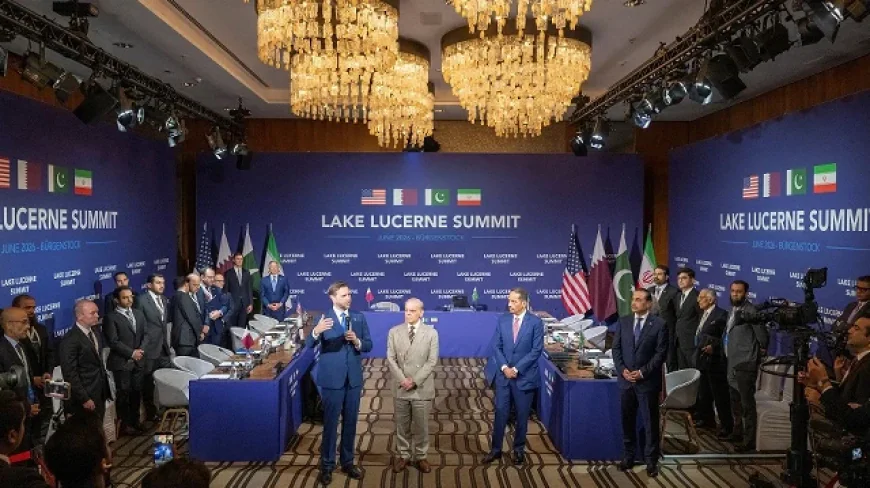
Delegations of Iran and US before ther start of Sunday's multilateral talks at the Burgenstock estate in Switzerland. Photo: Reuters
During the 39-day war, Trump was forced to confront the limits of military pressure against Iran. In late April, German Chancellor Friedrich Merz said the United States was being 'humiliated' by Iran's leadership.
For now, Trump's latest threats, issued while negotiations are ongoing, appear aimed at deflecting attention from the setbacks suffered by the United States and Israel during the conflict. He is seeking to project an image of victory over Iran despite continuing debate within the United States over the war's outcome. According to assessments cited by several American media outlets, the campaign failed to achieve its stated strategic objectives. Israel Hayom also said earlier this month that Iran emerged stronger after the war, while Israel had become weaker.
What's Your Reaction?
 Like
0
Like
0
 Dislike
0
Dislike
0
 Love
0
Love
0
 Funny
0
Funny
0
 Wow
0
Wow
0
 Sad
0
Sad
0
 Angry
0
Angry
0
Comments (0)