

Standard Chartered Bangladesh prepares to sell retail banking portfolio
The move is part of the bank’s global strategy to prioritise high-margin corporate, institutional and affluent wealth management clients

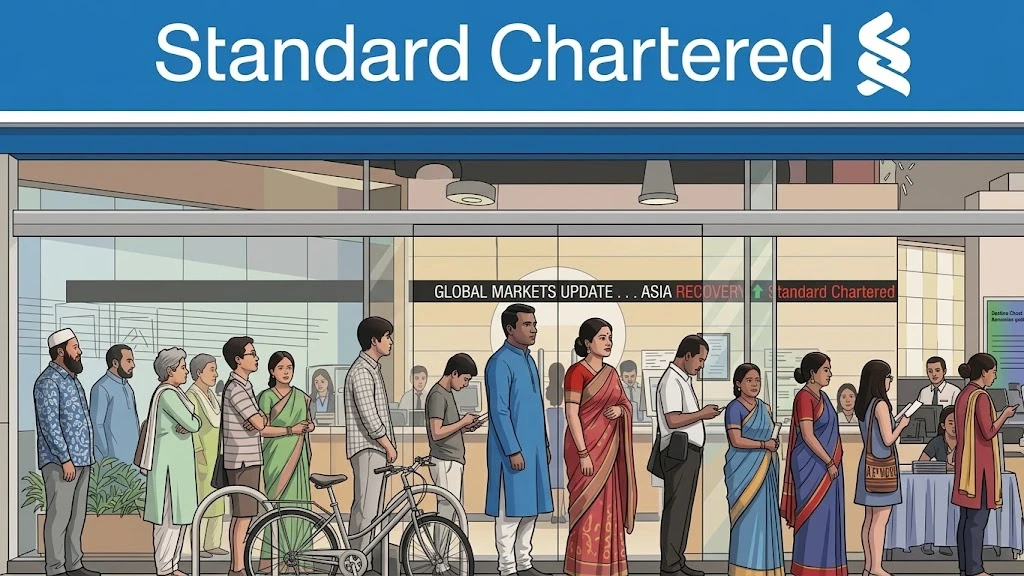
Standard Chartered Bank Bangladesh is preparing to sell its retail banking portfolio through a competitive bidding process, with several local banks showing interest in acquiring the business, according to senior bankers familiar with the development.
The move is part of the bank’s global strategy to prioritise high-margin corporate, institutional and affluent wealth management clients as it scales back retail banking in several markets globally, according to industry insiders.
The bank recently held a meeting with the Bangladesh Bank governor and verbally informed the central bank of its plan, according to central bank officials who attended the meeting.
It has also approached potential buyers and asked interested banks to prepare for a formal process, which is expected to involve valuation by an external consultant.
‘They are offering it to the market. It will go through a bidding process,’ said a top executive of a private commercial bank.
However, the detailed structure, timeline and scope of the proposed transaction have not yet been disclosed to potential buyers, he said.
Standard Chartered has indicated that the process could begin around September or October, while a more specific timetable is yet to be shared with interested banks.
The banker said his bank had already expressed interest and obtained verbal approval from its board to participate in the process.
Some other banks interested in acquiring the business are also preparing to hire international consultants to participate in the formal process after Standard Chartered announced the package.
Retail banking: What it means
The size of the bank’s retail and Cottage, Micro, Small, and Medium Enterprises (CMSME) portfolio was Tk8,479 crore at the end of 2025, nearly 28% of its total portfolio of Tk30,423 crore, according to its financial statement.
The bank’s total deposits were over Tk40,000 crore, of which around 20%, or Tk8,000 crore, were retail deposits.
Asked, Arif Hossain Khan, executive director and spokesperson of Bangladesh Bank, said, ‘Any foreign institution or foreign bank operating in Bangladesh will conduct its business according to its own strategy. If it decides to shift its focus from retail banking and concentrate only on corporate clients, that is its business strategy, and Bangladesh Bank has nothing to say about that.’
‘However, in certain areas, such as agricultural credit and lending to the CMSME sector, Bangladesh Bank has specific rules and regulations requiring banks to allocate a certain percentage of their total investment to these sectors. Bangladesh Bank will not exempt foreign banks from complying with those requirements,’ he said.
Enamul Huque, chief executive officer of Standard Chartered Bangladesh, was contacted through a WhatsApp message in this regard but in vain.
Portfolio sale: First-time experience in Bangladesh
The proposed transaction would be different from a sale or merger involving an entire bank.
A banker said Bangladesh had previously witnessed bank mergers and acquisitions, but he was not aware of a previous instance in which a foreign bank separately disposed of its retail banking customer portfolio.
The transaction could potentially involve a broader package covering customers, employees and branches supporting Standard Chartered’s retail banking operations, although the exact structure remains unclear.
‘If the retail business moves to another bank, the employees supporting the business also have to be considered,’ the banker said.
Potential buyers are therefore likely to assess not only the financial value of the portfolio but also the customer base, deposits, lending relationships and infrastructure associated with the retail business.
Earlier, HSBC announced on July 30, 2025, that it was winding down its retail banking business in Bangladesh through a phased exit lasting six to eight months.
Several banks interested
The banker said several banks were expected to participate in the process, although the final list of bidders is not yet clear.
He mentioned that banks including City Bank and BRAC Bank could potentially be among the interested institutions, while another banker later confirmed that banks were showing interest and that his institution had also expressed interest.
However, the detailed bidding process had not yet started, according to the conversation.
Potential buyers have been advised to prepare by identifying consultants who can assess the value of the portfolio once the formal process begins.
‘They are telling us to get ready for a process. You need a consultant who will value it,’ the banker said.
The banker said prospective buyers were waiting for Standard Chartered to provide a detailed calendar setting out the stages of the transaction.
Part of Standard Chartered’s global retail exit
The banker said Standard Chartered’s decision should primarily be viewed in the context of the group’s broader international strategy rather than as a direct signal about Bangladesh.
Standard Chartered has been reducing or exiting retail banking operations in several foreign markets while retaining and focusing more on corporate banking.
The bank’s rationale, he said, is linked to the rising cost of capital and the cost of operating retail banking in foreign markets, particularly because of compliance and anti-money-laundering requirements.
‘The economics of retail banking in a foreign country have become too high,’ the banker said.
He said Standard Chartered has been exiting or reducing retail operations in several markets, including Sri Lanka, parts of the Middle East and Thailand, while also exiting retail banking in India.
The strategy is to deploy capital in businesses and markets where the returns are more attractive, while continuing to maintain corporate banking operations in selected markets.
Standard Chartered has downsized its retail banking operation in India by selling a part of its India portfolio, where customers only hold credit cards and do not have a wider banking relationship.
Bangladesh-specific risk also a factor
Although the banker did not interpret the retail exit as a specific message about Bangladesh, he said country risk is one of the factors international banks consider when allocating capital.
Bangladesh’s risk premium could be higher than that of some other Asian markets because of political instability, economic conditions and other country-specific factors, he said.
However, he stressed that the primary consideration for Standard Chartered appears to be the overall economics of retail banking in foreign markets.
The proposed sale will now test how much competing banks are willing to pay for Standard Chartered’s established retail customer base and whether they can retain those customers after a transfer.
For Bangladesh’s banking sector, the transaction could also provide a rare example of a foreign bank separately transferring its retail banking franchise rather than selling or merging its entire banking operation.
StanChart customers face disruption in retail banking services
Standard Chartered began to trim its physical branch network and ATM booths, saying that it encourages cashless transactions.
Standard Chartered Bangladesh has 18 branches and 70 self-service terminals, including ATMs and Cash Recycling Machines, across the country. Five years ago, the bank operated with approximately 24 branches and around 83 to 96 ATMs/booths across the country, according to the bank.
What's Your Reaction?
 Like
0
Like
0
 Dislike
0
Dislike
0
 Love
0
Love
0
 Funny
0
Funny
0
 Wow
0
Wow
0
 Sad
0
Sad
0
 Angry
0
Angry
0











Comments (0)