

Bangladesh University students' two-day Sylhet adventure
Once the destination was settled, deliberations began over a name for the tour and eventually, it was named 'Harikel Expedition'

Nazmul Islam
After much speculation, planning and preparation, it was finally decided that this year's batch tour would be to Sylhet. Discussions continued for quite some time over where to go, how to travel and where to stay. Once the destination was settled, deliberations began over a name for the tour. Eventually, it was named 'Harikel Expedition'.
Even after the name was chosen, the expedition had not yet begun. Instead, the most difficult phase of preparation got underway — arranging travel for 59 people together.
The ticket ordeal
A group of 59 is a large one. Everyone wanted to travel together by train. Efforts were made to arrange two carriages for the purpose. But despite two days of trying, the carriages could not be secured. Then came an alternative plan. A few of us decided that everyone would gather at 8am and buy tickets through the railway app together.
About 20 more sleep-loving university students like us were enlisted for this task. At the appointed time, everyone sat down for the online ticket-buying mission. In the end, tickets for all 59 were purchased. But there was no relief. Each person's ticket was in a different carriage. A group of 59, yet scattered across the train the moment they boarded.
Despite all this, enthusiasm for the journey did not fade. Accommodation had already been arranged beside Dargah Gate in Sylhet city. The hotel was chosen on the calculation that being in the city would make travel in different directions convenient.
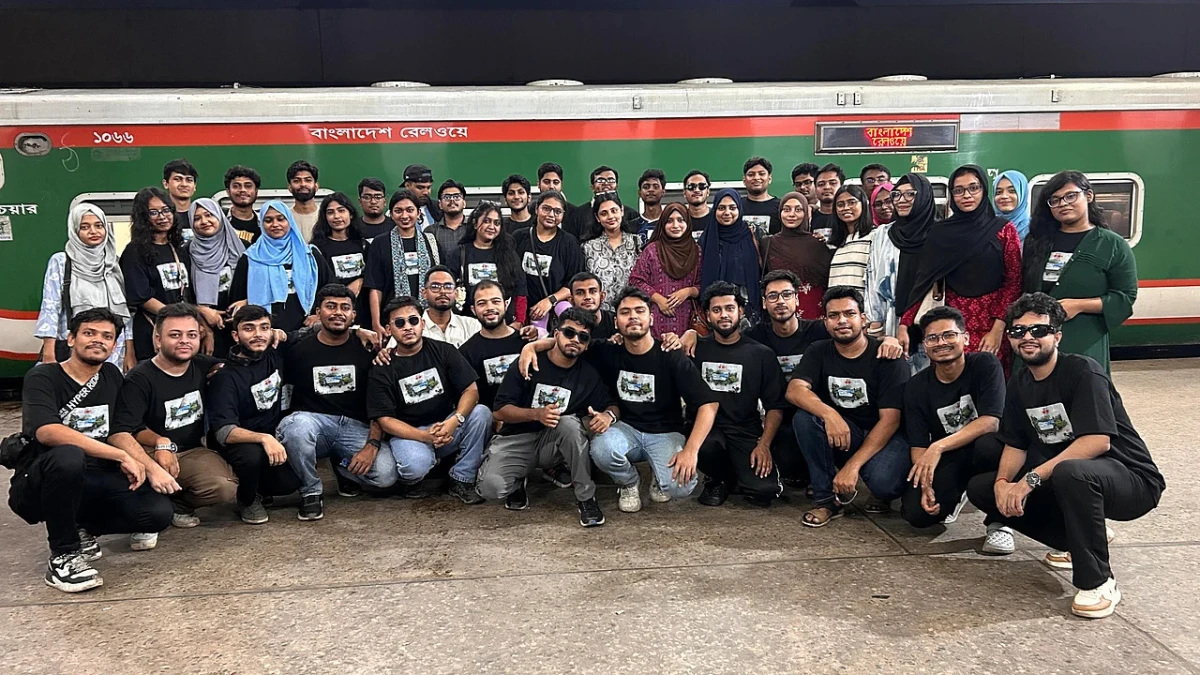
With all preparations complete, the 59-strong group assembled at Kamalapur Railway Station on the night of 2 September. The journey towards Sylhet began at 10:30pm on the Upaban Express.
A night train. Darkness outside the window, and inside, adda among familiar faces. Some were chatting, some trying to sleep, others busy with plans for the next day. Thus the night passed.
The next morning at around 8am, the train stopped at Sylhet station. Boarding pre-arranged lagunas, everyone reached the hotel. After freshening up, some rest and a meal, the first day's excursion of the 'Harikel Expedition' began.

Among rows of lush tea plants at Malnicherra Tea Garden.
Rain-soaked Malnichhara
The first destination was Malnichhara Tea Garden. Located on the outskirts of Sylhet city, this tea garden is deeply tied to the country's tea history. Established in 1854, Malnichhara is described in government information as the first tea garden in the subcontinent.
When we arrived there, the sky was overcast. There was light drizzle. Rows of rain-soaked tea bushes, wet paths and greenery all around — Sylhet seemed recognisable at first sight.
We were wandering in groups. Some were taking photos, some shooting videos, others busy in adda with friends in the rain. But not much time was given. More roads and more destinations lay ahead.
Leaving Malnichhara behind, we set off for Ratargul.
The Ratargul swamp forest
Ratargul in Gowainghat is one of Bangladesh's well-known freshwater swamp forests. During the monsoon, a large portion of the forest is submerged. Boating through the gaps between trees is the main attraction there at that time.
As soon as we got into the boats, the surroundings changed. Leaving behind the noise of the land route, the boat began moving slowly along narrow waterways. Trees standing in the water, green shade overhead and small ripples created by the boat's movement — all together, a different kind of environment.
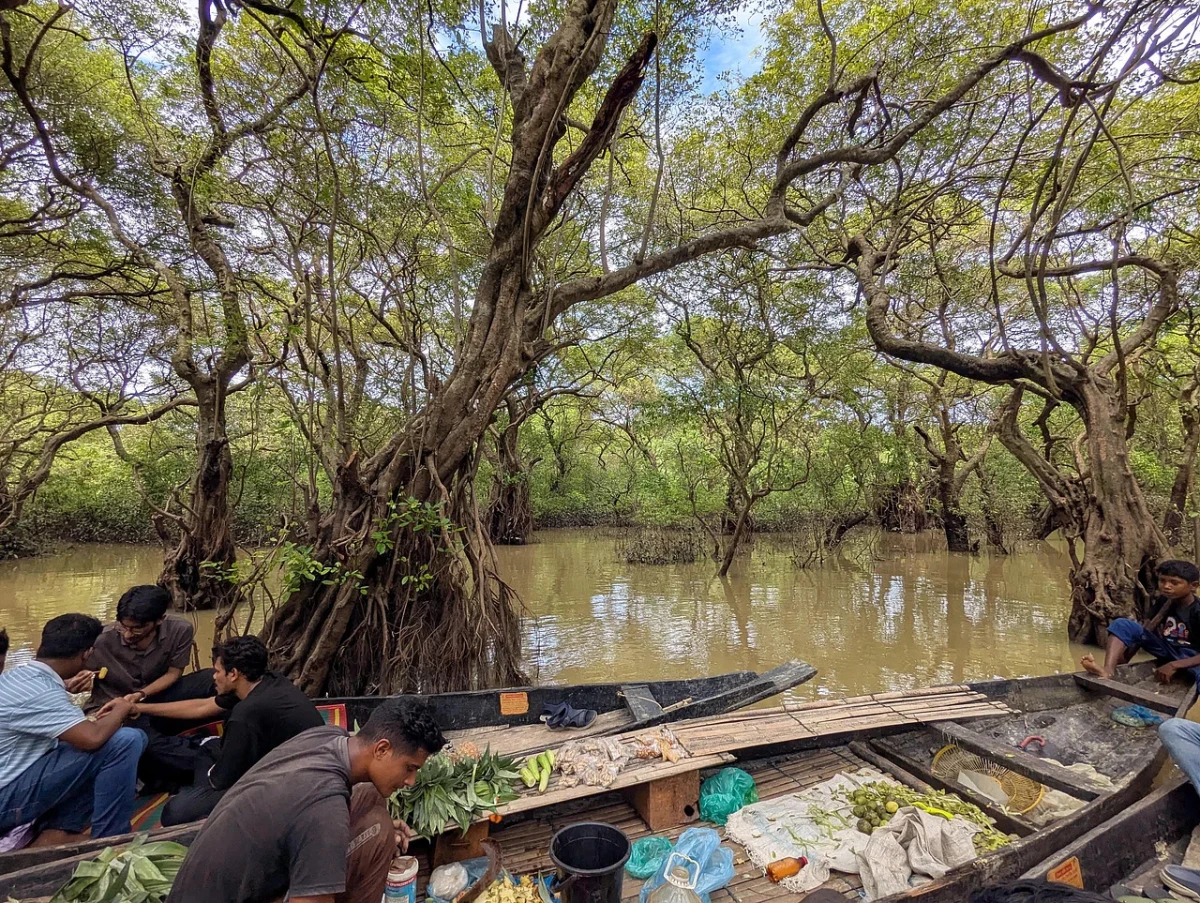
A boat amid rows of trees on the way through the Ratargul swamp forest. Photo: Author
With a group of 59, our presence was quite noticeable even in Ratargul's quiet surroundings. Some were taking photos, some shooting videos, others moving from one end of the boat to the other to chat with friends. After the boat ride, it was time for our much-anticipated destination — Sadapathar.
Fatigue lost at Sadapathar
On the way from Ratargul to Sadapathar, fatigue was accumulating in everyone's body as we sat in the vehicle. Having visited one place after another since morning, we were quite exhausted. But as we moved towards Bholaganj, the scenery began to change. Distant hill lines, greenery all around and border-adjacent nature made it clear the destination was not far.
The stone-filled area of the Dhala River in Bholaganj of Companiganj is known as Sadapathar. The waters of the Dhala River descending from India's Meghalaya, the stones and the hills on the other side are the main attractions of this area.

Time spent together by the travel companions in the waters of the Dhalai River at Sadapathor. Photo: Author
After covering a long distance, stepping into the water there seemed to instantly change everyone's appearance. Cold water was flowing over our feet. The continuous sound of water striking the stones filled the air. Ahead were distant hills, with clouds clinging to them. Sometimes the hills were clear, sometimes blurred behind clouds.
Streams rushing over white stones, clouds resting on the hills and greenery all around — the scene was worth holding in one's eyes. The tired group, having sat in the vehicle all this while, seemed to regain new life upon stepping into the water.
Some were sitting on the stones taking photos, some were in the water spending time with friends. Others stood gazing at the distant hills. The fatigue of the long journey was by then forgotten.
Time passed and the sun leaned towards the western sky. We had to return to the hotel. So, gathering as much of Sadapathar's beauty as possible in our eyes and minds, it was time to head back. The first day's expedition ended with tired bodies and full hearts.
Second day, a slightly lazy start
The plan for the second day was to visit several more places. So we were supposed to leave early in the morning. But the strain of the previous day took its toll on sleep. By the time everyone got ready and finished breakfast, it was nearly 9am.
Then we set off for Lalakhai.
Blue-green waters of Lalakhai
Lalakhai in Jaintiapur upazila is an area surrounded by hills, forests, tea gardens and the Sari River. Sarighat is about 42 kilometres from Sylhet city. From there, one has to go towards Lalakhai by boat.
The colour of Lalakhai's water and the greenery on both sides are the main attractions here. As the boat moves through the river, sometimes hill shadows fall on the water, sometimes the green slopes of tea gardens come into view. The boat's slow pace and the surrounding scenery together create a distinct travel experience.

The Piyain River and the hills of Meghalaya at Jaflong. Photo: Author
But our experience at Lalakhai was not limited to nature alone. We also had the opportunity to visit a nearby punji area and observe the lives of local people. The homes of the hill community, the tea gardens and people's daily lives — everything is different from urban life.
Seeing the style of houses, the surrounding environment and the movement of people, it felt that travel does not mean only seeing new places; it also means getting to know the lives of the people there from close. From Lalakhai, our next destination was Jaflong.
Racing against time at Jaflong
Jaflong lies on the banks of the Piyain River at the foot of the Khasi-Jaintia hills. The place is known for the hills on the other side, the river's rocky bank and clear water. Jaflong will always feature in any travel list for Sylhet. It was on ours too. But because time ran out while touring Lalakhai, we reached Jaflong quite late.
Time was short. So there was not much wandering. Within whatever time we had, we tried to take in the river's stones, the hills and the border scenery. Meanwhile, it was decided that since the day was a working day, we could go to Mayabi Jharna. No sooner said than done. We set off from Jaflong towards Mayabi Jharna.
But there, we had to be somewhat disappointed. The water was low and the place was relatively small. On top of that, there was a crowd of visitors. As a result, the experience fell short of expectations. After staying a while, we had to return.
By the time we were returning, it was evening. One more place was on our list — Agun Pahar. But time was then very short. The return train was at 11pm. So despite the desire, Agun Pahar remained unvisited on the 'Harikel Expedition' list.

Students pose for a group photo during their ‘Harikel Expedition’. Photo: Author
The rush to return
The journey back from Jaflong to the hotel was no less of an adventure. A long road, uneven in places, potholed in others. The laguna moved forward with jolts, and we kept looking at the clock again and again. The night was deepening. Ahead lay packing bags, eating, then the station. Eventually, we reached the hotel at around 10pm.
By then, two days of fatigue weighed on our bodies. Still, the bags had to be packed quickly. The 11pm train had to be caught. By then, so many photos, so many videos, so many stories had accumulated. There was no time even to organise them.
Leaving the hotel, we were on the road to the station again. Ahead lay Dhaka's busyness, classes, exams, assignments and familiar campus life. Behind remained Sylhet's hills, rivers, tea gardens and two days of diverse experiences.
The journey became bigger than the destination
The 'Harikel Expedition' began with a ticket ordeal. The race for tickets for 59 people, the night train, rain-soaked Malnichhara, Ratargul's swamp forest, Sadapathar's cold water, Lalakhai's blue-green river, Jaflong's hills. So many stories accumulated over two days.
Not all places were seen as planned. The Agun Pahar plan was dropped, and Mayabi Jharna could not fulfil expectations either. Yet the account of travel is not measured by destinations alone. Walking together, laughter amid fatigue, stories that emerged unexpectedly — these ultimately become the memories of a journey.
University life will end one day. Everyone will scatter to different cities and professions. Then perhaps they will remember the night train, Sylhet's rain, Sadapathar's cold water or that rush back from Jaflong. It will feel that we did not just go to Sylhet for two days to travel; we brought back with us some moments that have no return ticket.
What's Your Reaction?
 Like
0
Like
0
 Dislike
0
Dislike
0
 Love
0
Love
0
 Funny
0
Funny
0
 Wow
0
Wow
0
 Sad
0
Sad
0
 Angry
0
Angry
0








Comments (0)