

Rare wildlife holds Rema-Kalenga’s tourism appeal
Dense greenery, old trees and diverse wildlife of Rema-Kalenga are increasingly attracting tourists and nature lovers seeking a quieter alternative to conventional tourist destinations

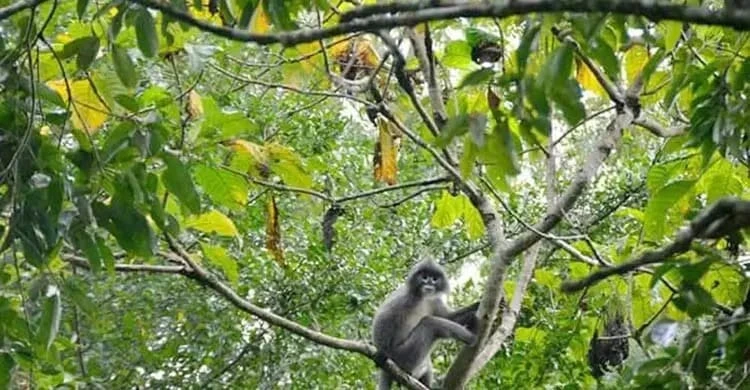
Deep inside Rema-Kalenga Wildlife Sanctuary in Chunarughat upazila under Habiganj, tourists can find an experience that goes beyond the usual green landscape: rare wildlife moving freely through the forest canopy.
Located across a vast area, Rema-Kalenga is one of Bangladesh’s richest natural forests in terms of biodiversity. Its dense greenery, old trees and diverse wildlife are increasingly attracting tourists and nature lovers seeking a quieter alternative to conventional tourist destinations.
One of the most striking sights for visitors is the Malaysian giant squirrel, a large and relatively rare species found in Bangladesh. The animals can often be spotted moving swiftly from branch to branch high in the forest canopy.
With a body length of up to around 60 centimetres and a tail almost as long as its body, an adult Malaysian giant squirrel can measure more than a metre from head to tail. It can weigh up to around two kilogrammes. Its dark brown or reddish-maroon body and thick bushy tail distinguish it from smaller squirrel species.
The long tail also helps the animal maintain balance as it moves rapidly through the treetops.
“Without conserving large and old trees, it is difficult to sustain animals such as the giant squirrel. If deep forest and mature trees decline, these animals will lose both food and safe shelter,” said Dr Subash Chandra Deb, a professor of zoology at Habiganj Brindaban Government College.
Rema-Kalenga is home to a wide range of wildlife. The sanctuary has 37 species of mammals, 215 species of birds, seven species of amphibians, 18 species of reptiles and 638 species of trees, plants and creepers, according to the information provided.
The forest is particularly known for its birdlife, with species including the drongo, parakeet, common myna, red-headed trogon, red-whiskered bulbul, great hornbill, vulture, jungle fowl, owl, kingfisher, eagle and kite.
Three species of monkeys are also found in the forest, including the capped langur, rhesus macaque and nocturnal slow loris. Five species of squirrels have also been recorded, including the rare Malaysian giant squirrel.
Other wildlife includes the capped langur, spectacled langur, hoolock gibbon, barking deer, fishing cat, wild boar, civet, mongoose and porcupine. The forest is also home to 18 species of snakes, including the king cobra, rat snake and vine snake.
For tourists walking along the designated trails, encounters with wildlife can be an unexpected highlight. The silence of the forest is occasionally broken by birds calling from the canopy or the movement of animals among the branches.
The sanctuary was established in 1982 and expanded in 1996. It now covers about 1,795.54 hectares and is divided into the Rema, Kalenga, Chonbari and Rashidpur beats. The area is managed through 11 units and seven camps.
Growing tourism facilities
Rema-Kalenga once had limited facilities for visitors, particularly those wishing to stay overnight. Several cottages have now been developed, allowing tourists to spend both the day and night in the forest.
A restaurant facility is also available, although visitors need to place orders in advance.
Staying overnight offers tourists the opportunity to experience the forest after sunset and observe wildlife at different times of the day. Visitors may also spot animals such as deer and other wildlife in the early morning.
The sanctuary’s location also makes it accessible from Dhaka. It is about 130 kilometres by road from the capital and around 40 kilometres from Habiganj town.
Visitors can travel from Dhaka by bus or train to Shayestaganj and then take a CNG-run auto-rickshaw to Chunarughat. From there, another CNG can be taken to Rema-Kalenga. Visitors can also hire a CNG directly from Shayestaganj, with the cost reportedly around Tk500.
Protecting the attraction
Forest officials say tourism can benefit from the sanctuary’s biodiversity, but visitors must ensure that their presence does not disturb wildlife.
Kalenga Beat Officer Al Amin said the presence of Malaysian giant squirrels was important for the sanctuary’s biodiversity and showed that the forest remained an important wildlife habitat.
He urged visitors to remain quiet and use designated trails so that animals are not frightened.
“Visitors need to be careful so that wildlife does not become afraid. If they travel quietly along the designated trails, they can see many rare animals,” he said.
Abul Kalam, divisional forest officer of the Wildlife and Nature Conservation Division, also stressed the need for public cooperation in protecting the forest and its wildlife.
“The forest should be allowed to grow naturally. Activities that damage the forest should be avoided and trees must not be cut,” he said.
He also urged tourists to travel quietly along designated trails so that wildlife is not disturbed.
With its dense forest, rare wildlife and improving visitor facilities, Rema-Kalenga offers an increasingly attractive destination for nature-based tourism in Bangladesh.
What's Your Reaction?
 Like
0
 Dislike
0
 Love
0
 Funny
0
 Wow
0
 Sad
0
 Angry
0








Comments (0)