

Rebirth metaphor in Gustiyan Rachmadi’s sculpture
Dr Gustiyan Rachmadi currently teaches sculpture at the Indonesian Arts and Culture Institute (ISBI) Bandung, where he also serves as Vice Dean for General and Finance Affairs
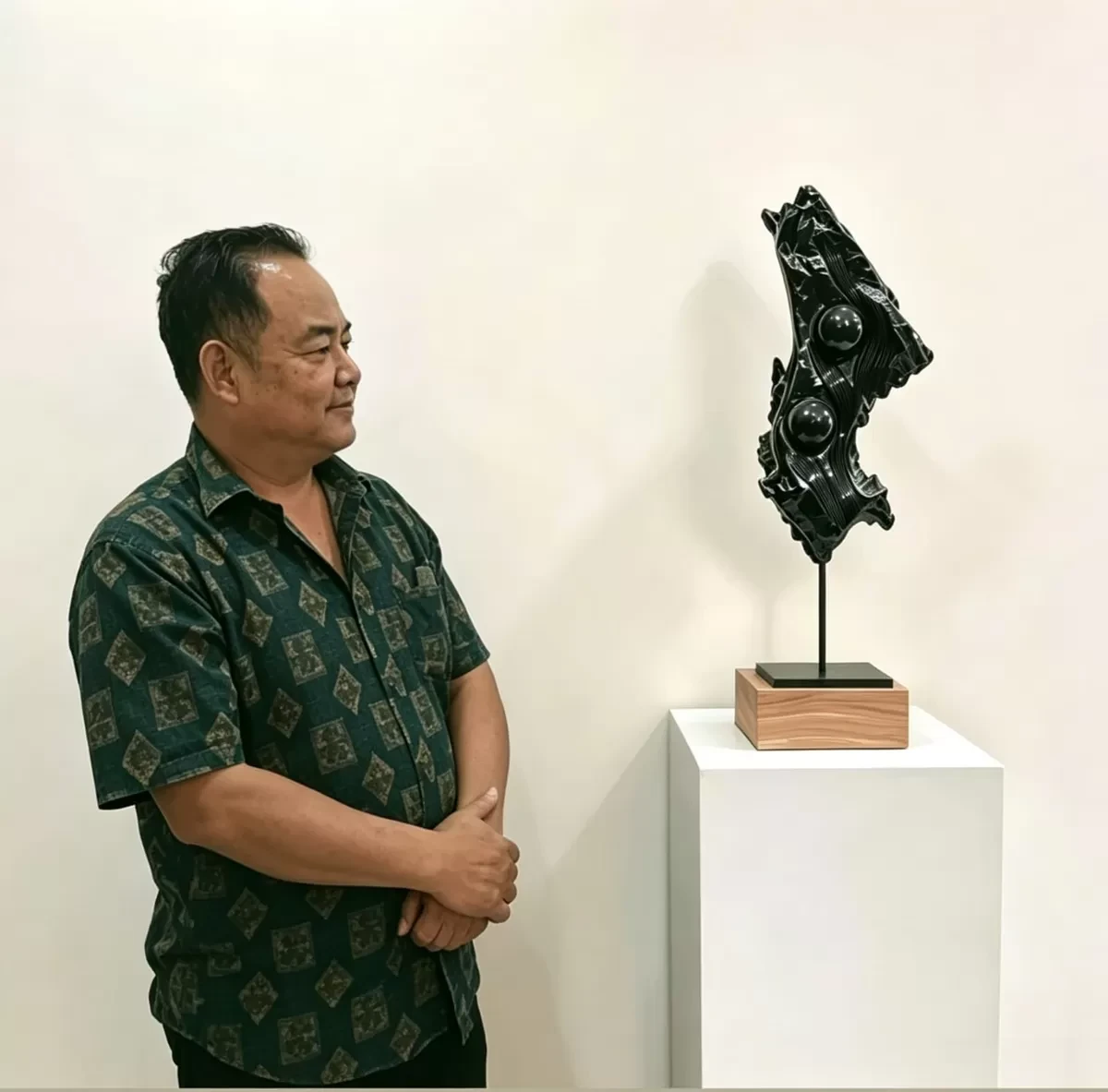
Have you ever paused in a forest or a garden, if only to watch a fragment of rotting wood lie inert upon the earth? To the ordinary eye, one habituated to the logic of utility and modern cleanliness, such wood is nothing but refuse matter that has forfeited its function, the remnant of a biological cycle, biding its time until fungi and soil consume it entirely.
However, within the realm of contemporary visual art, human perceptions of objects are often dismantled and reconstructed. Through Gustiyan Rachmadi’s latest sculpture, entitled 'Arise', the sculptor undertakes a revolutionary aesthetic intervention into this perception. He takes the idea of decay, a condition that has long been associated with deterioration and defeat and transforms it into a stage for a compelling spiritual and aesthetic resurrection.
Wabi-Sabi and Post-Minimalism
To fully understand the proposition conveyed by Arise, it is necessary to examine the conceptual foundation underlying the work. Gustiyan weaves together two major philosophical threads that complement one another: the traditional Japanese aesthetic of Wabi-Sabi and the artistic movement of Post-Minimalism.
In the philosophy of Wabi-Sabi, which is deeply rooted in Zen Buddhism, true beauty is not found in perfect symmetry, smooth lines, or contrived grandeur. Rather, beauty resides in things that are imperfect, impermanent, and incomplete. Wabi-Sabi teaches us to appreciate ‘material honesty’ and to regard cracks, faded colours, and cavities caused by decay as visual archives of time. Cracks in wood are not merely defects, but authentic evidence that the material has undergone a long journey of interaction with climate and nature.
This principle is then combined with the spirit of Post-Minimalism, which developed from the late 60s onward. In contrast to classical Minimalism, which tends to be rigid, geometric, and seemingly cold in its industrial character, Post-Minimalism introduces spirit, organic textures, and experimental processes into three-dimensional works. In Arise, Gustiyan does not merely present pure geometric forms; rather, he introduces organic forms that appear alive and substantial, inviting viewers not only to look at the work but also to respond to it emotionally and tactilely.
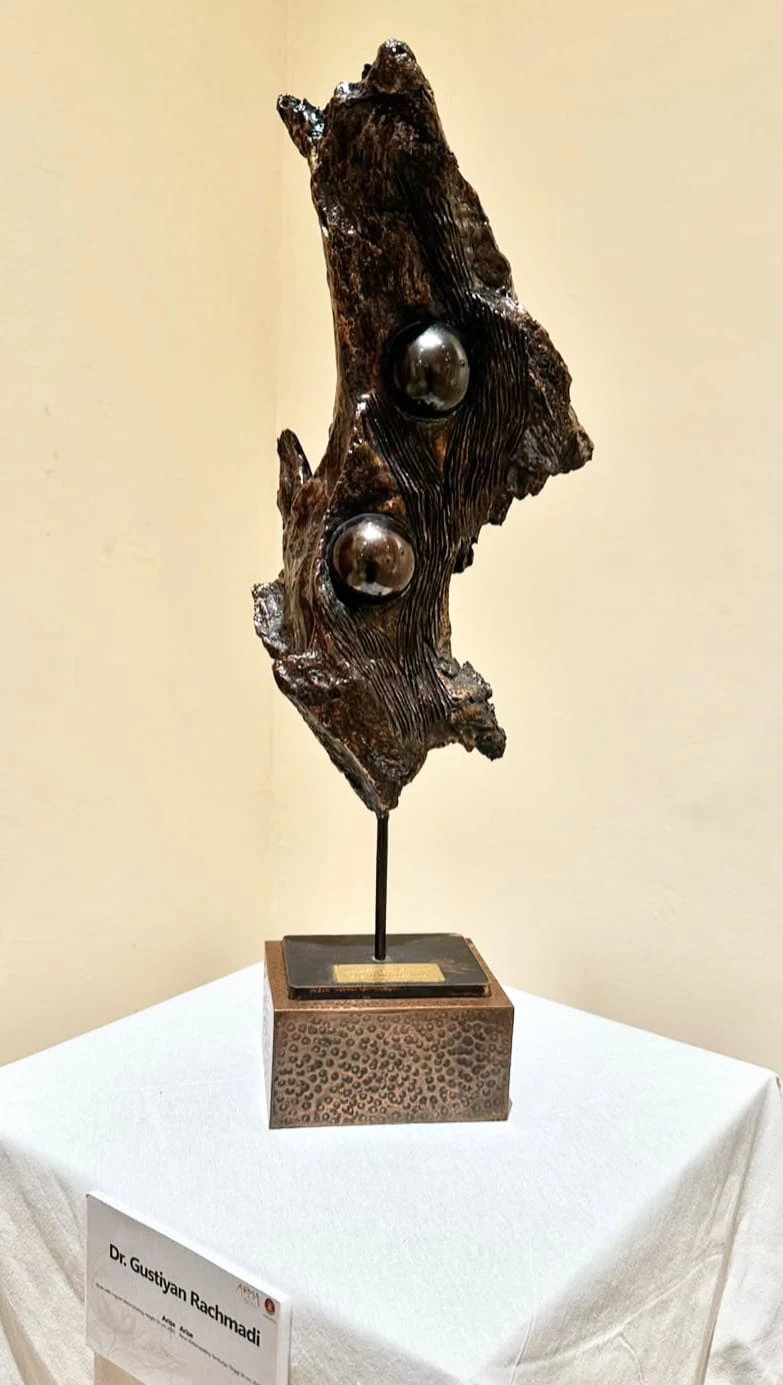
Gustiyan Rachmadi’s latest sculpture Arise
Marvel of hybrid materiality
One of the most prominent attractions, as well as one of the points of novelty, in this work lies in its exploration of materiality and the techniques of creation. Gustiyan does not simply take an actual piece of decayed wood and display it inside a gallery. Such an action might feel overly literal. Instead, he undertakes a process of translating its form and character.
The visual characteristics of decayed wood, deep cracks, irregular cavities, and coarse pores are precisely translated through a hybrid material based on resin and fiberglass. This technique enables the artist to construct a sculptural mass that is flexible while possessing a very high degree of structural durability.
The actual technical leap occurs at the finishing stage. Gustiyan applies electroplating technology using copper and nickel over the surface of the rough-textured resin, which is then accented with a black patina.
This process creates extraordinary visual effects and philosophical meanings:
Dignifying the decay
An object that visually adopts the image of fragile and degraded decayed wood is now elevated in status. It is transformed into a metal-layered structure that appears solid, valuable, enduring, and monumental.
Dialectics of texture
The composition of the work deliberately divides the treatment of its surface into two contrasting worlds. Approximately 80% of the sculpture’s main mass is left with a rough, porous, and dark-coloured surface. However, from behind these dark cracks emerge hemispherical forms whose metal surfaces have been polished to a smoothness of 2000 grit, producing a mirror-shine effect capable of reflecting the surrounding light and shadows.
Metaphor of 'Arise'
The title Arise, meaning “to rise” or “to emerge,” is physically manifested through the spatial syntax and directional lines of the sculpture. The basic form of the sculpture is designed to curve and move diagonally upward. It does not stand rigidly upright; rather, it possesses a gesture resembling an organism struggling to penetrate a heavy burden in order to grow toward the direction of light.
The placement of three polished hemispherical forms along this diagonal line functions as a visual focal point. These gleaming spheres appear not to have been attached from the outside, but rather to be ‘pushing outward’ from between the cracks of the dark wooden body.
Here lies the profound poetic message conveyed by Gustiyan Rachmadi:
“True resurrection is not a process of turning back time in order to become whole and smooth again as before. Resurrection does not mean pretending that the wounds or suffering of the past never occurred.”
Metaphorically, the rough and cracked surface of the sculpture represents the past, wounds, suffering, and bitter traces of life’s journey. Meanwhile, the smooth and polished hemispherical forms symbolise new awareness, hope, and healing.
The beauty and precious value of the polished spheres would not be meaningful if they stood alone upon a smooth surface. Their brilliance becomes so captivating and valuable precisely because it is born from and emerges directly out of the rough cracks.
Just like a tree shoot capable of breaking through the hard surface of asphalt, Arise asserts that hope and new strength do not emerge after hardship has disappeared. Rather, they grow and blossom in the midst of the very scars themselves.
Unique discovery in sculpture
The work Arise represents a highly fresh academic and artistic contribution to contemporary sculpture in Indonesia. At a time when many sculptural works remain trapped within a rigid dichotomy between using entirely pure traditional natural materials or relying entirely on modern industrial fabrication, Gustiyan successfully bridges the two. He combines the aesthetic values of nature with the precision of electrochemical technology.
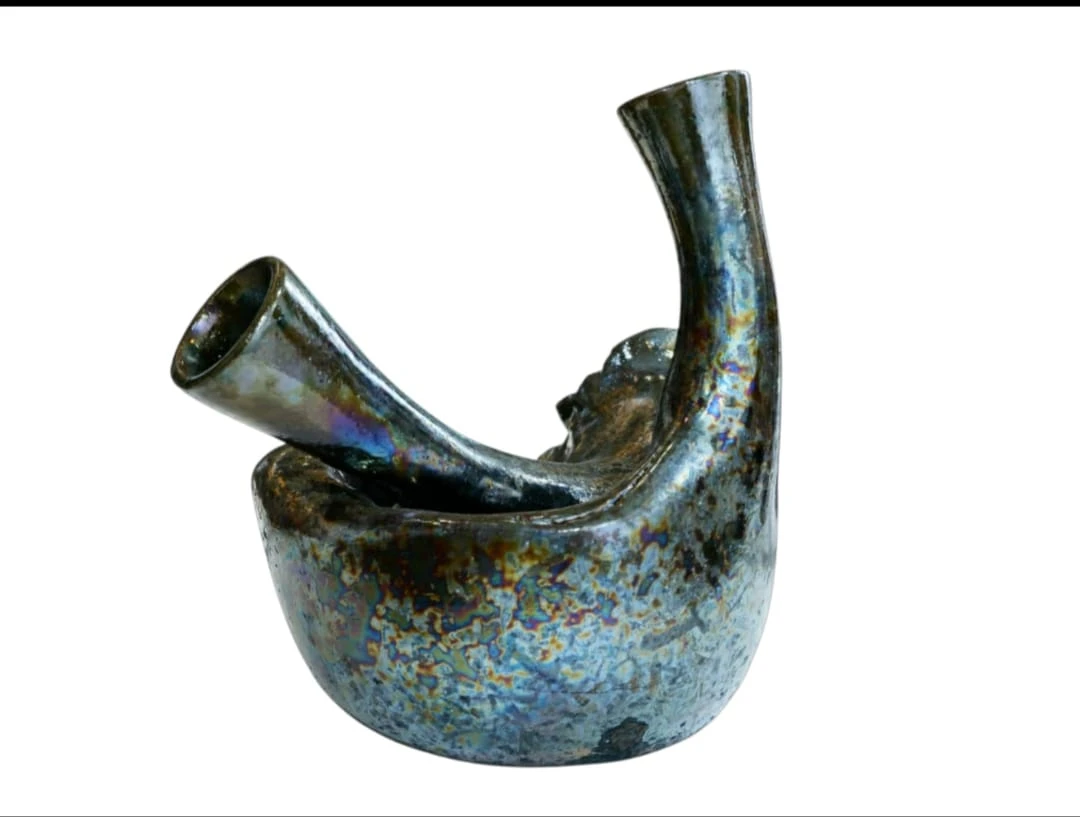
Gustiyan Rachmadi’s sculpture combines aesthetic values of nature and technology.
Through this work, Gustiyan Rachmadi has not only succeeded in transforming the waste-like form of a natural object into a highly refined aesthetic object within the gallery space. More than that, he offers a philosophical mirror to anyone who views it that within imperfection, cracks, and the lowest points of human life, there is always a hidden potential to emerge, transform, and rise again as an entity that is far stronger and more valuable.
Gustiyan Rachmadi currently teaches sculpture at the Indonesian Arts and Culture Institute (ISBI) Bandung, where he also serves as Vice Dean for General and Finance Affairs.
What's Your Reaction?
 Like
0
Like
0
 Dislike
0
Dislike
0
 Love
0
Love
0
 Funny
0
Funny
0
 Wow
0
Wow
0
 Sad
0
Sad
0
 Angry
0
Angry
0

Dr Mohammad Ferdous Khan appears to be a multifaceted and evolving professional, balancing academic, creative, and media-oriented pursuits. He has done his PhD from University of Dhaka in 2025 entitled “Reflection of Social Relations in Advertising Art of Post Independent Bangladesh". His research papers appear in different journals home and abroad.







Comments (0)