

Bangladesh, Japan target one trillion yen investment
The two prime ministers agreed that the upgraded initiative would integrate the development of power, energy, deep-sea port, industrial and ICT infrastructure

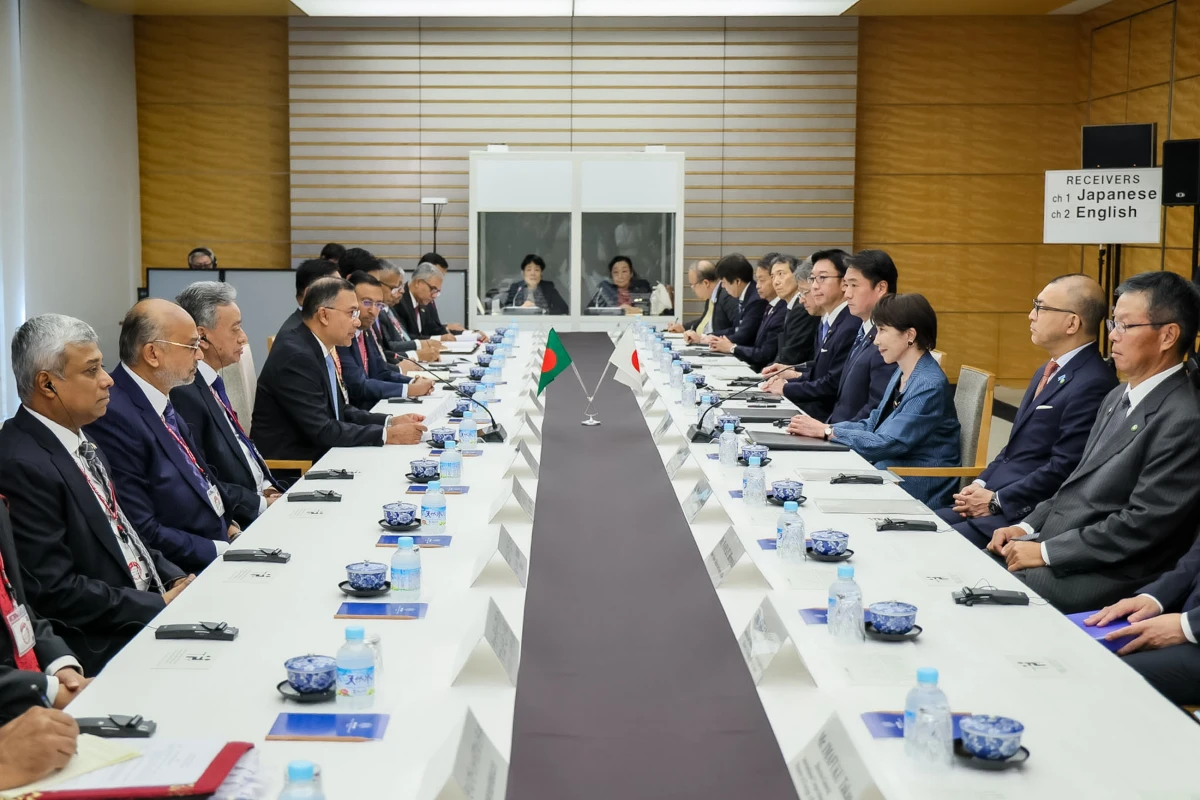
Japanese Prime Minister Takaichi Sanae has praised projected Japanese private investment of up to one trillion yen in Bangladesh over the next five years, which is expected to generate 200,000 jobs, while lauding Prime Minister Tarique Rahman’s efforts to promote investment.
The projection was outlined in a joint statement issued after bilateral summit talks between the two prime ministers in Tokyo on the second day of Tarique Rahman’s official visit to Japan from October 26 to 29.
BIG-B for Shared Prosperity
The two prime ministers agreed that the upgraded initiative would integrate the development of power, energy, deep-sea port, industrial and ICT infrastructure to establish a major hub for industrial value chains and develop a trade and supply gateway.
The initiative will focus on four priorities: enhancing connectivity; strengthening resilience against natural disasters and geopolitical uncertainties; promoting public-private partnerships for economic growth and rulemaking; and expanding cooperation for peace and stability.
Under the framework, the two countries will work together to develop the Matarbari-Maheshkhali area into a major logistics, energy and industrial hub centred on the Matarbari Deep-Sea Port.
Third Terminal, MRT and Port Connectivity
Emphasising regional connectivity, the two prime ministers agreed to proceed with preparatory work for the early operationalisation of the third terminal at Hazrat Shahjalal International Airport in Dhaka.
They also expressed their intention to advance the early construction of Dhaka’s MRT lines and discuss future cooperation, including the operation and management of Matarbari Deep-Sea Port.
Both leaders reaffirmed their commitment to steadily advancing cooperation to strengthen regional connectivity and sustain rapid economic growth.
Investment and Business Environment
Takaichi commended the Rahman administration’s efforts to promote foreign direct investment and welcomed the projection of Japanese private investment and employment generation in Bangladesh over the next five years.
The two leaders agreed to establish complementary and resilient supply chains in manufacturing, food and agriculture, ICT and pharmaceuticals.
Trade Pact and Industrial Diversification
The two leaders welcomed the signing of the Japan-Bangladesh Economic Partnership Agreement (EPA) and reaffirmed their commitment to bringing it into force at an early date to deliver mutual benefits to their peoples.
They expressed their determination to promote trade, investment and industrial diversification through the agreement, supporting Bangladesh’s smooth, sustainable and resilient transition from Least Developed Country status.
Energy Security and Climate Cooperation
Prime Minister Tarique Rahman appreciated Japan’s 50 billion yen ‘Emergency Support Loan for Enhancing Economic Resilience and Stable Energy Supply’, the first yen loan project under Japan’s Partnership on Wide Energy and Resources Resilience Asia, or POWERR Asia.
On climate change, the two sides highlighted cooperation in developing a long-term low-emission development strategy, improving energy efficiency and capacity, and promoting renewable energy.
Digital Transformation and Skilled Workforce
Building on bilateral ICT cooperation, the leaders recognised the importance of exploring further opportunities in digital transformation, developing highly skilled ICT professionals and ensuring secure and reliable digital connectivity.
They also agreed to continue cooperation to strengthen human capital, develop a skilled workforce and address social vulnerabilities.
Cooperation will cover public health and medical care, education, disaster risk reduction and management, waste management, sustainable cities and local government.
Defence and Maritime Security
The two prime ministers reaffirmed their intention to strengthen bilateral security cooperation amid growing geopolitical uncertainty.
They welcomed the signing and entry into force of the agreement concerning the transfer of defence equipment and technology and expressed expectations for further progress in bilateral cooperation.
Democracy and People-to-People Connectivity
Reviewing relations since Bangladesh’s independence, the two leaders recognised their longstanding friendship and the progress made under their Strategic Partnership in infrastructure, energy, human resource development, trade and investment.
They reaffirmed their shared values of democracy, freedom and the rule of law.
Rohingya Repatriation and Myanmar Crisis
The two prime ministers expressed concern over the worsening crisis in Myanmar, its implications for regional security, displacement and the rise in transnational crime.
They called for an immediate cessation of violence, the release of those detained, conditions conducive to humanitarian assistance, and dialogue involving all parties and affected groups, including the Rohingyas.
Takaichi commended Bangladesh for temporarily sheltering displaced people, including Rohingyas from Rakhine State, and expressed support for continued humanitarian assistance.
Tarique Rahman stressed that the Rohingya crisis originated in Myanmar and that its solution lay there.
Middle East Peace
The Bangladesh and Japanese prime ministers called for early de-escalation in the Middle East and the urgent and full reopening of the Strait of Hormuz, ensuring safe, secure and unimpeded passage for all vessels in accordance with international law and without additional costs.
They recognised the strategic importance of peace and stability in the Red Sea and the Bab el Mandeb Strait for global energy security and uninterrupted trade.
The leaders stressed the need to protect civilian vessels and seafarers and urged restraint from actions that could endanger maritime personnel.
They reaffirmed the importance of freedom of navigation and overflight and the peaceful settlement of maritime disputes in accordance with international law, as reflected in the United Nations Convention on the Law of the Sea.
UN Cooperation and Nuclear Disarmament
The two prime ministers reaffirmed their commitment to multilateralism, international law and the principles of the UN Charter.
Takaichi commended the election of Foreign Minister Dr Khalilur Rahman as president of the 81st UN General Assembly and expressed Japan's intention to cooperate with him to help build a more resilient and effective United Nations.
The leaders agreed to continue working towards early reform of the UN Security Council (UNSC), including the expansion of both permanent and non-permanent membership categories.
They also reaffirmed their commitment to a world without nuclear weapons and to maintaining and strengthening the Nuclear Non-Proliferation Treaty.
Tarique Rahman thanked Takaichi and the Japanese people for their warm hospitality and invited her to visit Bangladesh at a mutually convenient time.
What's Your Reaction?
 Like
0
 Dislike
0
 Love
0
 Funny
0
 Wow
0
 Sad
0
 Angry
0









Comments (0)