

Nepal rescue focuses on workers trapped in 3 tunnels
Oxygen has been supplied to those tunnels through pipes and new equipment sent to open a passage

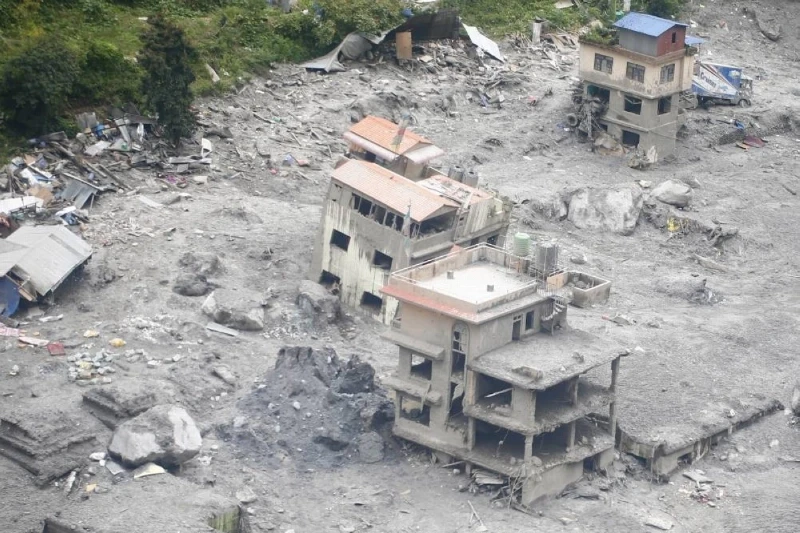
Rescuers in Nepal are focusing on three hydropower project tunnels where they believe dozens of workers could be trapped, authorities said on Tuesday, two weeks after a devastating flood killed hundreds and left thousands missing in the Himalayan country and in neighbouring China's Tibet region.
At least 11 hydropower projects were engulfed when a glacier collapsed into a river on the Nepal-China border on August 26, burying the entrances to the tunnels of these projects under debris and mud and cutting off those trapped inside.
"Our search operation is focussed on finding survivors, including in tunnels. Our bigger focus is on the Chilime hydroelectric project, where we believe people are trapped, because there was a canteen, residency and arrangements for food," Dharma Raj Upreti, chief of the country's disaster authority, told Reuters.
Teams were also focused on tunnels of the Upper Trishuli 3A and 3B projects, which are linked by an interconnected tunnel, said Upreti. "Oxygen has been supplied to these tunnels through pipes and we have sent new equipment needed for the operation (to open a passage into them)," he said.
Meanwhile, Nepal's Prime Minister Balendra Shah vowed there would be no let-up in the rescue operations.
"We know our responsibility and its sensitivity. We are translating the humanitarian spirit of the Nepali people into practice through the search and rescue operation," he said in a social media post late on Monday.
About 121 of a total 900 people missing from the hydroelectric projects could have been trapped in these tunnels, army rescuers said on Monday, while others may have been working elsewhere at the power plants but not inside the vast network of tunnels.
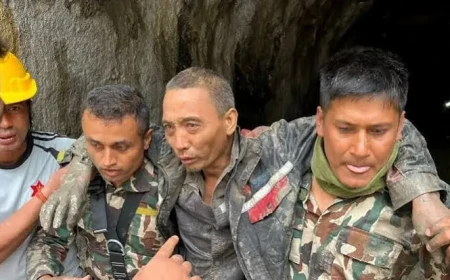
In recent days, search teams have rescued four people, including a Chinese national who was pulled from a tunnel on Saturday. The others were two hydropower workers rescued from another tunnel on Friday and a Nepali woman pulled out from her buried house on Saturday.
At least 1,399 people have been killed by the mudslide and more than 5,400 are missing in Nepal and Tibet. The toll includes 43 people who died on the Chinese side and 519 missing there, as of Saturday.
None of the bodies retrieved in Tibet were those of foreign nationals, China's state news agency Xinhua reported on Tuesday.
Both China and Nepal have said climate change was responsible for the glacier collapse which triggered the flooding.
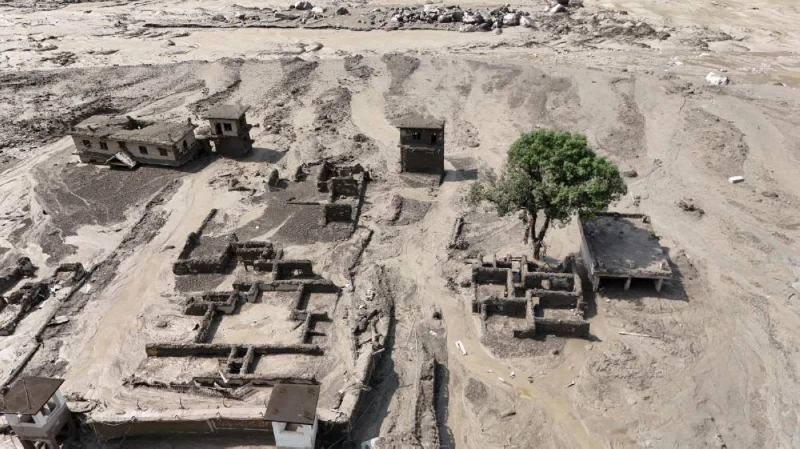
Govt estimates Rs 723.31b needed for reconstruction of infrastructures damaged by the Bhotekoshi flood in Nepal. Photo: Skanda Gautam/THT
Rescue of workers ‘triumph for humanity’
There is renewed hope amid the devastation wreaked by the flash flooding disaster on the Nepal-Tibet border as the world witnesses “one of the great rescues of the 21st century”.
Nine days after the deadly floods, two workers were pulled out alive from a flooded hydropower tunnel in Nepal.
Sanjay Shah and Kabir Maharajan were rescued from the Trishuli 3A hydropower project on Friday, more than a week after a glacial collapse created a torrent of mud, water and debris that swept away buildings, roads and bridges along the border between Nepal and China.
Hundreds more employees who worked in various hydropower projects along the banks of Nepal’s Bhote Koshi and Trishuli rivers remain missing, but the Australian engineer and geologist Arnold Dix, who was invited by Nepali authorities to advise on the Trishuli 3A operation, says Friday’s successful rescue will help lift spirits.
“We’ve found two people alive, so that gives us hope,” Dix says.
“After more than a week, everyone’s exhausted, but this spurs us on to try even harder and it now also gives us focus for how we might approach other rescues in other locations," he said, adding, "We now have proof that people can survive this long.”

Security officials and disaster experts say the Bhote Koshi flood may rank among the deadliest in Nepal’s modern history. Angad Dhakal/TKP
Fresh air detected in tunnels
Fresh air has been detected for the first time in tunnels at hydropower facilities in Nepal, where around 900 people may be trapped after flooding.
This was reported by ABC News Australia, citing Australian tunnelling specialist Arnold Dix, who is taking part in the rescue operation at the Chilime hydropower facility in Rasuwa District.
Searches in blocked tunnels
According to Dix, rescuers found an area where people could have survived. He noted that until then, only water and mud had been found in the tunnels. Teams can hear a cavity and are calling out to those who may potentially have remained there.
On August 26, a glacier collapsed into a river on the border between Nepal and China. At least 11 hydropower facilities were affected by the disaster, and the entrances to their tunnels were blocked by debris and silt. According to ABC News Australia, at least 1,399 deaths have been confirmed in Nepal and Tibet, while more than 5,400 people are still missing. At least 900 of the missing people are believed to be in the tunnels of hydropower facilities.
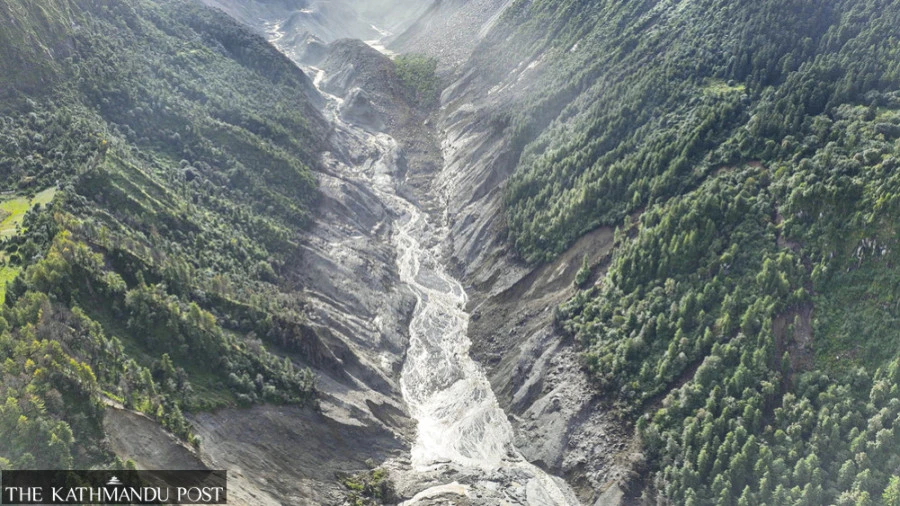
The recurrence of the extreme floods in mountain rivers has worried environmentalists, who have long warned that rising temperatures are contributing to changes in the Himalayan cryosphere and increasing the risk of more disasters. Photo: RSS
Rescue continues
Dix previously said that people in such tunnels could survive for up to 17 days. In his assessment, some underground power stations likely withstood significant pressure during the flooding. At the same time, it is unknown whether emergency systems had time to activate and whether these facilities were flooded with water and debris.
Over the past few days, search teams have rescued four people. They include a Chinese citizen who was pulled from a tunnel on Saturday, as well as two workers from a hydropower facility rescued from another tunnel on Friday. Another person rescued was a Nepalese woman who was pulled from a buried house on Saturday. Nepal’s Prime Minister Balendra Shah said search and rescue efforts would not stop.
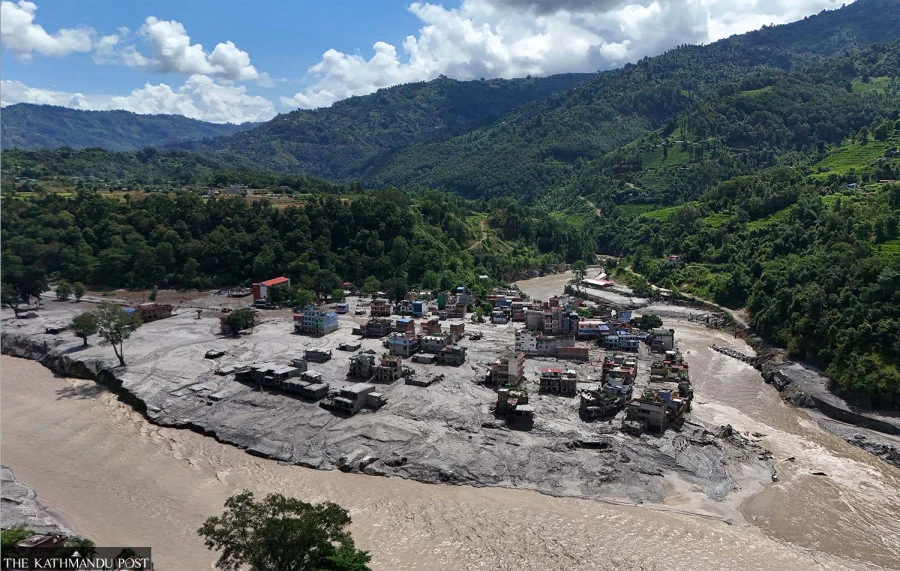
Infrastructure accounts for the bulk of the estimated cost, with energy, roads and transport systems among the hardest-hit sectors. Photo: The Kathmandu Post
Billions needed for Bhotekoshi rebuilding
The government has estimated that Rs 723.31 billion will be needed to rebuild infrastructure and other sectors devastated by the Bhotekoshi River flood in Rasuwa on August 26.
The estimate comes from a Rapid Damage and Needs Assessment (RDNA) prepared by a joint technical team of the National Planning Commission and the National Disaster Risk Reduction and Management Authority.
Infrastructure recovery alone will require Rs 473.57 billion, about 75 percent of the total needs. The energy sector suffered the largest losses, with 13 hydropower projects (759 MW) and five solar plants (24 MW) affected. Restoring energy and grid systems will cost Rs 390.62 billion, the report said.
The flood also damaged 69 km of roads, washed away 33 motorable bridges and partially damaged four others. Of 64 suspension bridges in the affected areas, 53 were damaged.
The overall cost of restoring transport infrastructure has been estimated at Rs 73.34 billion.The disaster affected Rasuwa, Nuwakot, Dhading, Gorkha and Chitwan, damaging 7,570 private houses, 48 public buildings, 18 schools, seven health facilities and 30 cultural heritage sites.
Recovery of social and productive sectors will require Rs 103.55 billion, including Rs 50.77 billion for trade, businesses, banks and agriculture.
Among the 15 local units affected, Bidur Municipality in Nuwakot recorded damage to 3,026 houses, the highest reported.
The report also estimated Rs 94.75 billion for disaster risk reduction and river management and Rs 51.54 million for silt and debris management.
The reconstruction plan has been divided into two phases: Rs 8.74 billion for immediate relief and short-term recovery within six months, and Rs 714.58 billion for long-term reconstruction.
What's Your Reaction?
 Like
0
Like
0
 Dislike
0
Dislike
0
 Love
0
Love
0
 Funny
0
Funny
0
 Wow
0
Wow
0
 Sad
0
Sad
0
 Angry
0
Angry
0









Comments (0)