

Bangladesh marks second anniversary of Hasina's downfall this year
August 5 became a day of victory for many people in Bangladesh, but also one of tragedy, as it witnessed deadly police attacks in which hundreds of people were reportedly killed even after the fall of the Awami League government

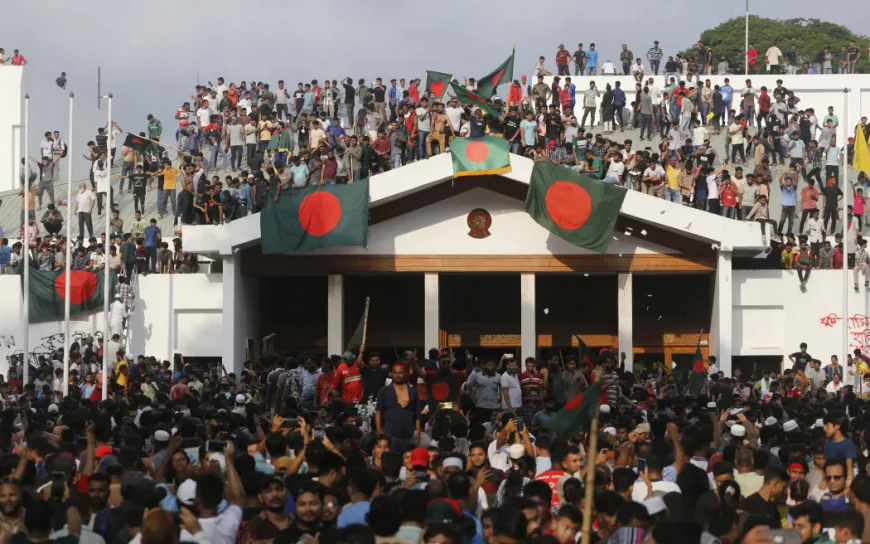
Bangladesh marks the second anniversary of the downfall of the Awami League government, led by the-then prime minister Sheikh Hasina, this year as the country got freed from the misrule of her government on 5 August 2024. She fled to India in the face of a massive popular uprising led by students, ending her nearly 16 years in power.
The fall of Sheikh Hasina came after hundreds of people were killed and thousands injured during violent attacks carried out by law enforcement personnel and activists of the Awami League and its affiliated organisations, including Jubo League and Chhatra League.
August 5 became a day of victory for many people in Bangladesh, but also one of tragedy, as it witnessed deadly police attacks in which hundreds of people were reportedly killed even after the fall of the Awami League government.
Sheikh Hasina resigned and fled the country amid the uprising, despite having repeatedly declared during her time in office that "Sheikh Hasina has not fled, she does not flee". She made the same remark at a meeting with business leaders on July 22, 2024.
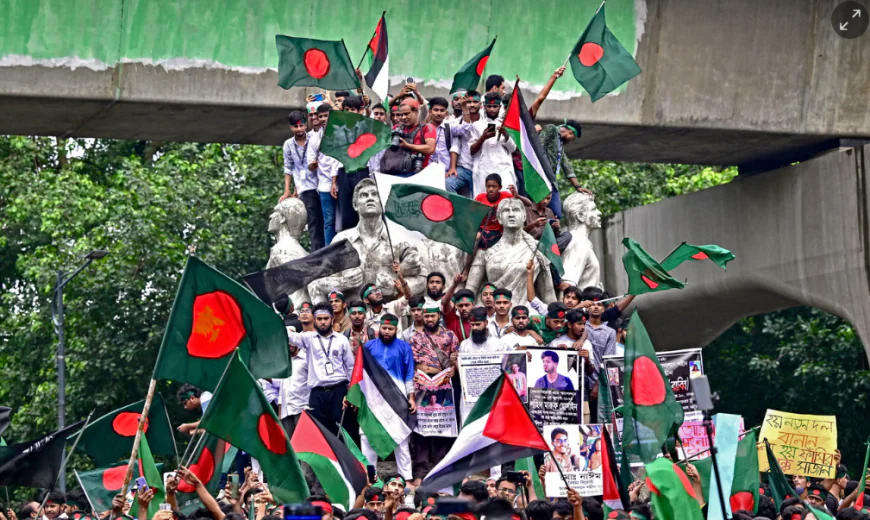
Demonstrators wave Bangladesh's flag during Martyr March to mark one month since ousting of the country's former Prime Minister Sheikh Hasina Photograph: Munir Uz Zaman/AFP
Just 12 days later, she resigned and left the country amid growing public anger as hundreds of thousands of people marched towards Dhaka from different parts of the country, defying an indefinite curfew despite heavy morning rain.
Millions of people from all walks of life celebrated across the country after Army Chief General Waker-Uz-Zaman confirmed Sheikh Hasina's resignation, ending what many had regarded as her unchallenged grip on power and the Awami League's political dominance.
Tens of thousands of people filled the streets of the capital, while thousands entered the prime minister's official residence, Ganabhaban, in celebration after Sheikh Hasina's resignation during the student-led mass uprising.
Many also entered the Prime Minister's Office and the parliament building soon after Sheikh Hasina left the country, while students, elderly people, children and workers remained on the streets from late morning until evening to celebrate the end of her long rule.
As Sheikh Hasina sought to remain in power until the last moment, there were reports of clashes between protesters and police at the entrances to the capital even after thousands had gathered in Shahbagh and people continued arriving from across the country.
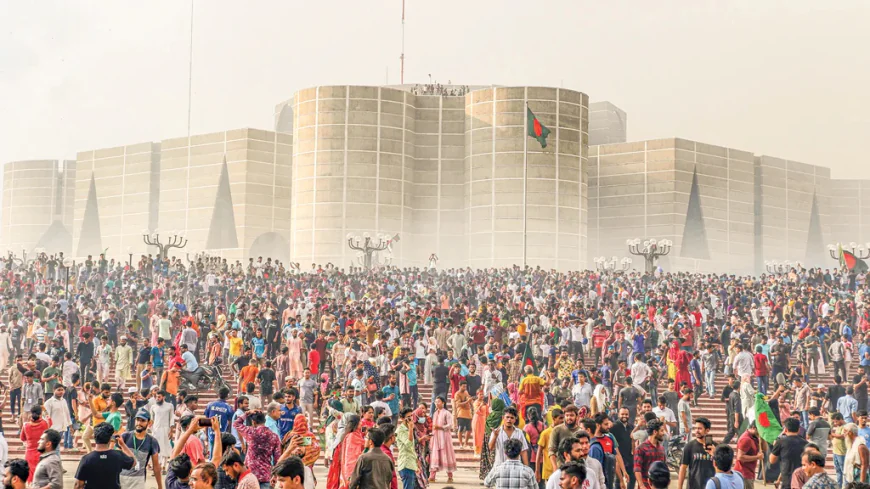
Mass people and students at the National Parliament on 5 August during the July Mass Uprising. File Photo
Her departure without prior announcement was followed by widespread violence, with reports that police opened fire on crowds in different parts of the country, including the capital.
Crowds angered by the government's crackdown on protesters during the uprising also set fire to various establishments, including Awami League offices, police stations and media houses, following her departure.
Hasina was widely criticised throughout her years in office for seeking to retain absolute power despite domestic and international criticism over alleged human rights violations and restrictions on freedom of expression after returning to power in 2009.
Her government's handling of the student movement demanding reforms to the quota system in public sector recruitment eventually turned the protest into a nationwide uprising.
Few had imagined that the quota reform movement, which gathered momentum on July 1, would evolve into the July Uprising involving students and people from all walks of life.
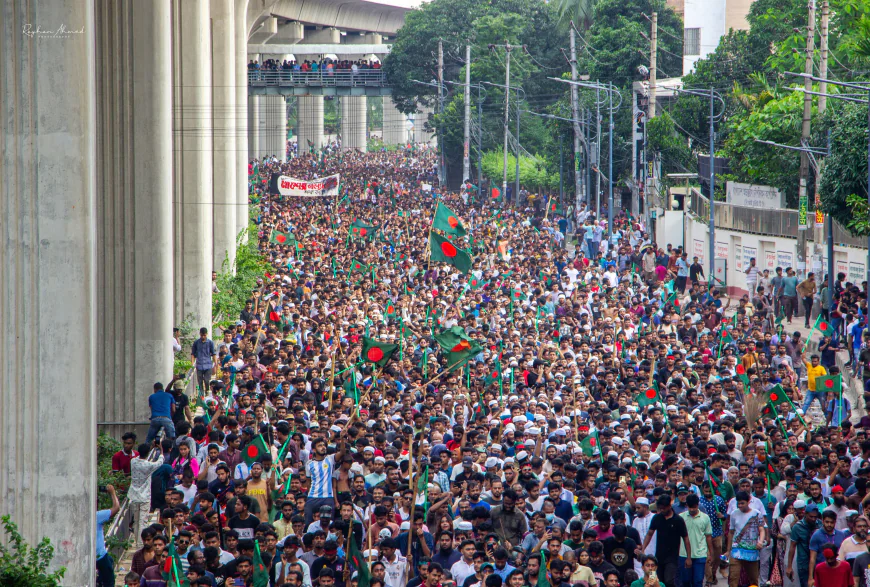
Victory march by protesters after the resignation of Sheikh Hasina on 5 August in 2024. Photo: Wikipedia
Students initially launched the protests after a High Court order declared illegal the government's 2018 circular abolishing quotas in the recruitment of first and second-class government officials.
The previous government had issued the circular in 2018 following widespread student protests, which were met with violent attacks by activists of the Awami League's student wing, Bangladesh Chhatra League.
However, student anger resurfaced after the court reinstated the 56 percent quota system, including 30 percent for descendants of freedom fighters who took part in the 1971 Liberation War, 10 percent for women, 10 percent for residents of underdeveloped districts, 5 percent for members of minority communities and 1 percent for people with disabilities.
Students quickly returned to the streets, arguing that the restored quota system deprived meritorious candidates of fair opportunities.
The movement later escalated into a nationwide uprising as the government responded with force, deploying security personnel and pro-Awami League activists. The United Nations estimated that at least 1,400 people were killed and around 20,000 injured during the violence.
Media reports said the death toll rose sharply on August 5 when members of law enforcement agencies allegedly opened fire as students and protesters attempted to join the "March to Dhaka Programme" at Shahbagh despite the curfew and police barricades.
The students had originally announced the "March to Dhaka Programme" for August 6, but violence on August 3 and 4, which reportedly left at least 93 and 66 people dead respectively, prompted them to bring it forward to August 5.
Earlier, student leaders had announced a nine-point demand, including an unconditional public apology from Sheikh Hasina and acceptance of responsibility for the deaths of more than 200 people during the violence between July 16 and July 21 and its aftermath.
The authorities later detained six key coordinators of the student movement — Nahid Islam, Sarjis Alam, Hasnat Abdullah, Asif Mahmud, Nusrat Tabassum and Abu Baker Mojumder.
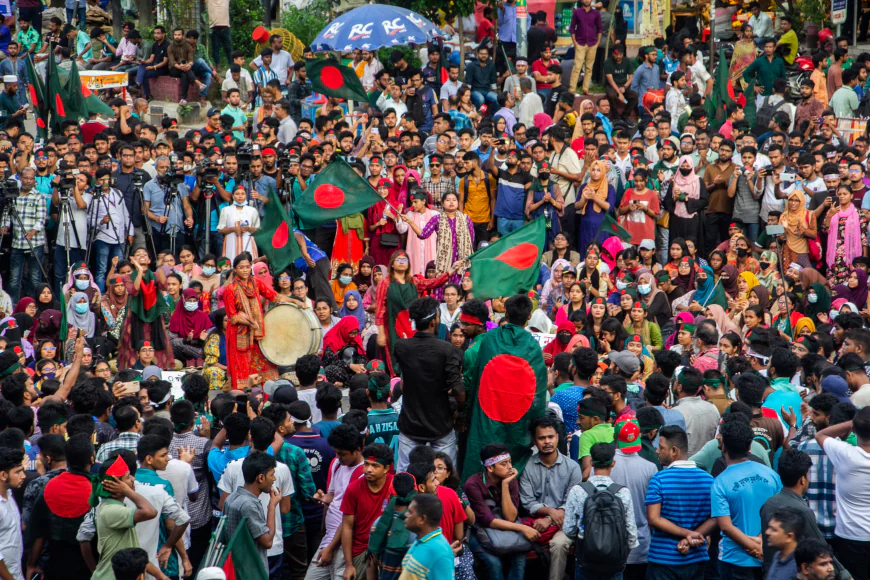
Students launched the "Bangla Blockade" following a one-point demand for scrapping all illogical and discriminatory quotas in public service through enactment of a law and keeping a minimum quota for marginalised citizens in line with the constitution. Photo: Wikipedia
After their release, the student leaders announced a one-point demand for Sheikh Hasina's resignation at a rally at the Central Shaheed Minar on August 3.
Nahid Islam, a key coordinator of the Anti-Discrimination Student Movement, made the announcement.
Following the declaration of the one-point demand, attacks on demonstrators intensified, prompting movement leaders to announce the "March to Dhaka" programme for August 5. Protesters also referred to the day as "36 July", saying that July would not end until Sheikh Hasina's fall.
On August 5, millions of people gathered in neighbourhoods across Dhaka and its outskirts before marching towards Shahbagh. Thousands more travelled from other parts of the country despite numerous obstacles.
The situation remained highly tense, with thousands determined to remove Sheikh Hasina from power. Crowds advanced towards Ganabhaban despite extensive security measures.
Sheikh Hasina eventually resigned as prime minister and left the country for India on a military helicopter with her younger sister, Sheikh Rehana, bringing her long rule to an end.
What's Your Reaction?
 Like
0
Like
0
 Dislike
0
Dislike
0
 Love
0
Love
0
 Funny
0
Funny
0
 Wow
0
Wow
0
 Sad
0
Sad
0
 Angry
0
Angry
0

Comments (0)