

Architectural wonders of Bangladesh
Intricately-carved mosques and sprawling, crumbling Buddhist temples are among the discoveries to be made. Strike out on an adventure of Bangladeshi heritage

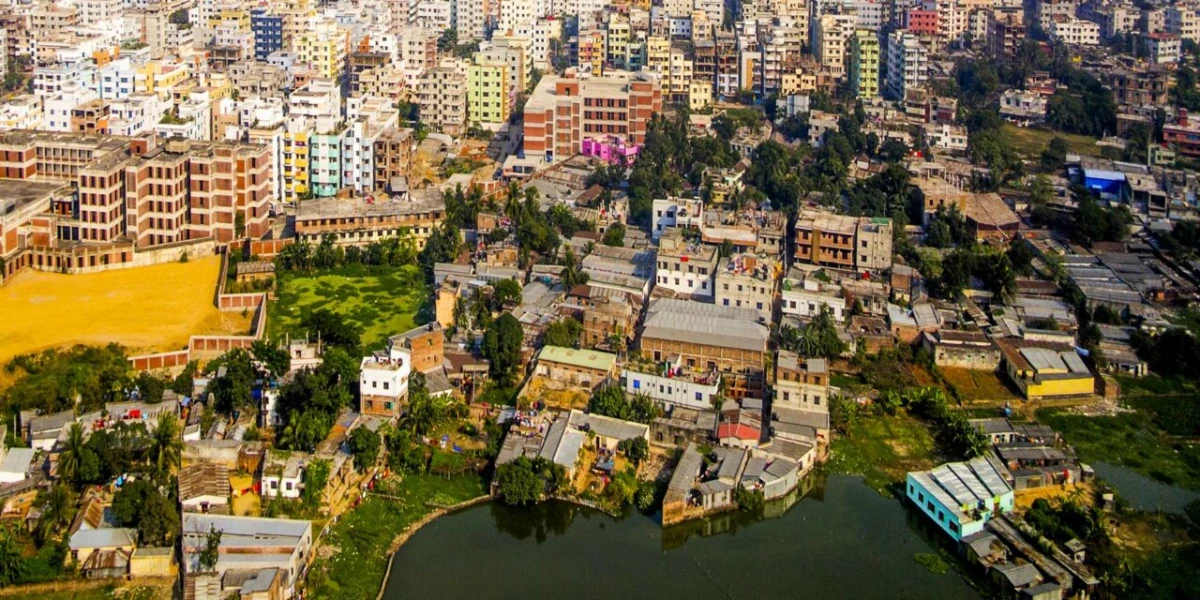
A land with a fascinating history, Bangladesh is an undiscovered travel gem still well off the beaten tourist trail and yet home to so many cultural treasures just waiting to be uncovered. Historically passed through the hands of Muslims, Hindus and Buddhists, it was later part of Bengal under British Indian rule, until – as East Pakistan – it fought for and won its own autonomy in 1971.
Modern day, independent Bangladesh boasts a contemporary capital city with forward-thinking ideas and industry, and yet the country is still strewn with ancient architectural wonders from its rich past. Intricately-carved mosques and sprawling, crumbling Buddhist temples are among the discoveries to be made. Strike out on an adventure of Bangladeshi heritage; we have picked out some of the unmissable hotspots.
Dhaka
Before the British, this strategically-situated city had been ruled by Hindu, Muslim and Buddhist dynasties. Today, in the nation’s capital, the ancient collides with the modern to create a hotchpotch of architectural curiosities, its historic streets lined with iconic buildings.
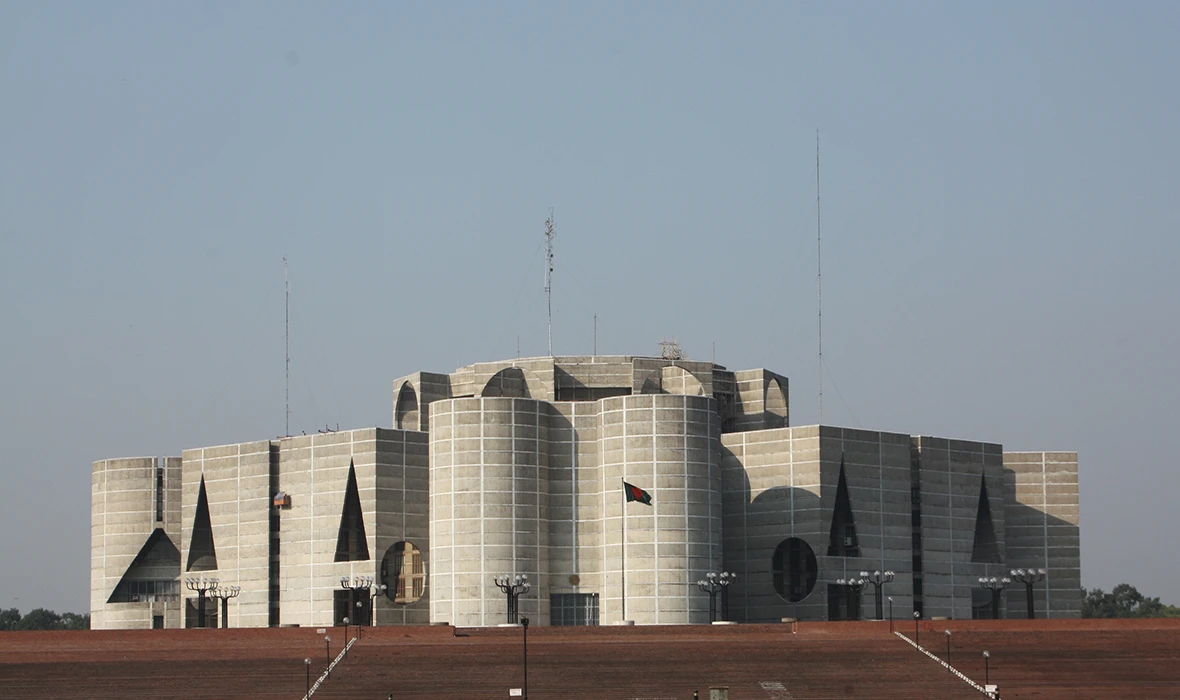
The National Parliament House of Bangladesh. Photo: Remote Lands
Take a tour of the National Parliament House, designed by famous architect, Louis Kahn: the clean, modern lines of this formidable stone edifice are combined with an aesthetic that recalls the style of the (albeit unfinished) Lalbagh Fort, built by the Mughal viceroys in 1678.
Don’t miss the stunning five-domed, star-shaped Tara Masjid. Richly decorated with motifs of blue stars and intricate mosaics, the mosque gives the illusion that it is floating if you catch it in the sunshine.
Paharpur
Geographically located to the north-west of Bangladesh in the district of Naogaon, the heart-land of ancient “Varendra”, close to the village of Paharpur the extensive ruins of the Buddhist monastic complex are the most spectacular and important pre-Islamic monument in Bangladesh.
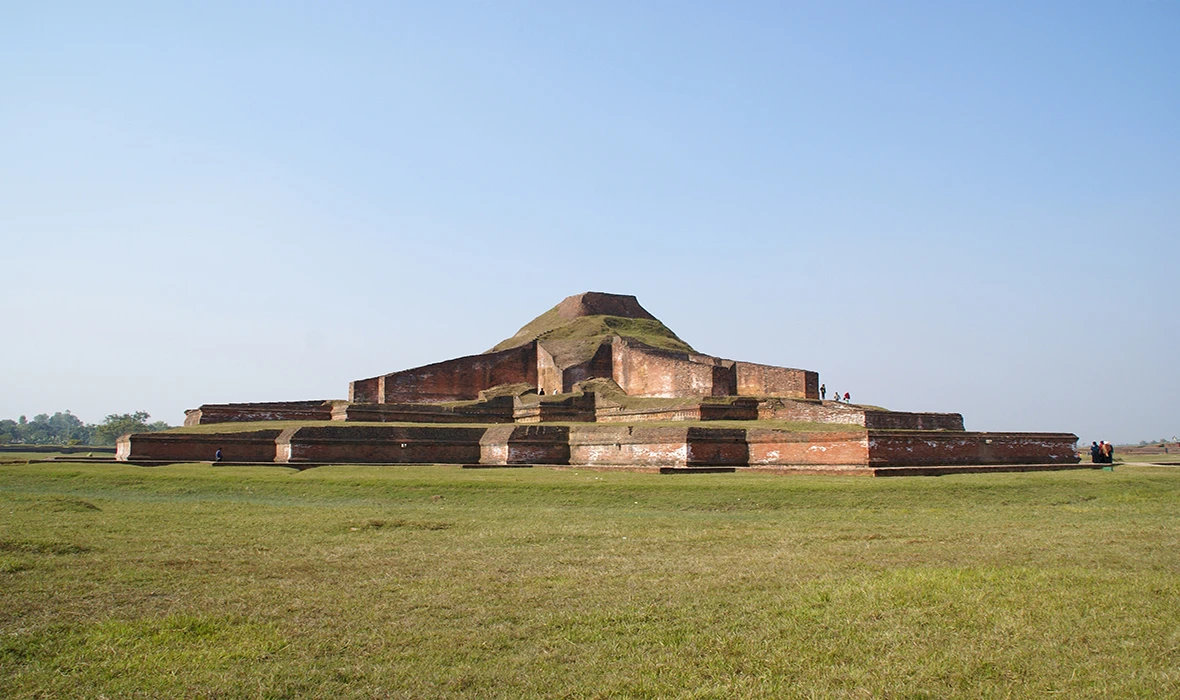
Buddhist Vihara at Paharpur in Naogaon. Photo: Remote Lands
Head three hours’ northwest of Dhaka to discover a historic city, home to some of the most famous and mysterious Buddhist viharas (monasteries) in southern Asia. Most famous among them is the Somapura Mahavihara – a UNESCO World Heritage Site and one of the largest in the world.
The stone quadrangle structure was built around a Buddhist-style stupa by the second Pala king around 850 AD, and today its stones sprawl over green lawns, intricately carved and beautifully preserved. Visit the adjacent museum to find clay stone statues of deities that once formed part of the decoration.
The first builder of the monastery was Dharmapala Vikramshila (770-810AD), the king of Varendri-Magadha, as inscribed on a clay seal discovered in the monastery compound. The plan of the monastery can be described as a large square quadrangle measuring approximately 920 feet, with the main entrance, an elaborate structure, on the northern side.
Dinajpur
Further northwest, in the countryside surrounding the city of Dinajpur, lies the breathtaking 18th century Kantaji Temple, sometimes called Kantanagar. One of the most famous Hindu temples in the country, it was built by maharaja Pran Nath and is typical of the royal Mughal architecture.
Admire the intricate designs of the facade, covered with plaques and panels crafted from terracotta and brick, to create frescoes telling the legendary stories of the Ramayana.
Kantaji Temple is one of the finest historical architectural of Bangladesh. I heard about a lot about it from my early age; thus couldn’t miss it during my recent visit to Dinajpur. The first reaction when it came to my sight for the first time was ‘WOW’. Yes, it is beautiful and mesmerizing. The way it is standing for last 300 years gives a majestic impression!
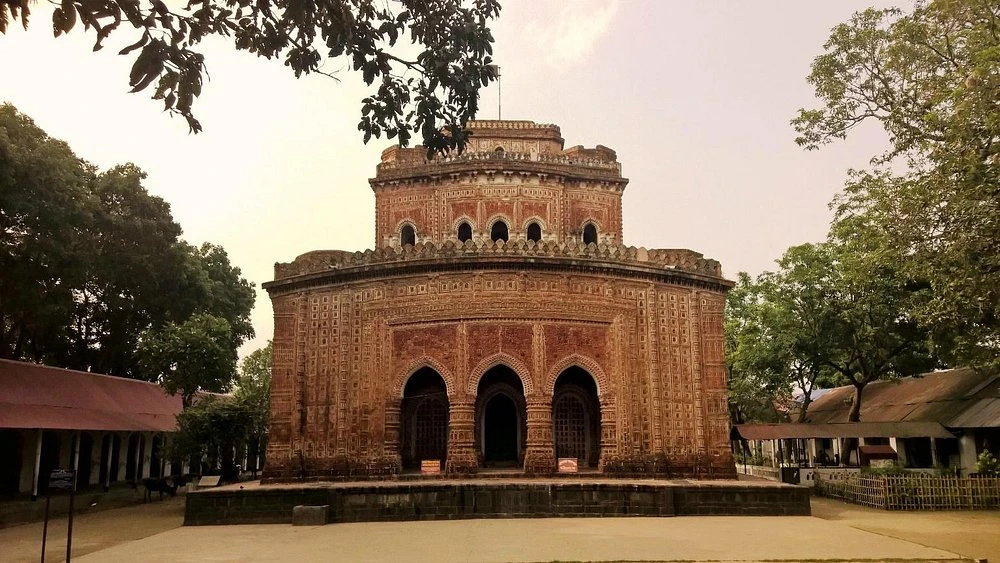
Kantaji Temple in Dinajpur. Photo: Remote Lands
Every piece of the bricks of which the temple is made is the example of the finest craftsmanship. They made the simple piece of brick into a piece of art! They are engraved with gods & goddesses, ritual, kings, festivals, social activities and many other elements which clearly tell a lot about the history of this region. The temple is surrounded by the barrack style houses where the groups of priests and servents of the temple reside.
The temple is just 20-30 minutes journey from Dinajpur Town. Best way to go there is via own vehicle, otherwise you can take a Battery-Van for the round trip.
Overall it was really a fantastic experience and those who loves old architecture, it’s a must place to visit in Bangladesh.
Rajshahi
On the outskirts of Rajshahi city, on Bangladesh’s eastern border with India, are more sacred Hindu treasures. Puthia Temple City is aptly named, containing a large number of temples and palaces surrounding a verdant green lawn.
Join the pilgrims and intrepid explorers who venture this way to explore terracotta masterpieces including ornate and grand Pancharatna Govinda, smaller and intricately-decorated Jagaddhatri – which is dedicated to Krishna – and beautiful Shiva, with its five spires overlooking the lake.
The range of sites is impressive. The first temple visited was dedicated to Shiva. All the rest are dedicated to Krishna. Renovation work is ongoing re some sites. The light pink royal palace is a shell but provides great views of the oldest temple in particular. Do not miss the bathing area of the queen on the river.
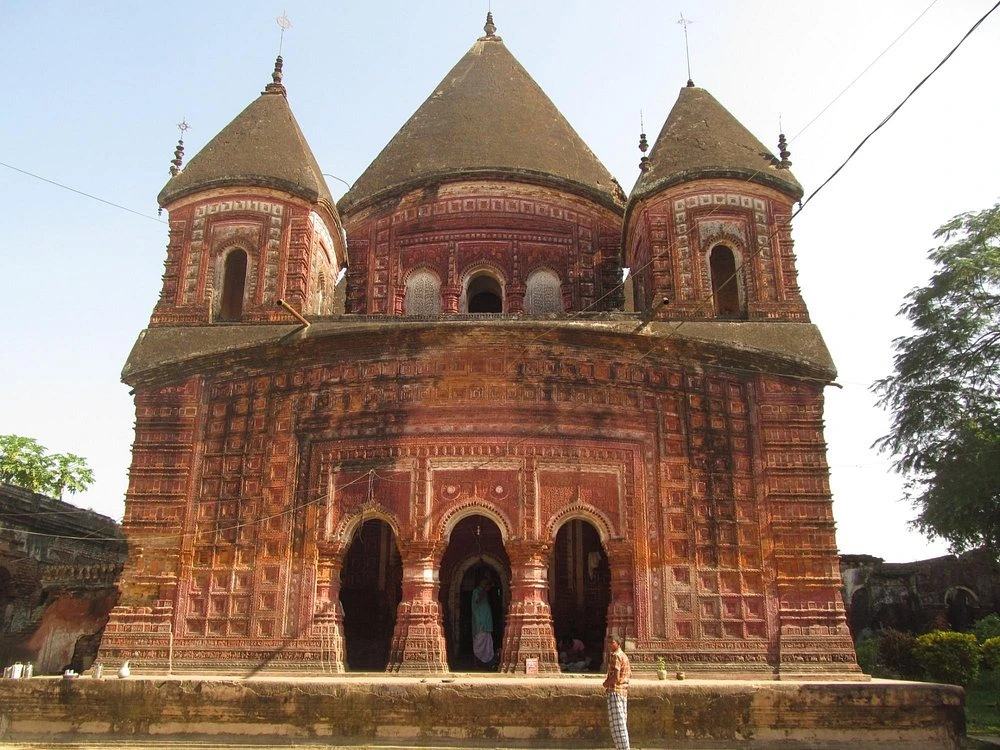
Puthia Temple in Rajshahi. Photo: Remote Lands
The miniatures on her post-bathing sanctuary are the most prolific in the country. A final trio of temples is near a madresa. The large pond to the right of the royal palace is a nice spot for a coffee. Access to some areas (certainly the royal palace and the final trio of temples) will require keys from the keeper of the (many) keys.
Puthia Temple Complex is located 23km East of Rajshahi city. It has all weather metal road connection. One can travel by bus or any other private means. Those who are plying by public transport, from main road auto rickshaw or rickshaw van are available.
From Rajshahi by car it will take 35 minutes and by public transport it will take an hour. Here main point of attraction is Govinda temple. It was built between 1823-1859 by queen of Puthia. The temple has exquisite terracotta ornamentation depicting romance of Sree Radha and Sree Krishna. Local priests are still continuing to offer prayer.
Not much of devotees are seen.There are sign of building ruins all around the temple. Adjacent to the temple there is the palace of Local Zaminder. A The temple has exquisite terracotta ornamentation depicting romance of Sree Radha and Sree Krishna .
Local priests are still continuing to offer prayer regularly bot not many of the devotees are seen. A two storeyed huge building facing a big playground .Opposite to the field is a three storied Dol Mondir. From there five walks will lead to a very big Shiva Temple built in 1823 by Rani Bhuvonmoyee widow of Raza Jagat Narayon Roy overlooking Shiva Sagar a huge artificial lake. It has the touch of Joypuri Architecture.
In the sanctuary there is a very large black basalt Shiva Linga, the largest in the country. This is a protected monument. The beauty of the temple takes it height when viewed from road across the Shiva Sagar. The beauty of the temple takes it height when viewed from road across the Shiva Sagar.
Bagerhat
Deep in the south west, venture to Bagerhat to see the Shat Gombuj Masjid, or Sixty Dome Mosque; also a UNESCO World Heritage Site, it is the largest brick-built mosque in Bangladesh.
Built in the mid-15th century by saint-general Khan Jahan Ali, it was used by the Muslim community around the swampy Sundarbands. Interestingly, despite its name, this vast mosque boasts 77 domes, though if you count, it does have exactly 60 pillars.
The mosque is a fine example of the provincial Mughal-style architecture introduced in the 17th century in what is now Bangladesh. The mosque's most notable features are its seven bulbous domes crowning the roof and covering the main prayer hall.
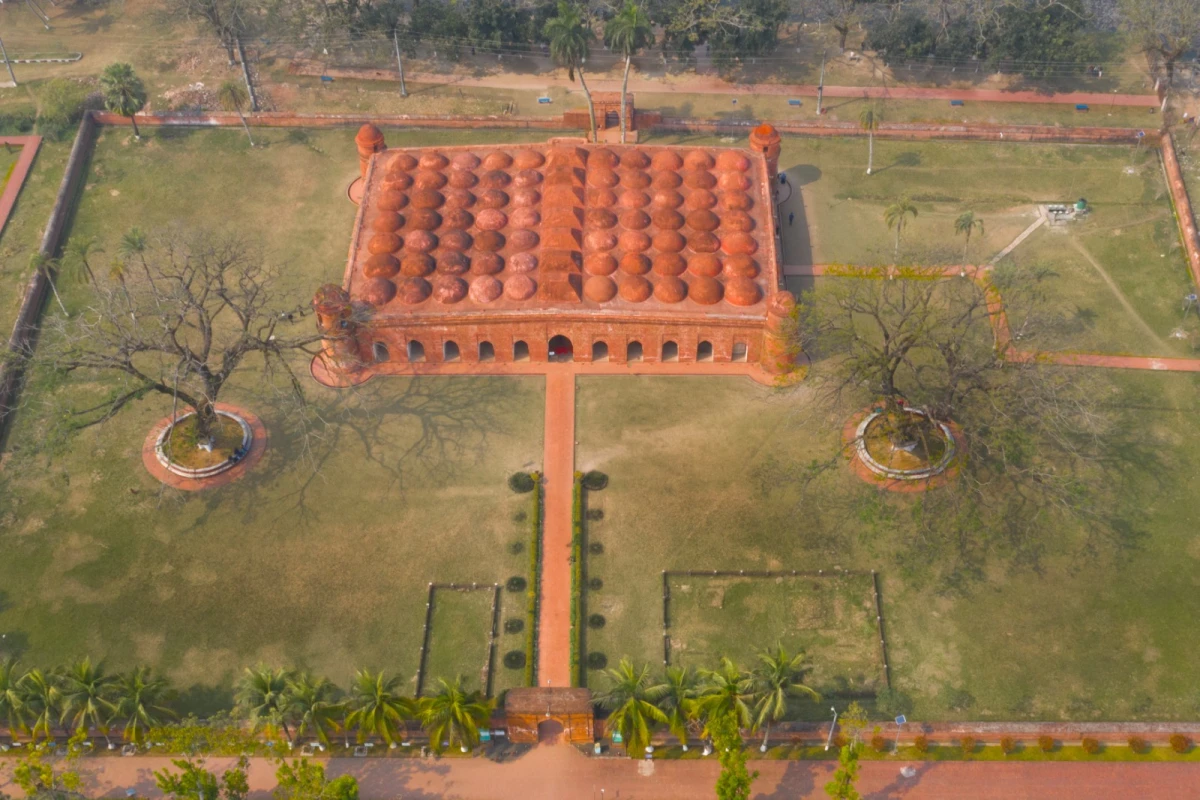
An aerial view of the Sixty Dome Mosque in Bagerhat. Photo: Remote Lands
The monument stands in a romantic setting on a buttressed 4.6-metre-high (15 ft) bank overlooking an extensive flood plain. The mosque dates from the reign of Mughal emperor Aurangzeb. It may have been built by the Mughal governor Shaista Khan.
Picturesquely situated on the edge of a river, the Shat Cumbuj Mosque's exterior is the most innovative of all the Dhaka Mughal-period monuments. The north and south ends of this three-domed rectangular mosque are each marked by two enormous double-storied corner pavilions; when viewed from the east, these give the impression that the mosque has five exterior bays. On the east are three cusped entrance arches flanked by shallow niches. Slender engaged columns with bulbous bases demarcate the central bay.
Its interior compares favourably with that of others dating to the second half of the 16th century. The central mihrab has two rows of cusping, and its surface is embellished with moulded plaster relief, recalling the ornateness of the mihrab in the mosque of Haji Khwaja Shahbaz.
The road to Chattogram
The ancient city of Chattogram has been inhabited for over a thousand years by Bengali Buddhists, who were uprooted by Sufi Muslim Sultanates, giving way to the Mughal Dynasty and the British colonial administration.
Though war torn in more recent modern history, Chattogram and its surrounding area is home to sacred and beautiful heritage sites. On the road from Dhaka, you can visit the ashes of Buddhist leader Atish Dipankar at Kamalapur temple, and make stops at a number of ruined temples around Cumilla.
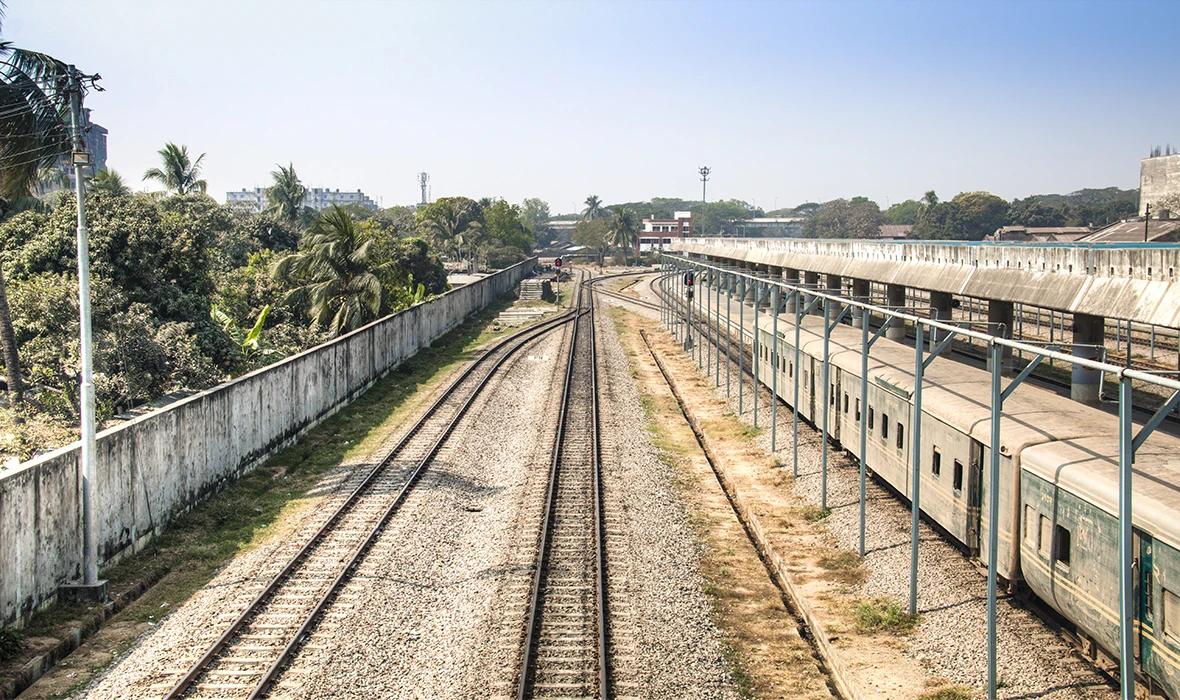
The train station in Chattogram, the main port city of Bangladesh. Photo: Remote Lands
In the city of Chattogram, the Nandan Kanon temple houses the sacred hair relic of Gautama Buddha and, if you are fortunate enough, you can see it when it’s displayed once a year. Islamic influences here include the Shahi Jama-e-Masjid, adorned with typically central Asian features – minarets and curved arches.
The Chandanpura Mosque will likewise lure you with its onion domes and intricate, decorative panels. More modern city sites include the British colonial court building; visit this sprawling compound and enjoy the view over the city from its hilltop vantage point.
What's Your Reaction?
 Like
0
Like
0
 Dislike
0
Dislike
0
 Love
0
Love
0
 Funny
0
Funny
0
 Wow
0
Wow
0
 Sad
0
Sad
0
 Angry
0
Angry
0









Comments (0)